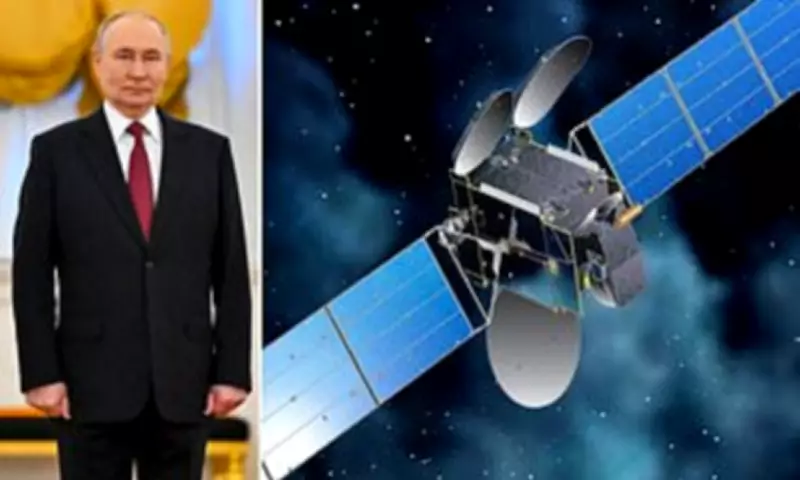
Defence officials across Europe have raised significant concerns after two Russian spacecraft were observed intercepting communications from more than a dozen vital European satellites. This activity threatens to compromise sensitive information transmitted by these satellites and increases the risk that Moscow might attempt to move or even crash them.
Close Approaches to Critical Infrastructure
The satellites in question are primarily used for television services, but they also carry sensitive official information and some military communications. Defence specialists have consistently warned that space is emerging as a new frontier in Russia's hybrid warfare campaign against Western nations.
Two specific Russian spacecraft, identified as Luch-1 and Luch-2, have made remarkably close approaches to several of Europe's most important satellites. These satellites service the continent, including the United Kingdom, as well as extensive regions of the Middle East and Africa.

Signals Intelligence Operations Suspected
Since its launch in 2023, Luch-2 has approached an alarming total of 17 European satellites. Major General Michael Traut, chief of the German military's space command, told the Financial Times that both satellites are strongly suspected of conducting signals intelligence operations.
A senior European intelligence official confirmed to the newspaper that the two Luch spacecraft appear to be attempting to intercept data transferred between the satellites and ground stations on Earth. This intercepted data is believed to be largely unencrypted, making it particularly vulnerable.
Belinda Marchand, chief science officer at the US company Slingshot Aerospace, reported that Luch-2 is currently 'in proximity' to Intelsat 39, a crucial geostationary satellite that provides services to Europe and Africa.
Growing Threats and Military Warnings
Last year, German Defence Minister Boris Pistorius issued a stark warning about the escalating threat posed by Russian spacecraft shadowing Intelsat satellites. He stated at a Berlin space conference that Russia and China have rapidly expanded their space warfare capabilities in recent years.
'They can disrupt satellite operations, blind satellites, manipulate or kinetically destroy them,' Mr Pistorius emphasised. He underscored the urgent need for discussions about developing offensive capabilities in space as a deterrent measure.
The defence minister further warned that the Kremlin might consider using nuclear weapons in space, while simultaneously promising that Germany would invest billions in projects designed to protect its satellites from potential attacks. He urged NATO allies to contemplate building similar 'offensive capabilities' in orbit.
Germany plans to invest approximately £31 billion in space projects specifically aimed at strengthening military space systems against sabotage and hostile actions.
European Space Command Concerns
France's top military space official, Major General Vincent Chusseau, recently warned of intensifying 'hostile or unfriendly' activity in space, particularly by Russian President Vladimir Putin. He explained that the ongoing conflict in Ukraine demonstrates that 'space is now a fully-fledged operational domain.'
Speaking to Reuters, Mr Chusseau noted there has been a significant spike in hostile space activity since Russia's full-scale invasion of Ukraine in 2022. France, which is Europe's largest government spender on space initiatives, publicly accused Moscow in 2018 of attempting to spy on its secret communications by approaching a Franco-Italian military satellite with a prowling spacecraft the previous year.
Geopolitical Context and Denials
The Kremlin has responded by claiming that Western powers have unleashed a massive hybrid war against Russia, encompassing propaganda campaigns, cyberattacks, and intelligence operations. Moscow maintains that it opposes any weapons in space and has denied assertions by the United States that Russia has launched weapons into Earth's orbit capable of inspecting and attacking other satellites.

Meanwhile, China, the world's second-largest government spender on space behind America, is rapidly advancing its own space capabilities. 'Each day shows dizzying progress – launching ever more satellites for new constellations, developing modes of action that go beyond what we had seen before,' Mr Chusseau observed.
Broader Security Landscape
This escalating hostility in space unfolds against a backdrop of increasing drone incursions into NATO airspace, which has put European security forces on high alert. Most recently, Denmark's Aalborg airport was forced to shut down after suspicious overnight drones were spotted violating the country's airspace in what authorities described as a 'hybrid attack' by a 'professional actor.'
Drones have played a pivotal role in the ongoing war between Russia and Ukraine. Late last month, the Kremlin launched over 100 drones and one missile at Ukraine in a single overnight attack, defying a week-long 'pause' in attacks on cities that had been announced. The governor of Ukraine's southern Zaporizhzhia region reported that Russia struck a residential building, wounding at least one person.