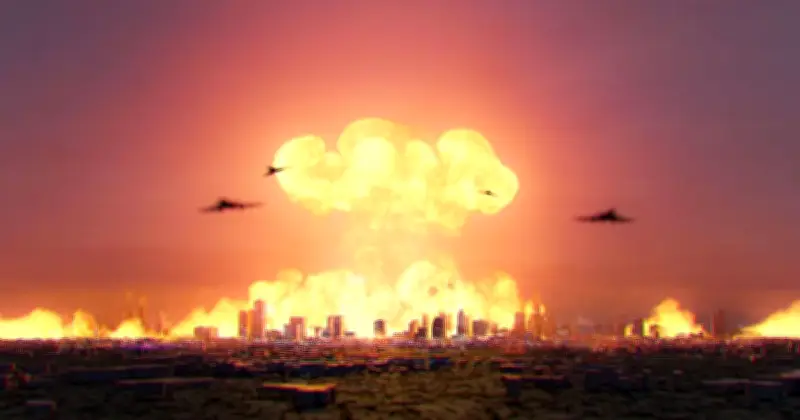
A simulation using data from NUKEMAP has detailed how a conflict between Russia and the United States could escalate from conventional fighting to all-out nuclear war. The model, based on real force postures, targets and fatality estimates, predicts 91.5 million immediate casualties, including 34.1 million fatalities and 57.4 million injuries, from a series of nuclear exchanges.
Escalation from warning shot to tactical war
The simulation shows Russia, seeking to halt a US-NATO advance, launching a nuclear warning shot from a base near Kaliningrad, the semi-exclave separated from the rest of Russia by Lithuania and Poland. NATO then retaliates with a single tactical nuclear airstrike, crossing the nuclear threshold and escalating fighting into a tactical nuclear war across Europe.
Russia sends 300 nuclear warheads via aircraft and short-range missiles to hit NATO bases and advancing troops in countries including Poland, Germany, Belgium, Italy, Turkey and the South-east of the UK. This area of the UK hosts critical military and nuclear assets, including RAF Lakenheath and Mildenhall in Suffolk and RAF Marham in Norfolk. NATO responds with some 180 nuclear warheads via aircraft. In just three hours, the simulation predicts 2.6 million immediate casualties.
Strategic strikes and city targeting
With Europe destroyed, NATO launches a strategic nuclear strike of 600 warheads from US land and submarine-based missiles aimed at Russian nuclear forces. Before losing its weapon systems, Russia launches on warning, responding with missiles from silos, road-mobile vehicles and submarines. Over about 45 minutes, immediate casualties are estimated at 3.4 million.
Next, to inhibit the enemy's recovery, Russia and NATO each target the other's 30 most-populated cities and economic centres, using five to 10 warheads on each city depending on population size. In the US, this would include New York City, Los Angeles, Chicago, Houston and Phoenix; in Russia, Moscow, St. Petersburg and Novosibirsk. Immediate casualties reach 85.3 million in over 45 minutes.
Long-term effects and comparison to Chernobyl
The simulation, created in 2019, three years before Vladimir Putin invaded Ukraine, predicts a total of 91.5 million immediate casualties. Its authors warned that deaths from nuclear fallout and other long-term effects would significantly increase this estimate.
The 1986 Chernobyl nuclear disaster released an unprecedented volume of radioactive isotopes into the atmosphere, contaminating vast regions of Europe. While only two plant workers died from the physical explosion and fires on the night of April 26, 134 emergency workers and staff developed Acute Radiation Syndrome, of whom 28 died within the first three months. Wind carried fallout across Belarus, Russia, Ukraine and much of Western and Northern Europe. Between 6,000 and 20,000 pediatric thyroid cancer cases were diagnosed among children and adolescents at the time.
A continental nuclear war would trigger global destruction dwarfing the Chernobyl disaster, creating an apocalyptic "nuclear winter" capable of wiping out most of humanity through mass starvation. Unlike localised reactor fallout, simultaneous military strikes would cause total institutional collapse, rendering the survival of European civilisation virtually impossible.