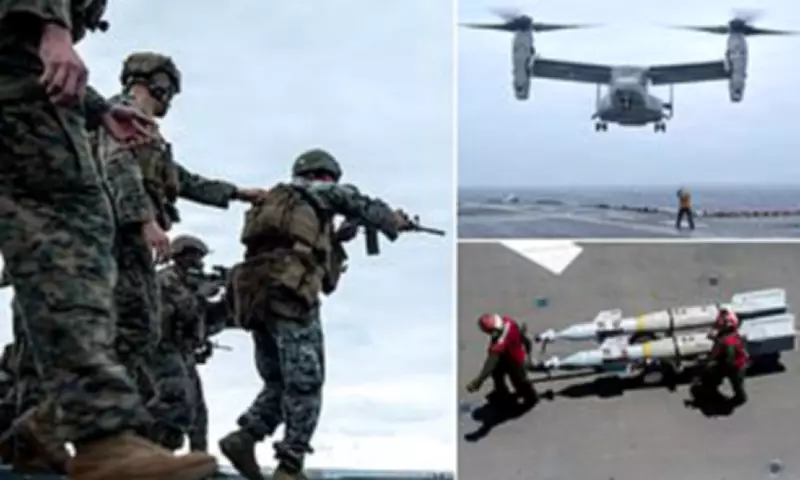
Donald Trump has been issued a stark warning today that launching an amphibious military operation to secure control of the strategically vital Strait of Hormuz would constitute a 'nightmare' scenario for American forces. The caution comes from General Sir Richard Shirreff, the former deputy commander of NATO forces, who expressed grave concerns during an interview on BBC Radio 4's Today programme.
Dire Warnings Amid US Troop Build-Up
These dire warnings emerge against the backdrop of a significant build-up of American land forces in the Gulf region. Recent reports indicate that approximately 10,000 US troops are now slated for deployment, supplementing existing Marine expeditionary forces already positioned in the area. This military escalation underscores the heightened tensions between the United States and Iran.
A Hostile Shore and Drone Threats
General Shirreff raised specific fears regarding the perils of any operation aimed at seizing control of the Strait of Hormuz, even if the objective were merely to escort a one-off convoy through the waterway. He described an amphibious assault as "about as difficult an operation as could be conceived," drawing a sobering historical parallel to the disastrous Gallipoli campaign.

"You have to land troops on a hostile shore," he explained. "You've got to be able to secure that hostile shore, and at the same time, the enemy has a vote here." He emphasized that despite Iran's military being "written down massively" by previous US actions, the regime retains formidable capabilities.
"They've still got missiles, they've still got huge numbers of drones," Shirreff stated. "And don't forget, funny old thing, the Russians have been supplying them with drones and with targeting information, so the Iranians still have capability. Do not underestimate them."
Specific Threats to US Troops
In relation to potential US efforts to seize Iranian islands within the Strait, the former NATO commander issued a particularly chilling warning. "There will be drones coming from hundreds of miles inland," he cautioned. "How far inland do you go?" This highlights the asymmetric warfare challenges that American forces would face, with threats emanating far beyond the immediate landing zones.
The discussion referenced recent US military movements, including Donald Trump's order to deploy the amphibious assault ship USS Tripoli, which carries 2,000 marines, to the Gulf. Additionally, US marines have been conducting firing drills on the flight deck of an America-class assault ship en route to the region, signaling preparedness for potential conflict.
A March on Tehran: 'Steroids to the Power of 10'
General Shirreff also addressed the even more extreme scenario of a US operation advancing beyond the Strait to march on Tehran itself. He described such an option as "militarily and politically inconceivable" but felt compelled to outline its implications nonetheless.
"Which is that if Trump says I'm going to march on Tehran, I'm going to topple the regime, and I'm going to occupy Iran - it's a similar operation to what happened in 2003 except on steroids to the power of 10," he asserted. "It would require hundreds of thousands of troops for Trump to do that."
This comparison to the 2003 invasion of Iraq underscores the monumental scale and complexity of a full-scale invasion of Iran, far exceeding any previous military engagements in the region.
Strategic Context and Iranian Posture
Throughout his assessment, General Shirreff characterized the Tehran regime as battered but "angry, vengeful" and still exerting control over the critical Strait of Hormuz. He concluded that as long as Iran maintains its grip on the waterway, Trump "is losing" in the strategic standoff.
The warnings from such a senior military figure highlight the profound risks associated with escalating military action in one of the world's most volatile regions. They serve as a sobering reminder of the potential human and strategic costs of a miscalculation in US-Iran relations.