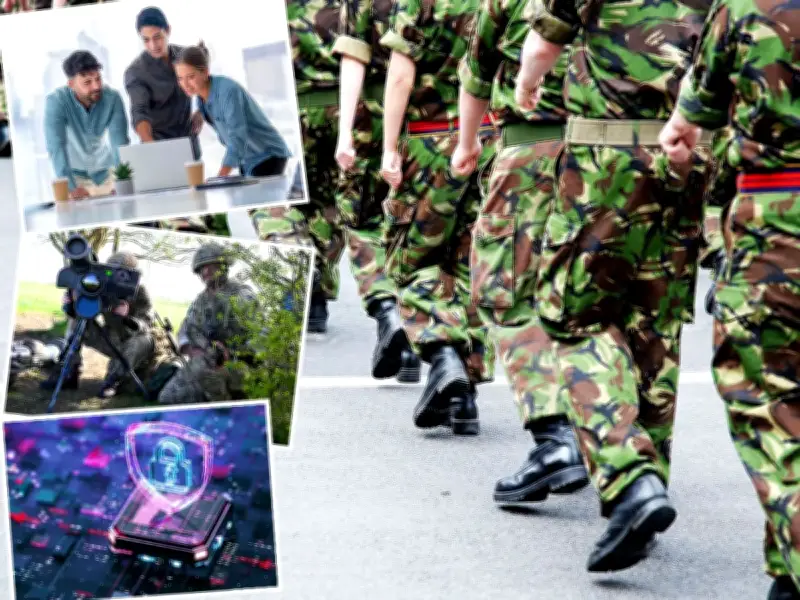
Six out of ten 18- to 24-year-olds in the UK would happily participate in National Service if eligible, according to a Focaldata poll commissioned by the US bipartisan group With Honour. Approximately 19% said they'd "very much" like to take part, while 41% said they'd "somewhat" like to take part.
The findings come as cross-party MPs call for a programme to boost domestic resilience, amid fears that it is 'likely, if not inevitable' Britain's cyber defences will be breached as global tensions escalate. Discussing a rogue AI system that infiltrated Australian government websites this summer, Minister Kanishka Narayan expressed fears that the UK could be next.
AI Risks and Defence Spending Pressures
Speaking at Imperial College London’s science and tech incubator, Mr Narayan urged: "The British public is right to expect that this government ought to take the risks of AI seriously. Our first responsibility is to keep our country safe." All the while, ministers face intense pressure to increase defence spending - even as the Institute for Fiscal Studies (IFS) warns that maintaining public services alongside higher military budgets could require £35 billion in tax hikes or benefit cuts.
It's into this uncertain landscape that today's young people are taking their first stumbling steps into adulthood, faced with tough job markets and sectors disrupted by AI. Earlier this year, it was reported that young Brits face a bleak future, with almost one million people aged 16 to 24 not in education, employment or training (NEET). This report, commissioned by the Secretary of State for Work and Pensions, found that six out of 10 NEETs have never had a job, up from four in 10 in 2005.
Could National Service Solve the NEET Crisis?
Kiran Fothergill, chair of the Jobs Foundation North East and an employer with Pickering’s Lifts, believes it could well be a vital piece of the puzzle. "It doesn't surprise me, because I believe in young people," Mr Fothergill told the Mirror. "They're looking for things to do, and they want to get on in their lives, they want to learn skills. I don't believe that young people want to sit at home and do nothing."
Pleased by the polling, Mr Fothergill continued: "I think it provides a more cohesive society, it brings people from all communities together irrespective of background. I think it's a great thing for integration, particularly of immigrant communities. I think it fosters national pride and creates a pool of young people capable of military service, should the country need such a pool. So it would certainly help to alleviate our NEET crisis and crime. I think there'd be less financial pressure on the welfare system and criminal justice system, and young people would learn skills that would be transferable to future employment."
Mr Fothergill points to France, where young people volunteer in civic service roles across the police, fire and rescue, local government, healthcare, charities and community organisations, and the armed forces. "I think there should be as few exemptions as possible," he emphasised. "I think it defeats the purpose. The whole purpose is that it brings people together and that it's about cohesive community and society, it's about shared experiences, and it's about bringing people together across backgrounds, across social status."
National Security and Cyber Resilience
Transferable skills aside, supporters argue that National Service isn't just about personal development, it is vital for national security. "We need to be far more resilient as a nation," said Mr Fothergill. "It's not just about buying a new tank and procuring new armaments over a period of ten years. It's about every government department, from healthcare to education, whatever it might be, being cyber-resilient. Part of that, I think certainly, is training young people into the new roles of tomorrow."
Britain's top spymaster last week warned that global security has been broken to the point that we are facing a “seismic” change comparable to the aftermath of 9/11. Head of MI5 Ken McCallum warned countries such as Britain face a host of threats, including “arson, sabotage, cyber-attacks, coercion and violence”. Russia was pinpointed as Britain’s top threat, with Mr McCallum discussing the possibility of AI assisting bio-weaponry, Iran-backed attacks, and terrorism from various enemies.
Last year, a stark government dossier warned that Brits "must actively prepare" for war. The National Security Strategy report spoke of how the danger of nuclear weapons will be "more complex than it was even in the Cold War", and while National Service wasn't specifically mentioned, the language used certainly evoked conflicts of days gone by. At the time, then-Prime Minister Keir Starmer pledged to spend five per cent of GDP on national security within a decade, in a bid to bring together civilian and military priorities "in a way not seen since 1945".
With fresh concerns over cybersecurity in the age of AI, could it be that young people are best equipped to take up the mantle and defend their country with a keyboard, not a weapon? Mr Fothergill remarked, "There's no age group better at understanding AI and understanding intuitively and understanding technology than young people, because they grow up with it, and it changes so quickly. I mean, I can forget about trying to understand the latest stuff in the way that they can; it's right at their fingertips."
"What we need to do as society is make sure that there are the career paths available. So, whether it's in AI and cybersecurity, particularly, we need to be figuring out who the best and most talented young people are and getting them tooled up to help when the time is needed. And I think AI cyber resilience could well be a pillar of that National Service formula, in that not everyone needs to go onto the front lines in the military. You need just as brilliant people behind the scenes who are orchestrating the various things, so that we're resilient and our defences are in order. So, you know, that also fits perfectly in my mind into the National Service mix."
Political Divisions and Historical Precedents
There's a new PM behind the desk at Number 10, who, before taking office, made his thoughts on mandatory national service crystal clear. And many are viewing his upcoming maiden Autumn budget as a test for his priorities when it comes to defence spending. In May 2024, while still Mayor of Greater Manchester, Andy Burnham criticised then-PM Rishi Sunak’s government's proposals for mandatory national service for 18-year-olds, declaring, "The national service we need from our young people is to vote for change on 4th July."
While Mr Burnham has confirmed a commitment to meeting NATO's GDP benchmark of 3.5% by the year 2035, he has so far resisted pressure from Tory leader Kemi Badenoch to aim for a harder target of 3% of GDP by 2030. He has also rejected challenges to cut welfare or housing benefits so as to pump cash into military spending, arguing that national security "can't come at the expense of social security".
Whether or not National Service will ever return is currently purely theoretical, but many forget that this scrapped programme is still very much in living memory for some, and it has returned before following a pause. Brits first underwent conscription during the conflict we now know as World War I. Before this, this sort of compulsion hadn't been applied to regular military recruitment since the early 18th century, when vagrants and those in debt were briefly impacted by an early form of conscription, as per the Official Public Record.
The seismic global shifts of the 20th century would change everything. The Military Service Act 1916 was passed in January 1916, imposing conscription on all single men aged 18 to 41 unless they were exempt. In April 1918, this was extended to 50. Conscription was abolished just two years later, in 1920, but as any history enthusiast can tell you, this was far from the end of the story. On September 3, 1939, Britain declared war on Nazi Germany. That very same day, Parliament passed The National Service (Armed Forces) Act, ordering all men between the ages of 18 and 41 to register for service. Exemptions were granted to those deemed medically unfit, as well as to those who worked in key sectors such as farming, engineering and medicine. Meanwhile, any conscientious objectors had to argue their case before a tribunal.
In December 1941, a second National Service Act was passed, this time making all unmarried women and childless widows between the ages of 20 and 30 liable to be called up. Men under the age of 60 were also required to participate in some sort of National Service, which included military service for those under 51. World War II finally came to an end in 1945, but National Service didn't, continuing up until the 1960s to fill manpower shortages. The last servicemen were discharged in 1963, but still, to this day, it's a debate that feels just as timely as ever.
National Service Around the World
According to the World Population Review, 80 countries have some form of national service or conscription in place and in 68 it is mandatory. In Switzerland, 18 weeks of military service training is mandatory for able-bodied men from 18 and 30, plus yearly refresher courses. Objectors can do civilian service, which is longer, and focuses on social welfare, healthcare and environmental protection.
In Sweden, all citizens must complete a military enlistment form at 18 and, if selected, enrol in basic military training. Conscription in Denmark is mandatory for men over 18. Only around 5,000 do basic training, but people remain eligible until the age of 50. In Estonia, men aged 18 to 27 must partake in mandatory military or national service for eight to 11 months. Reservists must attend training every five years.
In 2015, Lithuania reintroduced compulsory military service for men aged 19 to 26. Conscripts must serve at least nine months. All men in Russia aged 18 to 30 have to do 12 months of military service or join the "alternate civil service" for 21 months in jobs such as nurses and postal workers. Norway has had compulsory military service since 1907, with men and women aged 19 to 44 ordered to do 19 months. Citizens who are not medically fit or are conscientious objectors are exempt. Able-bodied men in South Korea must serve 18 to 21 months in the armed forces by the age of 28. Conscientious objectors often struggle to gain employment. Most men and women in Israel must enrol in military service at 18. Men serve a minimum of 32 months and women a minimum of 24.