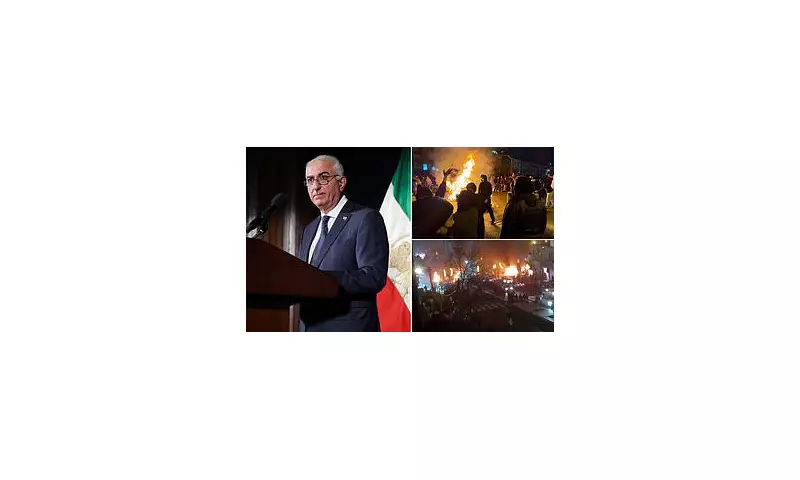
Iran's exiled crown prince, Reza Pahlavi, has publicly urged former US President Donald Trump to authorise a 'surgical strike' against Iran's elite security forces, as deadly anti-government protests continue to convulse the nation.
A Direct Appeal for International Action
Speaking to reporters in Washington on Friday, Pahlavi, the son of Iran's deposed Shah and a prominent opposition figure, made a direct appeal for the international community to intensify pressure on Tehran's clerical rulers. He argued that the focus should be on crippling the regime's command structure.
'Clearly, it's obvious what the targets should be, and the regime knows it,' Pahlavi stated. He suggested that the Iranian people would want the Revolutionary Guards, who have been at the forefront of the crackdown, to be the primary focus of any action.

Pahlavi added that he has established a secure channel for defectors and claimed that tens of thousands of people from within the government and security apparatus have made contact, whispering their loyalty to his cause. He positioned himself as the figure to ensure a stable transition, vowing, 'I will return to Iran,' though he set no timeline.
Protests and a Shifting Political Landscape
The unrest, which erupted on 28 December initially over a collapsing currency, has since morphed into widespread demonstrations calling for an end to the Islamic Republic. The human rights group Iran Human Rights (IHRNGO) reports that more than 3,400 people have been killed by security forces since the protests began.
At his press conference, Pahlavi played videos showing injured protesters and scenes from the demonstrations, where chants of 'Long Live the Shah' have been heard alongside broader anti-regime slogans. He called for nations to expel Iranian diplomats, freeze leaders' assets, and help bypass state internet controls using systems like Starlink.
'The Iranian people are taking decisive action on the ground. It is now time for the international community to join them fully,' he asserted, emphasising that foreign military intervention was not needed. 'The Iranian people's boots are already on the ground.'
US Response and Regional Implications
Donald Trump, who has previously threatened to intervene in support of the protesters, has recently expressed scepticism about Pahlavi's ability to rally significant support inside Iran. However, Pahlavi met with White House envoy Steve Witkoff last weekend, according to a report by Axios.
'I believe that President Trump is a man of his word and, ultimately, he will stand with the Iranian people,' Pahlavi said, adding it was 'never too late' for American help. He also outlined a vision for a future democratic Iran that would restore 'cordial relations' with neighbours, including Israel—a stark reversal from the current regime's stance.
Meanwhile, European powers including Britain, France, Germany, and Italy have summoned Iranian ambassadors to protest the violent state crackdown. Iranian authorities have attempted a dual strategy, acknowledging some economic grievances while brutally suppressing the protests, with no visible cracks yet appearing in the security establishment that has held power since the 1979 revolution.