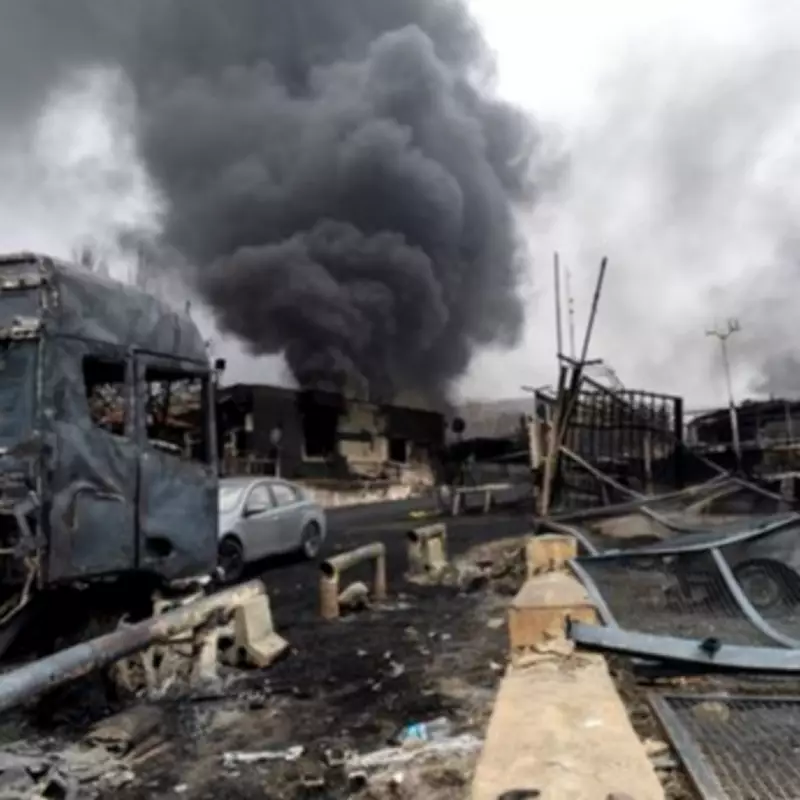
Iran War Escalation Threatens European Security as Conflict Spreads
The US-Israeli military campaign against Iran has now entered its tenth consecutive day of intense hostilities, with the conflict showing dangerous signs of expansion beyond the Middle East. In a significant development that brings the war closer to European borders, Turkish defense forces have successfully intercepted and shot down a second Iranian ballistic missile within their sovereign airspace.
Turkey's Missile Interception Challenges Victory Claims
This latest military action directly contradicts optimistic assessments from Washington regarding the conflict's progress. Despite bold assertions from US leadership about achieving decisive victory, the reality on the ground demonstrates Iran's continued capacity to project force beyond its immediate region. The interception occurred as Iran maintained its missile offensive against Israel, with air raid sirens sounding across the country throughout the night.
Casualty figures continue to mount with devastating effect. Current estimates indicate over 1,200 fatalities within Iran alongside approximately 12,000 injuries. The conflict has spread to neighboring Lebanon with nearly 400 casualties reported, while the United States military has suffered its seventh combat death in overnight operations.

Iran's Decentralized Defense Strategy Proves Resilient
Iranian Foreign Minister Seyed Abbas Araghchi recently outlined Tehran's defensive approach through social media channels, stating: "We've had two decades to study defeats of the U.S. military to our immediate east and west. We've incorporated lessons accordingly. Bombings in our capital have no impact on our ability to conduct war."
This statement reveals two fundamental pillars of Iran's military strategy: careful observation of American tactical weaknesses over extended periods, and implementation of a completely decentralized command structure designed specifically to withstand leadership decapitation attempts. Despite the loss of Ayatollah Ali Khamenei, operational continuity has been maintained through the IRGC's dispersed organizational model.
Leadership Transition and European Military Response
The accession of Motjaba Khamenei, the 56-year-old son of the late Ayatollah, to leadership positions has further strengthened IRGC influence within Iran's power structure. Although holding only mid-ranking clerical status, his deep connections with the Revolutionary Guards developed over many years suggest continued resistance rather than capitulation to American demands.
European military involvement continues to deepen as the conflict expands. Five NATO member states—Greece, France, Italy, Spain, and Germany—currently maintain warship deployments in the eastern Mediterranean region, primarily focused on protecting Cypriot interests and regional stability. The British Royal Navy is expected to deploy HMS Dragon to the area later this week, with arrival anticipated in the eastern Mediterranean within the coming days.
Economic Warfare and Asymmetric Tactics
Iran has demonstrated sophisticated understanding of economic warfare dynamics, deliberately employing cost-asymmetric strategies to strain American and allied resources. Recent attacks targeting critical infrastructure include a successful strike against a Bahraini desalination plant, highlighting vulnerabilities in Gulf States' essential water production capabilities.
US intelligence assessments reveal concerning details about Iran's tactical approach. According to reviewed documents: "Tehran, cognizant of its inability to win a conventional war against the U.S., relies on irregular tactics to drag out the war, primarily through economic coercion and cost asymmetry." The analysis notes that Iranian-produced Shahed drones costing between $20,000 and $50,000 per unit force American allies to expend Patriot missile interceptors valued at approximately $4 million per deployment.

This economic disparity mirrors tactics perfected by Iranian-backed proxies during the Red Sea crisis, where relatively inexpensive missile systems disrupted global trade routes for months while costing Western powers billions in defensive expenditures. The financial burden of maintaining US military presence alone has reached staggering proportions, with operational costs for the carrier USS Abraham Lincoln exceeding £60 million for regional deployment.
Global Economic Impact and Strategic Implications
As the conflict enters only its second week, ripple effects are already impacting the global economy through disrupted trade routes, energy market volatility, and substantial military expenditures. The sustained nature of hostilities contradicts early victory declarations and suggests a prolonged engagement that could further destabilize the region while drawing additional international actors into the confrontation.
The Iranian regime has demonstrated remarkable resilience and tolerance for suffering, approaching the conflict as an existential struggle for survival. This psychological dimension, combined with decentralized military structures and asymmetric warfare capabilities, presents complex challenges for American and Israeli military planners seeking decisive resolution to the escalating crisis.