
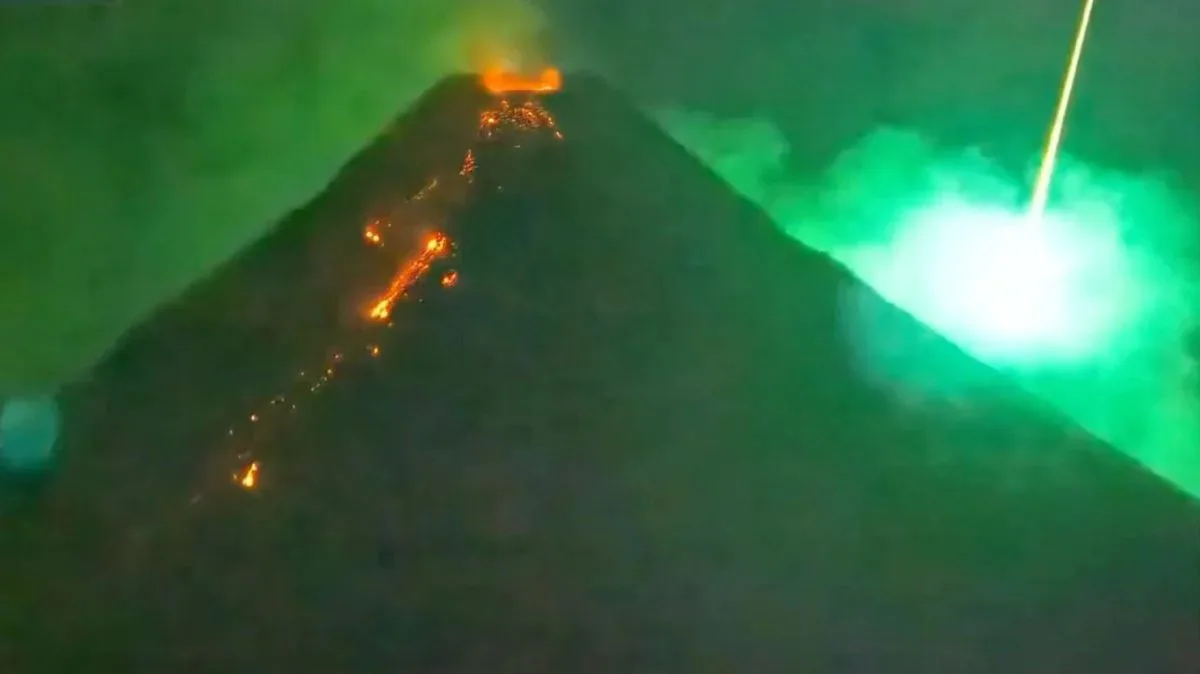
A Harvard professor has dismissed claims of a UFO sighting after a mysterious glowing orb was seen emerging from an erupting volcano in the Philippines. The incident occurred on May 25 when a green fireball was captured on camera streaking behind Mount Mayon, one of the world's most active volcanoes.
The footage, shared by afarTV, showed a small luminous white speck lifting off from the volcano shortly after the meteor passed. This sparked speculation among online viewers that an alien spacecraft had been spotted. However, theoretical physicist Avi Loeb of Harvard University has poured cold water on these theories.
Speaking to NewsNation Prime, Loeb explained that the light was likely a glint from a satellite reflecting sunlight. 'There are more than 10,000 communications satellites moving around the Earth, so it's not very unlikely to see such a thing,' he said, describing the event as a one-in-a-million optical illusion.
The Philippine Institute of Volcanology and Seismology (PHIVOLCS) initially reported that the meteor had struck the northern slopes of Mayon Volcano. However, after further review, the agency corrected its statement, confirming that the meteor disintegrated harmlessly in the atmosphere. PHIVOLCS posted on X: 'Our review of seismic, infrasound and additional camera footages around the volcano indicate that the meteor disintegrated while in the atmosphere and did not strike the slopes of Mayon.'
Local residents were terrified by the display, with one person from Los Baños saying they 'thought it was a missile because of how bright it was.' The meteor burned bright green and white for less than a second before disappearing into clouds. The volcano had been continuously erupting for 140 days, meaning multiple cameras were already monitoring the peak, increasing the chances of capturing such a rare event.




