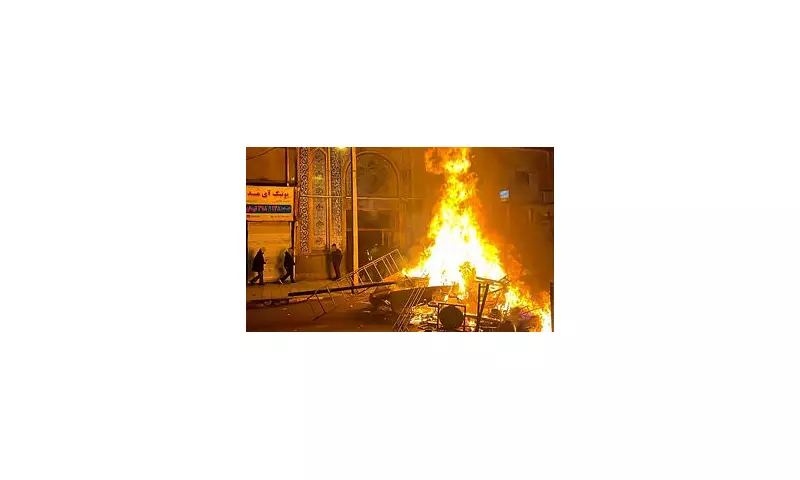
The Islamic Republic of Iran has plunged its people into darkness. On Saturday, as a new wave of anti-regime protests surged, authorities severed the nation's communications, imposing a near-total digital blackout. This calculated move, a familiar prelude to state violence, has thrown down a gauntlet to the international community and poses a direct challenge to the stark promises made by former US President Donald Trump.
A Stark Contrast in Leadership and a Regime's Brutal Playbook
The immediate silence was deafening. For those communicating with sources inside Iran, the vibrant digital chatter – filled with updates, grim humour, and vital coordination – was abruptly severed. This was no technical fault. It was a deliberate state-ordered act from the highest levels of the regime, designed to shroud its actions in secrecy. Amnesty International swiftly condemned the blackout, recognising it for what it is: a tool for enabling mass human rights abuses.
This is the established modus operandi of Iran's rulers: cut the lights, then swing the truncheon. Block the footage, then bury the dead. Yet, despite the regime's efforts, harrowing fragments of evidence continue to emerge. Videos show regime forces firing live ammunition into crowds, while opposition media like Iran International report mass casualties. The demands of the protesters have shifted irrevocably. Gone are the calls for reform; the unifying cry now is for the complete overthrow of the theocratic system.

The defining image of this uprising encapsulates this new, unyielding spirit: a young, unveiled woman casually lighting a cigarette from a burning poster of Supreme Leader Ayatollah Ali Khamenei. It is a layered act of profound defiance, signalling that the regime's ultimate authority is now viewed as mere kindling.
The American Response: From Rhetoric to Reality
This crisis presents a moment of truth for Donald Trump. In contrast to the cautious, disapproving statements from the Obama administration during the 2009 uprisings, Trump has previously adopted a far more confrontational tone. He vowed America was 'locked and loaded and ready to go' should the regime begin a massacre. Now, with communications severed and violence escalating, the world waits to see if this was mere bluster or a genuine pledge.
Any potential US action, however, must be guided by a critical principle: action does not mean invasion. As Andrew Fox, a senior fellow at the Henry Jackson Society and former British Army officer, notes, 'the aim here is not to occupy Iran, but to create the conditions for regime collapse from within.' An invasion would be a catastrophic error, gifting the regime an external enemy to rally against and ignoring the formidable geographical and historical defences of the Iranian 'fortress'.
A Surgical Strategy for Maximum Pressure
A smart, effective strategy would involve several coordinated, surgical pressures aimed at the regime's core without sparking a regional war. First, the US must work to pierce the digital blackout, deploying satellite internet and anti-jamming technologies to deny the regime the cover of darkness for its atrocities.
Second, punishment must be personalised. Rather than abstract sanctions, the US should target the specific individuals orchestrating the violence: commanders, judges, prison chiefs, and Revolutionary Guard officers. Their foreign assets should be frozen, and their overseas interests exposed, making loyalty to the regime a costly choice.
Third, a deterrent ring should be built around the machinery of repression. If live rounds are used against civilians, the specific military bases, command nodes, and logistics hubs enabling that violence could face precise, limited strikes. The goal, as Fox suggests, is to 'trigger defections or elite collapse' by demonstrating that repression carries a direct, severe cost for those who order and enact it.
Crucially, this must be framed as a solely American response to mass killing, keeping Israel out of the frame to avoid feeding the regime's conspiracy narratives. Furthermore, Washington must look beyond immediate regime collapse, engaging with credible civic and diaspora figures to help shape a stable future.

The task is monumental: to save lives without igniting a wider conflict. The world is watching, and the time for decisive, intelligent action is now.