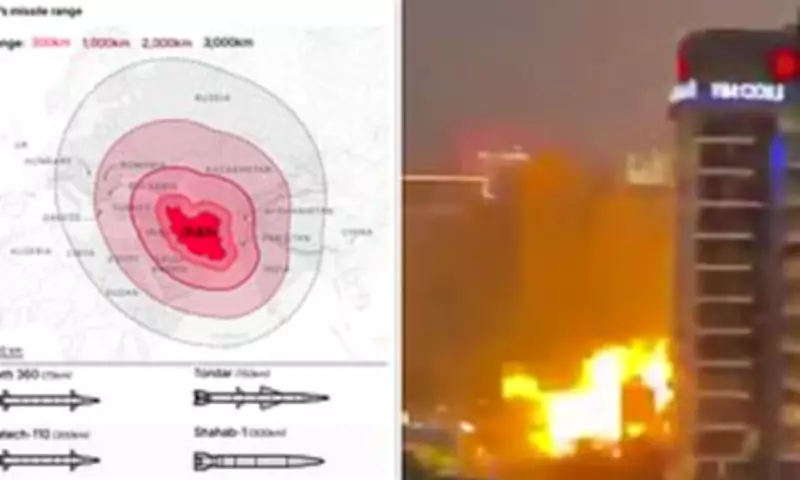
Europe Faces Iranian Missile Threat Following US-Israel Leadership Decapitation
European cities could become targets for Iranian ballistic missiles as a consequence of recent US and Israeli strikes that eliminated Tehran's top military leadership, according to a leading defence expert. The strategic decapitation has created dangerous uncertainty about who now controls Iran's substantial missile arsenal.
Leadership Vacuum Creates Unpredictable Military Environment
Dr. Sidharth Kaushal, a senior research fellow at the Royal United Services Institute (RUSI), has warned that the elimination of Iran's senior command structure may place critical military decisions in the hands of less experienced officers. This leadership vacuum could potentially drag European nations into the expanding regional conflict.
The weekend's coordinated airstrikes by American and Israeli forces successfully eliminated numerous key figures in Iran's political and military hierarchy. Among those killed were Supreme Leader Ayatollah Ali Khamenei, Army Chief of Staff General Abdol Rahim Mousavi, Defence Minister General Aziz Nasirzadeh, and Major General Mohammad Pakpour, who had recently assumed leadership of the Islamic Revolutionary Guard Corps.

Iran's Long-Range Missile Capabilities
Iran's Khorramshahr missiles, with ranges between 2,000 and 3,000 kilometres, place numerous Western European capitals within striking distance. According to defence analysts, these weapons could potentially reach Rome, Athens, Budapest, and potentially cities as far north as Germany, Poland, and Denmark.
The Khorramshahr 4 missile, believed to be a derivative of North Korean ballistic technology, carries a substantial 1,500-kilogram warhead and can be launched in coordinated volleys. Dr. Kaushal noted that this system was "always speculated that this would have been the delivery vehicle for a nuclear warhead if the Iranians had ever developed one."
Europe Already Feeling Conflict's Impact
European interests have already suffered collateral damage from the escalating conflict. Global oil and gas prices have surged dramatically over recent days, while Iranian-backed Lebanese group Hezbollah launched a drone attack against a British RAF airbase in Cyprus on Monday.
Iran's foreign ministry issued a stark warning to European nations this morning, stating that any "defensive action" against Iranian missile capabilities would be considered "an act of war" and complicity with aggressors. This followed statements from Germany, Britain, and France indicating they might take preemptive measures against Iran's launch capabilities.
Mosaic Warfare Doctrine Increases Uncertainty
Dr. Kaushal explained that Iran's military doctrine of "mosaic warfare" deliberately decentralises command authority to ensure operational continuity if senior leadership is eliminated. This strategic approach, developed since the 2000s, means that lower-level commanders may now exercise unprecedented authority without oversight from eliminated superiors.
"There is a question of just how much authority to do things that might widen the war sits now with people who would not have ordinarily controlled," Dr. Kaushal told the Daily Mail. "A lot is unknown about exactly what this would look like under the hood of the Iranian system."
Sleeper Cells and Proxy Threats
Security officials across Europe are increasingly concerned about potential activation of Iranian sleeper cells on the continent. Marc Henrichmann, a member of the German parliament's intelligence committee, warned that "Iranian sleeper cells in Europe cannot be ruled out" as part of Tehran's retaliation strategy.
British intelligence services have reportedly reviewed the UK's terror threat level following the Ayatollah's assassination. MI5 previously warned that Iran had been behind approximately twenty potentially deadly plots in Britain during the previous twelve months.

European Military Responses
Several European nations have already taken defensive measures. France has dispatched warships to Cyprus and provided additional land-based anti-drone and anti-missile systems following the attack on RAF Akrotiri. Germany has similarly responded to requests for naval support, while Greece has sent four F-16 fighter jets and two advanced frigates toward the region.
Defence Secretary John Healey acknowledged the heightened risk, stating that Britain's "alert and vigilance in the UK is also high" due to concerns about "increasing Iranian indiscriminate retaliatory attacks."
Broader Regional Implications
The conflict's ripple effects extend beyond immediate military concerns. The United States has expanded evacuations of non-essential personnel to six nations, including the United Arab Emirates—previously considered a stable regional hub. American officials have reported increased "chatter" among terrorist networks, suggesting heightened planning for attacks.
While Dr. Kaushal assessed the probability of direct Iranian attacks on Europe as relatively low, he cautioned that "it's not so unlikely that you can't conceive of the situation" given Iran's demonstrated capabilities and the current leadership vacuum creating unpredictable decision-making processes.