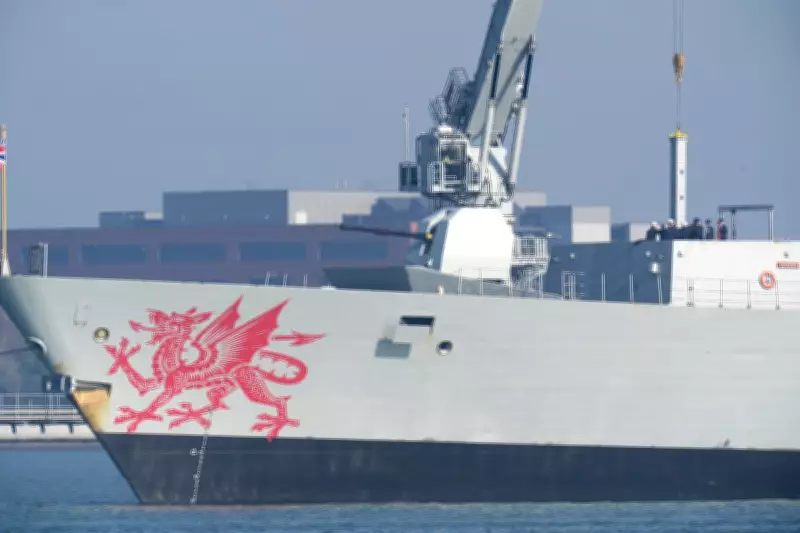
Royal Navy Warship Stuck in Port as Cyprus Crisis Unfolds
The intended display of British naval power following an Iranian drone strike on a Royal Air Force base in Cyprus has been embarrassingly delayed, with HMS Dragon still docked in Portsmouth nearly a week after the government announced its deployment.
On the night of 1st March, a drone struck RAF Akrotiri in Cyprus, forcing the UK to reconsider its hands-off approach to America's escalating conflict with Iran. In a televised address that evening, Prime Minister Sir Keir Starmer revealed he had agreed to a US request to use British military bases for defensive strikes against Iranian missile sites, stating British lives had been put at risk.
Naval Response Stalls Amid Contractual and Strategic Issues
By Tuesday, the government decided to scramble HMS Dragon to the eastern Mediterranean, but the Type 45 destroyer remains in Portsmouth where it is expected to stay until later this week. This delay has left Ministry of Defence officials reportedly fuming and exposed significant shortcomings in Britain's defence capabilities.

The situation has been complicated by contractual agreements with contractor Serco that initially prevented weekend working on the vessel. Armed forces minister Al Carns had to intervene to overturn a money-saving tweak made to the servicing contract last year that ended overtime work, including weekend shifts.
MoD sources revealed these contract changes stemmed from the department's need to find £2.6 billion in savings for this financial year. Before the issue was resolved, one MoD source stated: "People are fuming here. It is not on for a contractor to work to rule in these circumstances."
Cyprus Expresses Disappointment as Allies Mobilise
Under the 1960 Treaty of Guarantee that granted Cyprus independence, the UK has a legal obligation to ensure the island's security. However, the Cypriot government has expressed disappointment in Britain's response to the strike and has been forced to seek assistance from France.
This development comes as French, Dutch, Greek, Italian, and Spanish warships are either en route to or already in the region, raising serious questions about why Britain's HMS Dragon remains in Portsmouth while allies mobilise.
The delay has not gone unnoticed internationally. Reports that the UK was updating HMS Prince of Wales' readiness level prompted US president Donald Trump to suggest "we don't need them any longer" in a Truth Social post on Saturday evening.
Strategic Choices and Funding Challenges Exposed
Professor Kevin Rowlands, a former senior Royal Navy officer now at defence think tank RUSI, explained that each ship has a declared "readiness" level indicating how many days until it can sail. He noted that rather than unpreparedness, the situation highlights how UK strategic priorities have shifted toward Russia in recent years.
"The UK, through successive defence reviews, have made some strategic choices," he said. "It's Nato first. It's the North Atlantic, it's the high North. The principal adversary is Russia. And so, if those choices have been made, that has meant a drawdown of fewer forces in other regions, including the Middle East."
Other naval experts point to funding issues. Commodore Steve Prest, former director of Royal Navy acquisition, told BFBS Forces News that maintaining the navy's "full structure" has been a "real budgetary challenge."
"With the fleet that we have got, the ageing Type 23s in particular, and to an extent the Type 45s, have suffered from a lack of spares and a lack of maintenance," he said. "So getting them out in sufficient numbers at sufficient readiness has been a problem."
Historical Context and Forward Planning
This incident marks the first time since 1980 that no Royal Navy ships have been stationed in the Gulf, following years of scaling back British presence in the region. Admiral Lord Alan West, who served as First Sea Lord between 2002 and 2006, previously described the decision to bring home the last remaining vessel as a "terrible error."
Some have questioned why the UK didn't send a warship sooner. The Spectator reported Sir Keir was first asked by the US about using UK bases to attack Iran on 11th February, seventeen days before Israel and the US struck Tehran and killed Iranian leader Ali Khamenei on 28th February.

"You could see the buildup; it was unlikely to be without consequences," Commodore Prest told BFBS Forces News. "We could and should have seen this coming." He added he believes the UK has taken "our eye off the ball" strategically.
However, Professor Rowlands countered that forward planning happens "all the time" in the armed forces, and the navy would have been preparing "a month or two in advance" for potential Middle East action.
Broader Military Response
On Saturday, the Ministry of Defence confirmed the UK is also preparing an aircraft carrier for possible deployment to the Middle East. While this doesn't mean HMS Prince of Wales will be sent into the Gulf, it reduces preparation time should deployment become necessary.
A Ministry of Defence spokesperson stated: "We are reinforcing our defensive presence in the Eastern Mediterranean with four additional Typhoon jets to Qatar. Royal Navy Wildcat helicopters armed with Martlet drone-busting missiles are arriving in Cyprus."
"They will reinforce our RAF Typhoons, F-35B jets, ground-based counter-drone teams, radar systems, and Voyager refuelling aircraft already deployed. Our jets are flying continuous sorties to defend against indiscriminate Iranian strikes threatening UK people, interests and bases."
The spokesperson added: "The Royal Navy are working as fast as possible to prepare HMS Dragon for deployment, including resupplying her air defence missiles at our ammunition facility in HMNB in Portsmouth."
HMS Dragon, one of the Royal Navy's six Type 45 destroyers, recently underwent maintenance and has now been loaded with ammunition after crews worked over the weekend. Described by the navy as "one of the most advanced warships in the world," the vessel is equipped with the Sea Viper anti-air missile system and manned by a crew of around 200.