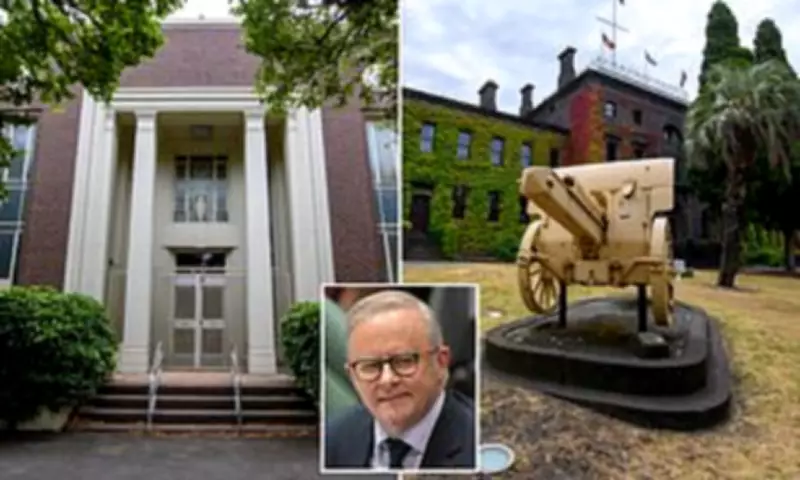
The Australian government has unveiled a landmark plan to sell dozens of historic military properties across the nation, aiming to generate nearly $2 billion for reinvestment into defence capabilities while slashing annual maintenance expenditure.
Major Defence Estate Restructuring Announced
Defence Minister Richard Marles confirmed on Wednesday that 67 defence sites will be either fully or partially sold, representing the most significant disposal of Australian military properties in the country's history. The ambitious initiative is projected to raise approximately $1.8 billion for the federal government, with an additional $100 million in yearly maintenance savings redirected to bolster defence resources.
Heritage Sites Among Properties Listed
Among the most notable properties earmarked for sale are the historic Victoria Barracks complexes in Melbourne, Sydney, and Brisbane. The Sydney Victoria Barracks, established in 1840, and Melbourne's Victoria Barracks, which played crucial roles in both world wars with buildings dating to 1850, are included in the extensive list.

Prime Minister Anthony Albanese described the strategy as "a sensible way forward" during parliamentary remarks, emphasising multiple benefits. "It is a win for the nation's defence, is a win for opportunities when it comes to housing," he stated. "But it's also a win for ensuring that ... we don't have estates just sitting there costing money to be maintained, that are serving no purpose."
Relocation and Rationale
Between 450 and 650 personnel currently based at affected sites will be relocated to other defence facilities as the sales progress. The decision follows an independent defence estate review that identified numerous properties as vacant, underutilised, or unfit for purpose due to issues including rusted structures, black mould, and chemical contamination.
Other significant sites on the chopping block include an unoccupied naval base on Sydney's Spectacle Island, HMAS Penguin diving base near Balmoral Beach, three military-owned golf courses in Victoria and the ACT, and the former Veterans Repatriation Commission Outpatient Clinic in Melbourne.
Financial and Strategic Implications
The government has already sold three properties to private commercial buyers, with the remaining 64 sites to be transferred to the Finance Department for disposal in coming years. Officials acknowledge some properties may take considerable time to sell, with expected buyers including state and territory governments alongside private investors.
Raelene Lockhorst, deputy director of the Australian Strategic Policy Institute's National Security Program, welcomed the announcement as positive. "It's aligning the estate footprint with the national defence strategy," she noted, "and the most important thing is that it's delivering substantial annual savings in maintenance costs for facilities that are under utilised or not used at all."
Political and Community Responses
The plan has generated mixed reactions across the political spectrum. Opposition assistant defence spokesman Phillip Thompson, an army veteran, expressed concerns about future military expansion needs. "We may need these bases for our military that must expand and grow in numbers," he cautioned.
Greens defence spokesperson David Shoebridge criticised the approach, arguing the sites could deliver "literally thousands of homes" while protecting heritage and providing public parklands. "Labor selling this land without any regard to the desperate need for public housing and the strong community support for the built heritage and green open space is a three-way betrayal," he asserted.
Minister Marles acknowledged emotional attachments to historic sites among military personnel, stating "It's understandable that those who've served in the army, who are very passionate about the army ... will have emotional attachments to places they serve." The government has retained one site recommended for sale—a dive-training facility at Pittwater on Sydney's northern beaches—due to its "critical capability" that cannot be easily relocated.

This comprehensive estate rationalisation represents a significant shift in how Australia manages its defence infrastructure, balancing historical preservation with contemporary strategic and financial priorities.