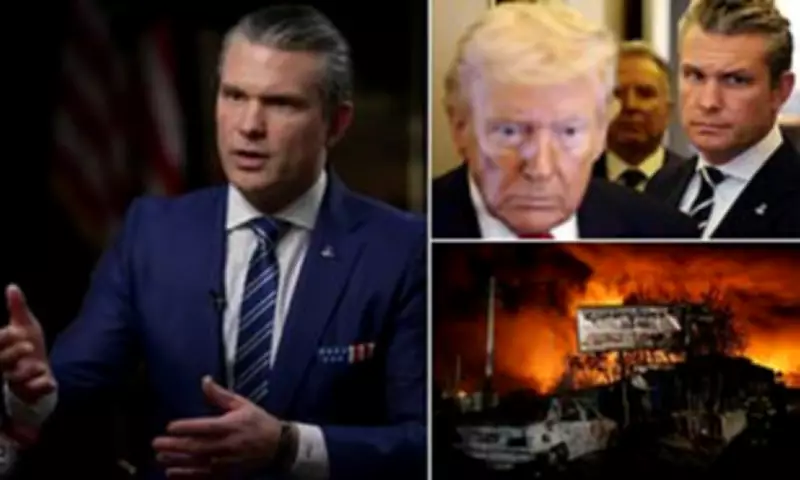
Defense Secretary Asserts Iran's Inevitable Surrender in Ongoing Military Operation
Defense Secretary Pete Hegseth has provided firm assurances to the American public that Iran will ultimately surrender as the joint United States and Israeli military operation extends into its second consecutive week. Hegseth delivered these confident statements during a comprehensive interview with Major Garrett on the prominent television program '60 Minutes,' which was broadcast nationally on Sunday evening.
Unconditional Surrender and Presidential Authority
When questioned about President Donald Trump's previous declaration demanding 'unconditional surrender' from Iran, Hegseth provided a detailed explanation of the administration's strategic position. 'It means we’re fighting to win. It means we set the terms. We’ll know when they’re not capable of fighting. There’ll be a point where they’ll have no choice but to do that. Whether they know it or not, they will be combat-ineffective. They will surrender,' the Defense Secretary stated unequivocally during the televised discussion.
Hegseth further emphasized that President Trump will be the ultimate authority in determining the conditions of Iran's military defeat. 'Whether they want to admit it or not, whether their pride lets them say it out loud or not — it’s President Trump who will set the terms of that,' he declared, reinforcing the administration's uncompromising stance toward the Iranian regime.

Contrasting Statements on Decision-Making
In a contrasting development, President Trump offered somewhat different perspective during his own comments to the Times of Israel on the same Sunday. The President indicated that the decision to conclude the military engagement would be reached through mutual consultation with Israeli Prime Minister Benjamin Netanyahu. 'I think it’s mutual… a little bit. We’ve been talking,' Trump revealed. 'I’ll make a decision at the right time, but everything’s going to be taken into account.'
Despite this diplomatic nuance, Hegseth remained resolute in his '60 Minutes' interview, vowing that American military forces are 'willing to go as far as we need to to be successful' in the operation specifically designed to eliminate Iran's nuclear capabilities entirely.
Ground Troops and Anticipated Casualties
When directly questioned about the potential deployment of American ground forces to the conflict zone, Hegseth maintained strategic ambiguity while asserting military prerogatives. 'We reserve the right - we would be completely unwise if we did not reserve the right to take any particular option, whether it included boots on the ground or no boots on the ground.'
The Defense Secretary also addressed the inevitable human cost of the ongoing military engagement with sobering realism. 'The president's been right to say there will be casualties,' Hegseth acknowledged. 'Things like this don't happen without casualties. There will be more casualties... especially our generation knows what it's like to see Americans come home in caskets.'
He continued with determined resolve: 'But that doesn't weaken us one bit. It stiffens our spine and our resolve to say this is a fight we will finish.'
Ceremonial Recognition and Conflict Toll
Hegseth conducted this significant interview on Friday, merely one day before accompanying President Trump to a solemn dignified transfer ceremony honoring American service members killed in the Iran conflict. The ceremony took place at Dover Air Force Base, where the remains of six United States military personnel were returned to their grieving families.
The fallen service members have been identified as:
- Nicole Amor, age 39
- Cody Khork, age 35
- Declan Coady, age 20
- Robert Marzan, age 54
- Jeffrey O’Brien, age 45
- Noah Tietjens, age 42
In a separate tragic development, United States Central Command confirmed on Sunday afternoon that a seventh American service member, whose identity remains undisclosed, died after sustaining serious wounds during an Iranian attack on US troops stationed in Saudi Arabia on March 1.

Regional Escalation and Iranian Response
The conflict has triggered significant regional escalation, with Iran launching retaliatory strikes against Gulf states since the US-Israeli operation commenced last week. Air raid sirens sounded across Israel overnight, while the United Arab Emirates reported successfully intercepting Iranian drones. In Iraq, air defense systems destroyed a drone approaching a US-operated military facility within Baghdad International Airport during early Monday operations.
Security concerns have escalated to the point where United States officials and their family members in Saudi Arabia received urgent advisories to evacuate the country 'due to safety risks.'
Devastation in Tehran and Leadership Changes
Iran itself has not escaped substantial damage from the ongoing conflict. The capital city of Tehran erupted in flames on Sunday following a fresh wave of devastating strikes conducted by both American and Israeli forces. The city's skies transformed into a disquieting reddish hue filled with acrid smoke after multiple oil and fuel depots were destroyed across the Iranian capital.
Eyewitnesses reported enormous fireballs illuminating the Tehran skyline, while residents complained of persistent burning odors permeating the air. These developments occurred as both the United States and Israel reaffirmed their commitment to continue military operations until achieving what they term the 'eradication' of the current Iranian regime.
The Israeli Defense Forces claimed on social media platform X that Abu al-Qassem Baba’iyan, head of Iran's Military Office and Chief of Staff of the Khatam al-Anbiya Central Headquarters, was killed during the latest wave of attacks. He represents the most recent high-ranking regime figure eliminated in Israeli strikes.
New Supreme Leader and Defiant Rhetoric
Despite these significant losses, Iranian officials demonstrated defiance by appointing a new Supreme Leader on Sunday. Mojtaba Khamenei, the 56-year-old second eldest son of the former Supreme Leader, assumed the position. According to Iranian media reports, Khamenei was selected by Iran's Assembly of Experts 'under pressure from the Revolutionary Guards,' with whom he maintains strong connections.
United States diplomatic cables previously characterized Mojtaba Khamenei as 'the power behind the robes' and a key player within the Iranian regime, as reported by the Associated Press. Although he has not occupied senior political roles, Khamenei studied under religious conservatives in Islamic seminaries located in Qom, the Shiite holy city.
President Trump had previously stated he would personally select Iran's new leader and specifically described Khamenei's son as 'unacceptable,' while Israeli officials vowed to eliminate whoever assumed leadership of the country.
Within Iran, videos circulated showing regime supporters chanting Mojtaba's name and demanding additional strikes across the Middle East immediately following his appointment announcement. Large crowds gathered in Tehran waving Iranian flags and shouting, 'Allahu Akbar, Khamenei Rahbar,' which translates to 'God is great, Khamenei is the leader.'
Economic Threats and Regional Implications
In a more ominous development, the Iranian military threatened to retaliate against any Israeli attacks on the country's energy infrastructure by striking oil facilities throughout the region. This warning followed Israeli targeting of Iranian fuel reserves the previous night.
Ebrahim Zolfaghari, spokesman for Iran's central military command, delivered a stark warning during a state television broadcast: 'The governments of Islamic countries are expected to warn the criminal America and the savage Zionist regime of such cowardly, inhumane actions as soon as possible. Otherwise, similar measures will be taken in the region, and if you can tolerate oil at more than $200 per barrel, continue this game.'