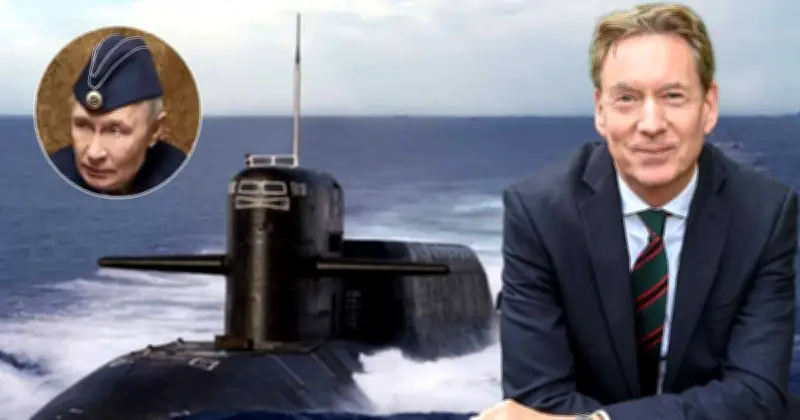
Veteran BBC Security Correspondent Frank Gardner has warned that the UK is "wide open" to Russian missile attacks, with no effective air defence and no "middle rung" on the escalatory ladder to respond to a strike without resorting to full strategic nuclear war.
UK's Defence Gaps
In an exclusive interview, Gardner said: "We have no effective air defence against Russia's missiles – we're wide open. We have no Golden Dome, we've got no Iron Dome. We've got our Type 45 destroyers, which could intercept the first wave, but most of them are not actually operational and those would run out of counter-missiles very quickly."
He added: "The second wave would have a complete freedom to choose targets, whether it's London or nautical targets in Portsmouth or Faslane or wherever. And the problem for the UK – and Putin knows this – is that we have no middle rung on the escalatory ladder. We don't have tactical nukes. We couldn't retaliate without having to go full strategic nuclear, which is horrific. That's the end of days, that's mushroom clouds over Moscow and London."
Below-Threshold War
Gardner described Britain as being in a "below-threshold war" with Russia, meaning under the boundary of open, declared war. He listed ongoing threats: "The constant cyber-attacks, the scoping out of our subsea cables and interference in democratic elections in several countries in the West. Probing of our airspace, the sabotage of warehouses belonging to Ukrainians in East London, incendiary devices in cargo shipments that blew up in Germany, arson attacks on a house linked to the former Prime Minister Keir Starmer – things like that."
He noted that both horrifying scenarios of nerve agent and polonium poisoning have taken place in the UK since 2006, yet the country remains in this below-threshold state.
Defence Spending Criticised
Gardner criticised successive governments: "Both the Tories, including the coalition government, and Labour, are equally to blame. They have been far too late to wake up and, all the time we were putting massive amounts of money into welfare and running down defence, Russia, China, Iran and North Korea – all states that consider us their enemies – were building up their armouries."
He recalled that after the Cold War ended, "everyone said: 'Well, we don't need to spend 5-6% on defence anymore. We can spend that money on things we really need – schools, hospitals, roads, transport'."
Putin's Advisors and NATO
Gardner suggested Putin was badly advised before the full-scale invasion of Ukraine: "People told him what they knew he wanted to hear. There's a similarity with Saddam Hussein here. My contention is that Saddam, at the time of the [US-led] invasion of Iraq in 2003, still believed he had some kind of powerful weapon and an unbeatable army, because people didn't want to disabuse him of this. Today nobody is telling Putin just how badly he's doing on the battlefield."
On the US commitment to NATO, he said: "For now, barring anything else happening, Trump can't pull out of NATO without a two-thirds Congress congressional vote in favour and that's extremely unlikely. But what he can do is massively reduce US forces in Europe." He referenced the "Narva Test" – a hypothetical scenario where Russia attacks a smaller NATO country using hybrid warfare tactics.
Gardner's new novel, Ballistic, includes submarine-launched Russian super weapons and the threat of invasion. He said: "Ballistic is very much anchored in the kind of scary world in which we live, where we are trying to rebuild our defences in a race against time. If we can, Russia won't attack. But if Putin thinks we're weak and we're low-hanging fruit, he might just be tempted."