

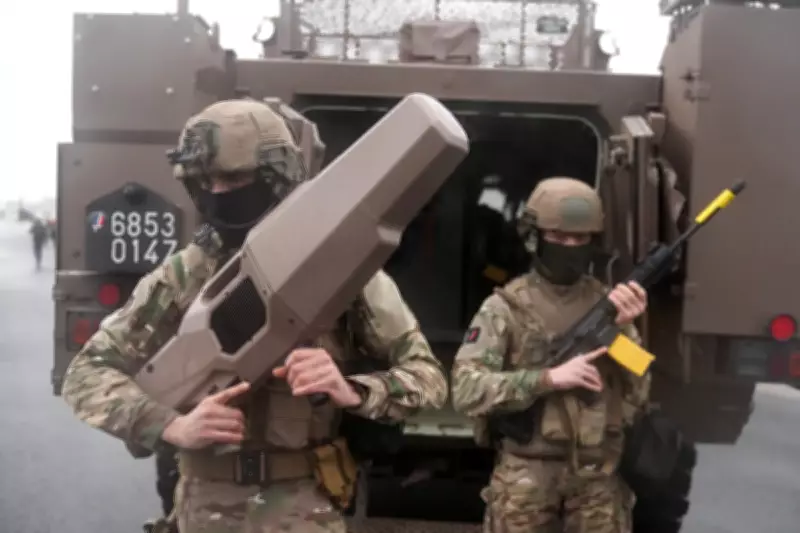
Five Major European Nations Forge Alliance to Build Affordable Drone Defenses
In a significant move to bolster continental security, five leading European military powers have announced a collaborative initiative to develop inexpensive drone defense systems and autonomous drones. This groundbreaking program will harness the hard-earned battlefield expertise of Ukraine, forged over four years of intense conflict with Russia.
Leveraging Ukrainian Battlefield Innovation
The coalition, comprising France, Poland, Germany, the United Kingdom, and Italy—collectively known as the E5—unveiled the initiative on Friday. It represents a concerted European effort to strengthen border defenses, including proposals for a comprehensive "drone wall" along the frontiers with Russia and Ukraine. This system aims to enhance the detection, tracking, and interception of unauthorized drones entering European airspace.
Both Moscow and Kyiv have developed advanced drone warfare capabilities through the brutal crucible of war, where rapid innovations have fundamentally reshaped modern combat tactics. Poland is already engaged in joint military training and manufacturing projects with Ukraine, focusing on drone technology. These collaborations have been spurred by a series of incidents where rogue drones have tested Europe's borders and airports, with Russia often blamed—though it denies any intentional involvement.

Addressing Cost-Effective Defense Solutions
Luke Pollard, Britain's Minister for Defense Readiness and Industry, emphasized the urgency of the initiative. "The UK and our E5 partners are stepping up—investing together in the next generation of air defense and autonomous systems to strengthen NATO's shield," he stated. Pollard highlighted a critical challenge: "We have some of the best kit on the entire planet for shooting down air threats. The problem is to be effective at shooting down relatively low-cost missiles, drones, and other threats facing us. We need to make sure that we're matching the cost of the threats with the cost of defense."
Poland's Defense Minister, Władysław Kosiniak-Kamysz, revealed that the group has signed an agreement to jointly invest in production and procurement under the program titled Low-Cost Effectors and Autonomous Platforms (LEAP). This initiative will focus on drone-based strike capabilities and affordable defense systems. "Combat technologies and techniques are changing rapidly—we must respond quickly and appropriately," Kosiniak-Kamysz asserted. He added, "We also signed a crucial commitment regarding the joint development of drone-based strike capabilities, low-cost joint production, and joint procurement of drone effectors, i.e., combat payloads, using artificial intelligence."
Responding to Security Threats and Political Shifts
The push for cost-effective solutions gained momentum after Russian drones breached Polish airspace in September 2025. In that incident, Warsaw and its NATO allies deployed multimillion-dollar fighter jets to counter drones costing mere thousands, which ultimately crashed in the Polish countryside. The new program aims to deploy low-cost kinetic or electronic effectors that can detect and destroy drones at a fraction of the price, offering a more sustainable defense strategy.
Europe's accelerated arming efforts come in response to heightened geopolitical uncertainties, including deep criticism from U.S. President Donald Trump regarding NATO, European defense spending, and longstanding alliances. The European Union has increased its military expenditures and is openly considering more ambitious defense projects. Kaja Kallas, the EU's Foreign Policy Chief, noted, "Europe's security is more uncertain than it has been in decades," citing Russian aggression, Middle Eastern instability, China's rise, and a "redefined" alliance with the U.S. She praised the low-cost interceptor program as emblematic of Europe's commitment to self-reliance: "If we want to keep our country safe, we must strengthen our hard power. The good news is that we are already investing record sums in defense. Europe is stepping up, but it's not about competing with NATO. It's about making Europe stronger within NATO. A stronger Europe makes the alliance also stronger."

However, NATO's cohesion has been tested during Trump's second administration, with recent controversies including threats to seize Greenland—a semi-autonomous territory of NATO ally Denmark—and disparaging remarks about allied troops in Afghanistan. While tensions over Greenland have temporarily eased, such internal disputes have undermined the alliance's ability to deter adversaries effectively.
This joint European initiative marks a pivotal step toward integrating Ukrainian combat experience into Western defense frameworks, aiming to create a more resilient and economically viable security architecture in the face of evolving threats.





