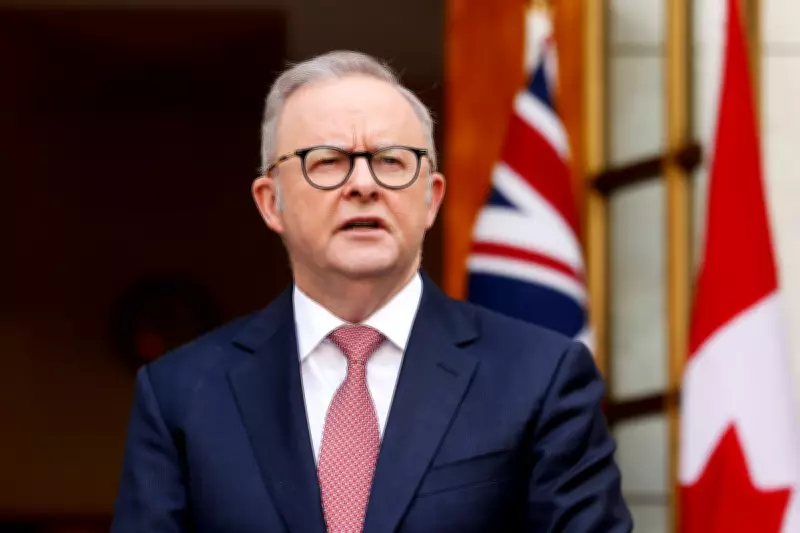
Prime Minister Anthony Albanese has publicly confirmed that three Australian defence personnel were aboard the United States submarine which launched a torpedo attack, sinking an Iranian warship in the Indian Ocean. The Australian leader clarified that while the personnel were present on the vessel, they did not participate in any offensive actions against Iran.
Details of the Incident and Australian Involvement
The attack occurred off the southern coast of Sri Lanka, where a US submarine targeted and sank the Iranian frigate identified as the IRIS Dena. The vessel was reportedly returning to Iran from an eastern Indian port at the time of the incident. Dozens of Iranian sailors were killed in the engagement, which represents a significant escalation in Washington's ongoing maritime confrontations with Tehran.
Speaking exclusively to Sky News, Prime Minister Albanese explained the context of Australian presence aboard the American submarine. "We wouldn't normally confirm such an issue, but given our National Security Committee meetings and the public interest, I can confirm that there were three Australian personnel on board that vessel," Albanese stated.

Training Under Aukus Defence Pact
The Australian defence personnel were embedded on the US submarine as part of long-standing training arrangements linked to the Aukus defence pact between Australia, the United States, and the United Kingdom. This trilateral agreement is designed to assist Australia in acquiring and building its own fleet of nuclear-powered submarines.
"These are long-standing third-country arrangements that have been in place for a long period of time," Albanese elaborated. "What they do is ensure that Australian Defence Force personnel, where they are embedded in third countries' defence assets, they act in accordance with Australian law, Australian policy, and that is, of course, taking place across the board."
Broader Australian Defence Preparations
Australia has deployed dozens of its personnel on US fast-attack submarines based out of Pearl Harbor as part of preparations for acquiring nuclear-powered submarines under the Aukus agreement. More than one hundred Australian Defence Force personnel are currently training within the United States, with plans to rotate through various positions.
According to reports from ABC News, approximately one in ten crew members serving on US nuclear-powered attack submarines is now an Australian defence personnel. This significant integration reflects the deepening defence cooperation between the two nations despite Australia's official position of avoiding direct military involvement in conflicts between the US and Iran.
Australia's Position on Iran Conflict
As a close ally of the United States, Australia has maintained that it will steer clear from any direct military role in the major conflict between Washington and Tehran. However, the Australian government has consistently expressed support for international efforts aimed at preventing Iran from developing nuclear weapons.
When questioned about the implications for international law regarding US and Israeli strikes on Iran, Prime Minister Albanese stated that Australia was "comfortable" with assessing that Iran posed a threat on multiple levels. This assessment comes amid heightened tensions in the region, where US and Israeli forces have been conducting strikes against Iranian targets while Tehran retaliates with missile and drone attacks.
International Reactions and Consequences
Iranian Foreign Minister Abbas Araghchi has accused the US Navy of committing "an atrocity at sea" by sinking the frigate IRIS Dena. In a social media statement released on Thursday, Araghchi warned that the United States "will come to bitterly regret" the attack on the Iranian warship.
The incident occurred hundreds of miles across the Indian Ocean from the Persian Gulf, where most of the recent confrontations between US and Iranian forces have taken place. This geographical expansion of hostilities represents a concerning development in the ongoing tensions between the two nations, with the sinking of the Iranian frigate marking one of the most significant naval engagements in the conflict to date.

The confirmation of Australian personnel aboard the attacking submarine, while not participating in combat operations, highlights the complex web of international military cooperation and the delicate balancing act that allied nations must maintain in global conflicts. The training arrangements under the Aukus pact continue despite Australia's official non-combatant position in the US-Iran confrontation.