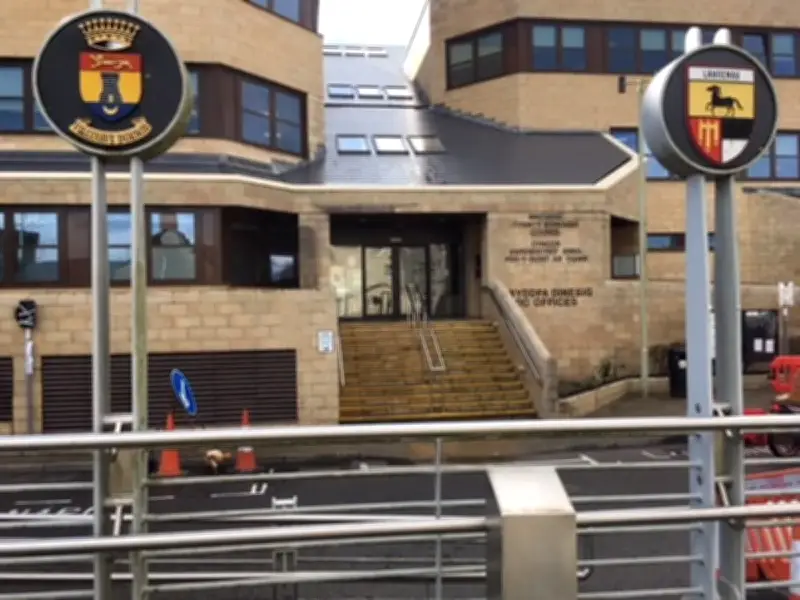
Bridgend County Borough councillors have called on the Welsh Government to introduce a new statutory recall mechanism for local councillors in Wales, allowing voters to remove an elected representative between elections, following heated discussions at a recent meeting.
Motion calls for recall powers
The motion, brought forward by the authority's deputy leader, councillor Jane Gebbie, asked that a process be introduced for recalling members where they had breached public trust through serious misconduct or criminal convictions.
Recall allows voters to remove an elected representative between elections, though currently only MPs can be recalled in the UK, with the Welsh Government also working on a new system for Members of the Senedd.
Residents' concerns raised
Addressing the chamber, Cllr Gebbie said she had brought the motion forward after receiving "hundreds of emails" from residents airing concern over public statements made by local councillor Owain Clatworthy, particularly the impact of those concerning Islam and Muslim communities.
She said they had raised questions about whether his views represented those of the council as well as his suitability to sit on the Corporate Parenting Committee - which has responsibility for children looked after by the authority, including those from asylum seeking backgrounds.
She also referenced a recent public petition that calls for Cllr Clatworthy's removal from council, which had received more than 2,000 signatures. Cllr Gebbie said while this was not by itself a finding of misconduct or a substitute for due process, it should prompt them to consider whether the democratic mechanisms available to residents were adequate.
Support and safeguards
In response, Cllr Clatworthy said he supported the motion in principle though reiterated that any recall system must be "tightly defined" for cases of serious criminal convictions or major proven sanctions, with strong safeguards against political abuse.
Speaking to the chamber he said: "I support giving the people of Wales the same right they already have over their MPs. The public should decide and not us."
Cllr Gebbie's motion argued the move would bring local councils in line with both the Welsh and UK governments, making sure that in cases of misconduct voters would have the opportunity to decide whether or not a councillor continued to represent them.
The motion presented to the council said: "The Welsh Government has rightly sought to strengthen ethical standards in local government through the Local Government and Elections (Wales) Act 2021 and the Ethical Standards Framework.
"Despite these reforms, councillors in Wales remain exempt from any statutory recall mechanism, even where serious misconduct has irreparably damaged public confidence.
"Members of Parliament are subject to the Recall of MPs Act 2015, enabling constituents, in prescribed circumstances, to petition for a by-election following serious misconduct.
"No equivalent democratic safeguard exists for local government in Wales, despite councillors making decisions that directly affect residents every day, including council tax, planning, education, housing, social care, economic development and community safety."
Amendments and debate
The motion calling on the Welsh Government to introduce new legislation that establishes a recall mechanism for councillors was tabled with an amendment by Cllr Alex Ulberini-Williams. It asked that any legislation makes sure recall petitions could only be triggered in "clearly defined circumstances" such as those involving serious criminal convictions or significant sanctions imposed under the Ethical Standards Framework.
Cllr Jonathan Pratt said he agreed with the motion in principle though would not support it, questioning whether it adds another tool for "political enemies" to use as they wished.
Cllr Elaine Winstanley said it was only right that there should be a recall method for elected officials, with the parliamentary mechanism only used rarely when there was gross misconduct or disgust with someone's behaviour.
Cllr Ross Penhale-Thomas said he felt rallied to contribute to the discussion, saying public discourse was "getting nasty". He urged members to tone down debate and properly engage with people on the issues that matter.
Following discussion at the full council meeting held in October 2026, the motion was passed by members after a show of hands, with only Cllr Pratt voting against.