Northern Ireland's Parades Commission failed to “properly weigh” what police told it about the potential for disorder if the Drumcree parade was given the go-ahead, Court of Appeal judges have been told.
A barrister for residents of the predominantly nationalist Garvaghy Road in Portadown told the court the commissioners had reached an “irrational conclusion” in permitting the Orange Order parade along the Troubles flashpoint for the first time in 28 years.
Residents' legal challenge
Denise Kiley KC made the argument at the start of the residents' fresh court challenge against the commission's decision. The residents say the Parades Commission adjudication body “materially misdirected itself” on the police assessment of the potential for disorder around the event and that the commission had not given an “accurate representation of the evidence” received from the PSNI in its decision.
However, Tony McGleenan KC, representing the commission, said the suggestion it had made a legal error “doesn't bear scrutiny”.
The residents are challenging the decision of a High Court judge – made in the early hours of Sunday September 27 – to refuse leave to apply for a judicial review of the commission's determination to permit the parade down the Garvaghy Road later that day.
Stand-off continues
Orangemen have attempted to commence their parade several times in the nine days since, but have been halted by police amid concerns of disorder if it proceeded down the road, which has witnessed a series of mass demonstrations and protest rallies.
Members of the Portadown District of the Orange Order remain at Drumcree Church, demanding to be allowed to begin their parade. Protesters have maintained a presence at the side of the road, insisting that what they see as a “triumphalist” parade should not be allowed, citing the violent history of the march in the 1990s.
Monday's hearing is the latest challenge to the parade, which was given the go-ahead for the first time in almost 30 years after three separate legal hearings over 13 hours late on September 26 and into the early hours of September 27 – the morning the parade was due to begin.
The hearing of the residents' new challenge had originally been listed for Friday but was postponed until Monday to allow for crunch talks facilitated by Northern Ireland Secretary Sir Chris Bryant, who had hoped to find a solution. The negotiations ended without agreement on Thursday, with both sides having discussed options including mediation, the possibility for the right to march to be respected but not exercised, and a “one-and-done” final march with no further applications.
Police assessment questioned
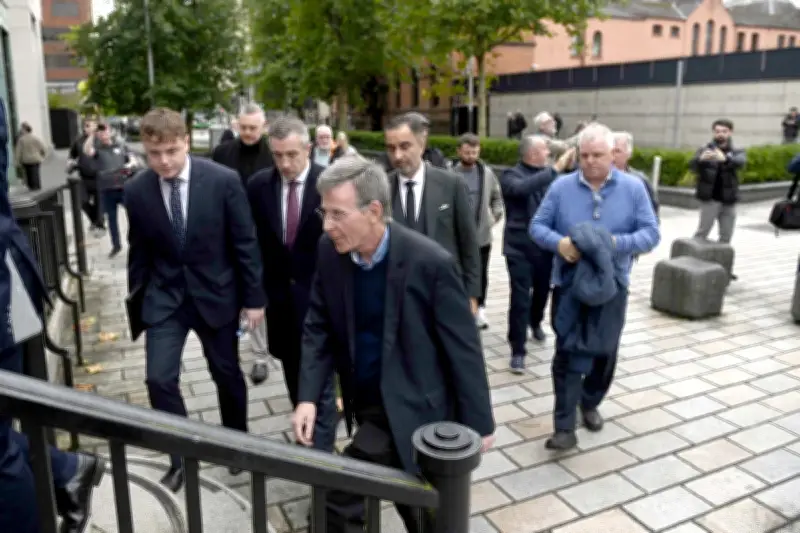
Three judges – Northern Ireland's Lady Chief Justice Dame Siobhan Keegan, Lady Justice McBride and Lord Justice Colton – are hearing the latest legal challenge. At the start of the hearing, Ms Kiley told the Court of Appeal judges it was in the public interest to ensure the Parades Commission came to correct decisions on parading applications.
Opening the case, she said the question of whether the determination remained live – given the date of the originally permitted parade has passed – was unresolved. However, she said the residents were not currently seeking a court determination on that point.
Outlining the basis of the appeal court challenge, she added: “There is a public interest in ensuring that the Parades Commission – a body charged with making these significant decisions on contentious parading issues – comes to correct and lawful determinations.”
Ms Kiley said the commission's assertion that there was no specific information from police about a risk of violence did not fully reflect what a senior commander had told it. The barrister said PSNI Assistant Chief Constable Ryan Henderson told the commission that while police had no clear intelligence about any planned disorder he had also stressed that officers were dealing with an “unclear picture” and that, as a result, police were planning for various scenarios, from a peaceful passing of the parade to an outbreak of violent disorder.
Ms Kiley said the commission's subsequent conclusion that there was no specific information about the prospect of disorder was “only part of the picture”. “It doesn't go on to record the uncertainty and the fact that the position remained unclear,” she said. “It is clear that what the police were telling the commission was, 'This is unclear, it's uncertain and we are preparing for all eventualities'.”
She said the commissioners “didn't properly understand the police assessment” and this impacted their decision to permit the parade. Ms Kiley said the commission had therefore reached an “irrational conclusion”. She described the Drumcree parade as “one of the most polarising parades in the history of Northern Ireland”.
The barrister said the commission had a duty to promote an understanding of parading but had failed to explain why it had reached its determination to permit the parade, particularly as it was the first time in 28 years. “There is a duty to explain decisions,” she said. “And where a decision has consistently been made on one basis for 28 years then a change cries out for explanation.” Ms Kiley also argued that the commission had failed to take into account the potential for the parade to trigger “wider disorder” across Northern Ireland.
Commission's defence
Mr McGleenan told the Court of Appeal that the determination to permit a limited parade down the Garvaghy Road should be read in its entirety. “It is a detailed 31-paragraph written analysis,” he said. “And it has to be read in its totality. And there is a grave danger of cherry-picking sentences here and sentences there to suggest a wrong legal test or a misdirection, or that something hasn't actually been considered.”
Mr McGleenan said police had given an assurance to the commissioners that they had the capacity to deal with any disorder that may have been triggered if a parade was permitted. He insisted the commission was “fully briefed” by police on the uncertainty around what might happen. “They met with the PSNI on the 23rd (September) at a lengthy meeting with them. They were read intelligence briefings. They were briefed about the police resource and their ability to contain any disorder or reaction that occurred. So they have all of that.”
Mr McGleenan said the residents were attempting to “make some forensic play” in asserting a difference between what the police told the commission and what the commissioners then recorded as the police assessment. He said “one accurately reflects the other”. The barrister said legal jurisprudence placed a positive obligation on facilitating the right of assembly.
Mr McGleenan described the determination as an “expert judgment by the body set up by Parliament to make these evaluations”. He said legal precedent made clear that considerable “deference” should be afforded to statutory decision-making bodies. On the residents' case that the commission should have explained why it was changing its determination after almost 30 years of prohibiting the parade, Mr McGleenan insisted the commissioners had explained why. He said what was proposed by the Orange lodge was very different to what had been applied for before, including numbers, time of year and symbols and emblems displayed. Mr McGleenan added: “The folk memory of what happened in the 1990s relates to something that's categorically different.”
It has not yet been confirmed whether the judges will treat Monday's proceedings as a leave hearing – which would determine if a separate full appeal should be granted – or whether it will be dealt with on a “rolled up” basis where the leave hearing and full appeal are effectively considered together.
Protests and political reactions
Residents around the Garvaghy Road have been staging protests against the decision to permit a parade of up to 35 Orangemen down the route. Due to the scale of the gatherings in the road, the PSNI has refused to allow the parade to proceed amid concerns of disorder. A large-scale protest started on the Sunday the march was due to begin, with more than 1,000 people blocking the road.
Under parading laws in Northern Ireland, protests must be notified to, and approved by, the Parades Commission. Police have confirmed the protest was unnotified to the commission and therefore unlawful.
Unionists have criticised several high-profile politicians, including Northern Ireland First Minister and Sinn Féin deputy leader Michelle O'Neill, for participating in the unnotified protest. Ms O'Neill is expected to face an urgent question over her participation during plenary business at Stormont on Monday. Sinn Féin leader Mary Lou McDonald said she and her party will “of course” co-operate with the PSNI over any potential investigation into the protest.
Monday marks the ninth day of the stand-off which has seen the Orangemen try numerous times to begin the march, but the road remains blocked by residents. The Orange Order and some unionist politicians have criticised the police and Chief Constable Jon Boutcher's handling of the dispute.
After being again denied permission to march by the PSNI at lunchtime on Sunday, Portadown District master Nigel Dawson told the Orangemen they had the support of the community, and added: “We continue to abide by the law and continue to show that every single minute and every single hour of the day since we won the court case. And of course we still await – and it is important we say this, that we have a police service in Northern Ireland that are at this moment in time unable or unwilling to police a court judgment.”
The weekend saw shows of support on both sides, with a gathering in the loyalist Edgarstown estate as well as a large political rally on the Garvaghy Road on Saturday. Irish rap trio Kneecap were swarmed with fans when they visited the Garvaghy Road on Sunday.
Sir Chris, who had appealed for calm before the weekend, said he was “pleased” that events had passed “without major incident”. He said: “I continue to speak with people of goodwill on all sides and believe a mutually agreeable solution is still possible if people can show leadership based on openness, compromise and magnanimity.”
At the rally on the Garvaghy Road on Saturday, Ms O'Neill said the right outcome “includes no march down this road” as Sinn Féin called on Sir Chris to use his powers to prohibit it. Deputy First Minister and DUP MLA Emma Little-Pengelly described that event as “electioneering” as she criticised Ms O'Neill and Sinn Féin for a “complete abdication of leadership”.
After the rally in support of the residents on Saturday, PSNI Assistant Chief Constable Anthony McNally said anyone blocking the Garvaghy Road will still be treated as “participating in an unnotified and therefore illegal protest”. The senior officer said evidence-gathering is continuing and anyone found to have broken the law “will face criminal justice consequences”.
Mr Dawson said Orangemen “remain confident” in their legal team, and Jamie Bryson, loyalist activist and legal adviser to the Portadown District, previously said they will accept the determination of the courts on Monday, challenging Garvaghy Road residents to do the same. In a speech over the weekend, Breandán Mac Cionnaith, of the Garvaghy Road Residents' Coalition, said: “Only one decision will be acceptable: There should be no Orange march – none at all.”