
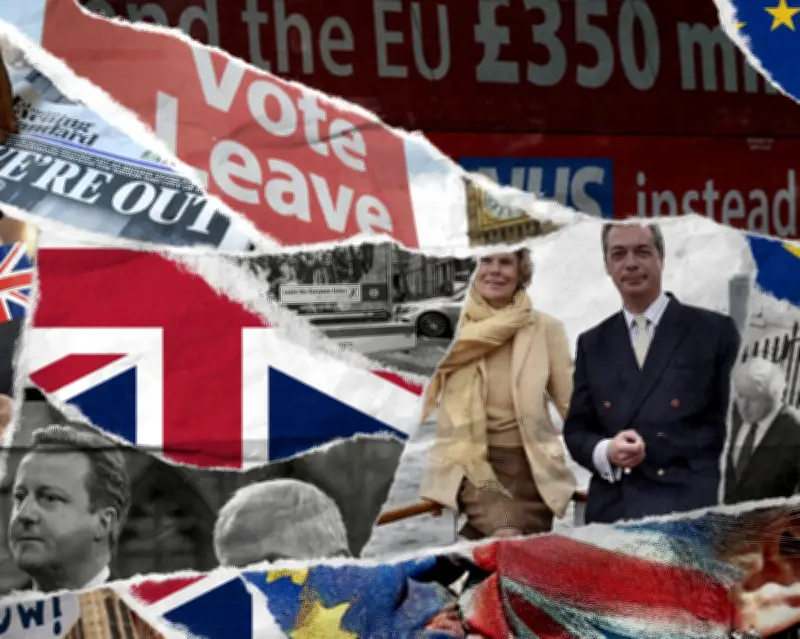
The five months surrounding the 2016 EU referendum were a tumultuous period that reshaped British politics. From David Cameron’s announcement of the referendum date to Boris Johnson’s dramatic decision to back Leave, the murder of MP Jo Cox, and Cameron’s resignation, the events unfolded with breathtaking speed. Those who were at the heart of the campaigns recount the key moments.
February 2016: The Starting Gun
On 20-21 February 2016, David Cameron announced that the referendum would be held on 23 June. The next day, Boris Johnson, then Mayor of London, declared he would campaign for Leave. Bernard Jenkin, a senior Conservative backbencher, recalled warning Cameron that an in/out referendum would “smash the Conservative party.” Cameron replied that he could live with 50 MPs voting Leave, a miscalculation that Jenkin said showed he “didn’t really understand the Conservative party at all.”
David Lidington, Minister for Europe, described the referendum as an attempt to “lance the boil of disaffection” but likened it to “chucking lumps of red meat to pursuing wolves.” Craig Oliver, No 10 communications director, entered the campaign with a “bleak view,” fearing that even if Remain won, the party would soon come for Cameron.
Will Walden, Johnson’s communications director, revealed that Johnson was genuinely torn. “He spent the weekend at his Oxfordshire farmhouse, being buffeted from all sides. He veered all over the place like a shopping trolley.” Johnson eventually decided to back Leave, a move that Oliver said was driven by “ambition and a desire to position himself as the favourite son of the hard right.”
April 2016: Campaign Begins
Campaigning officially started in early April when a government leaflet warning of Brexit dangers was sent to every household. Labour MP Jess Phillips found the Remain campaign “disorganised” and “elitist,” noting that knocking on doors was nearly impossible. “I thought people would have an affinity with free mobile roaming in Málaga,” she said, but the Leave message resonated more.
Ivan Rogers, Britain’s EU ambassador, warned that Leave was “very much better organised than Remain” and that the vote was a “knife-edge.” Tom Watson, Labour deputy leader, said his Labour MP colleagues were “certain” Remain would win but reported their constituencies were leaning Leave. “The whole campaign was based on hope and vapours,” he said.
Green MP Caroline Lucas criticised the Remain campaign for being dominated by “white establishment men” and focusing too much on economics, while Leave spoke “viscerally about taking back control.”
22 April: Obama’s Intervention
US President Barack Obama visited London and warned that Britain would be “at the back of the queue” for trade deals if it left the EU. Craig Oliver said the line was suggested by George Osborne and that Obama’s use of the word “queue” had “real impact.” Paul Stephenson, Vote Leave’s communications director, admitted it was the “peak of No 10’s campaign” and left them “on the back foot.” However, Dominic Cummings argued it would backfire as people resented being told what to do by a US president.
11 May: The £350m Battle Bus
Vote Leave launched a red battlebus emblazoned with the slogan: “We send the EU £350m a week. Let’s fund the NHS instead.” The figure was widely debunked, but Will Walden said Johnson himself questioned its justification. “Journalists spent the whole time arguing about the £350m, but Vote Leave’s view was, let them ask, because people still think ‘that’s a hell of a lot of money.’” Caroline Lucas called the lie “blatant” and said there was “no recourse to correct it.” The bus became an inescapable symbol of the Leave campaign.
20 May: Turkey Poster
Vote Leave released a poster claiming “Turkey (population 76 million) is joining the EU,” which critics called a “complete fantasy.” Jonathan Faull, a senior EU official, said Penny Mordaunt’s claim on television was “simply a lie.” Will Walden revealed that Johnson, who has Turkish ancestry, was furious when he saw the poster and nearly quit the campaign. “He went apoplectic. I could still hear him shouting and swearing from three feet away from the phone.”
15 June: The Thames Flotilla
Nigel Farage and Kate Hoey joined anti-EU fishermen on boats sailing up the Thames, met by a Remain flotilla led by Bob Geldof. Hoey described it as a “wonderful spectacle” that played into Leave’s hands because “establishment people were screwing ordinary fishermen.” Rachel Johnson, who was on Geldof’s boat, admitted it was a “really bad look” and said Farage “spun it brilliantly.” She later told her brother Boris: “You should have given me a damehood for services to Brexit.” Gawain Towler, Farage’s press head, said Geldof “started flicking Vs at Farage,” creating an image that ran on front pages worldwide.
16 June: Breaking Point and Jo Cox’s Murder
Nigel Farage released a poster showing Syrian refugees with the slogan “Breaking point: the EU has failed us all.” Hours later, Labour MP Jo Cox, a prominent Remain campaigner, was murdered by a white supremacist. Craig Oliver described that day as the “most difficult of my professional life.” He said the poster was given “a seriousness it didn’t deserve,” and Cox’s murder made him realise “something has deeply gone wrong.”
Jess Phillips, who had been at Cox’s house two days earlier, said she found out from a news flash while in Spain. “I rang her, like she was going to answer. I sent her messages saying ‘you’re going to be OK.’ I just couldn’t believe it.” Tom Watson recalled crying in the arms of the speaker’s chaplain. Campaigning was suspended for the weekend.
20 June: The Great Debate
The BBC hosted a head-to-head debate at Wembley Arena before 6,500 people. Boris Johnson declared a Leave vote would be the UK’s “independence day,” sparking an eruption from Leave supporters. BBC journalist Mishal Husain noted the “fervour” on the Leave side, which seemed absent from Remain. Paul Stephenson said Johnson’s line was a “rallying call” that dominated headlines.
23-24 June: The Result
On polling day, Johnson predicted Vote Leave would lose. But when the Sunderland result came in showing a strong Leave vote, he leapt off the sofa and said: “God, I think we’re going to win.” Will Walden recalled Johnson becoming “comedically focused on the betting markets” as confidence grew. When the result was declared, he was “both euphoric and sort of crestfallen.”
Tom Watson woke to find his 11-year-old son “perplexed” by the outcome. “It’s then that I realised we’ve taken his generation’s future away.” ITV’s Robert Peston said he had to “reassess how people vote, because economics had not been decisive.” Caroline Lucas heard David Dimbleby say “we’re out” on the radio and felt “a dagger in my heart.”
24 June: Cameron Resigns
David Cameron resigned the morning after the vote. Craig Oliver said he advised Cameron to go with dignity. “He walked into the office and said: ‘Well, that didn’t go well, did it?’” After his resignation speech, Oliver saw Johnson and Michael Gove looking “totally shocked, as if they’d never really intended this to happen.” Will Walden said Johnson felt “genuinely heartfelt concern for Dave and Sam.” As Johnson left his house, furious Remain supporters banged on his car windows. “At that point Boris realised the magnitude of the decision and how it would change the course of this country.”




