
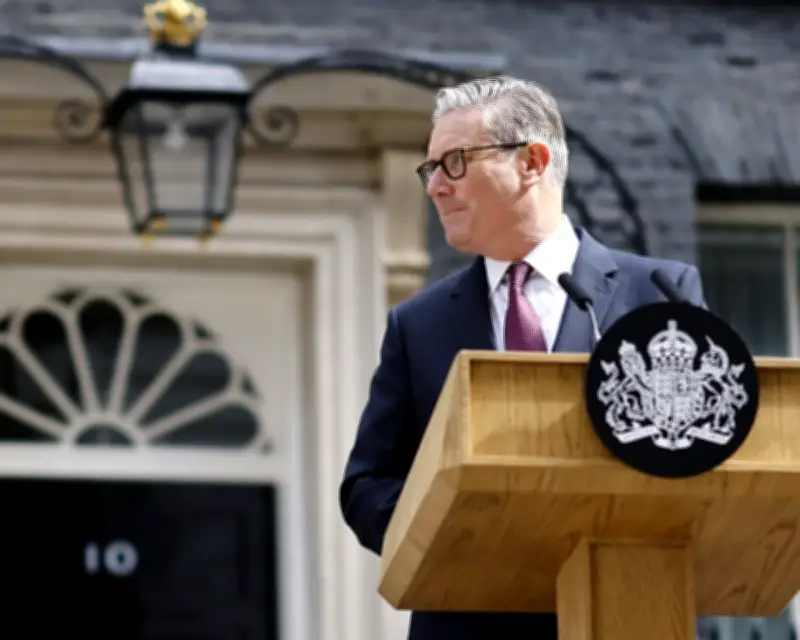
Keir Starmer has become the latest prime minister to fall victim to the poisoned chalice of high office in a post-Brexit Britain, as he made his resignation statement outside Downing Street on Monday. The spectacle has become a familiar ritual in a decade that has seen six prime ministers come and go, with the average tenure in Downing Street now less than two years since the 2016 referendum.
Brexit's Lingering Poison
While Starmer's own deficiencies—such as taking power without a clear sense of purpose and resenting the need to explain himself—contributed to his downfall, these weaknesses were cruelly exposed in the parched post-Brexit climate. Governing has become harder as resources were squandered on self-harming statecraft, disentangling the UK from the single market and building new systems to impede trade, burning through diplomatic capital and economic credibility.
The cost in foregone growth is estimated at 4% to 8% of GDP, representing how much richer Britain would have been on its pre-referendum trajectory. Beyond economics, the emotional toll includes a coarsened debate, radicalisation, and polarisation, with a movement that sold immiseration as liberation and blamed the losing side for refusing to indulge delusions.
The Referendum's Flawed Mandate
Brexit's manifestation through a referendum has been a complicating factor. Unlike ordinary elections, where results are conditional on performance and voters can change their minds, a plebiscite contains no promise of a next time. The supposed finality of the mandate was the leave side's trump card, with no volume of evidence able to puncture the assertion that living with the decision forever equated to non-negotiable fulfilment of popular will.
The scale of consequences was obscured by the ballot question and barely elucidated during the campaign. None of the grievances that mobilised the leave vote were ever going to be satisfied by losing EU membership. Making the country poorer and surrendering a seat on continental steering committees was not the way to "take back control."
Radicalisation and Scapegoating
This misdirection has led to ugly consequences, turning Brexit into a competition to define patriotic purpose. When the winners' stated goal led to a dead-end, new enemies were needed to sustain the cause. Nigel Farage is now exploring ever more vindictive ways to cast immigration as the cause of the nation's misfortunes, with racial animus that was once coded now unambiguous. Reform UK's housing policy promises to reverse "anti-white" bias, revoking settled immigration status for hundreds of thousands and making them eligible for eviction and deportation—a blueprint for ethnic cleansing.
Starmer's Failed Strategy
Starmer's inability to grapple with this radicalisation will be the sorriest part of his legacy. In opposition, he internalised the taboo on questioning Brexit, assuming former Labour strongholds were captured by the leave side. In government, this assumption fuelled creeping Faragism at the Home Office, replicating the doomed Tory strategy of trying to win voters back by amplifying Farage's arguments.
Though Starmer eventually found the right path after provoking fury with rhetoric resembling Enoch Powell's, his speech at last year's Labour conference—speaking of patriotism rooted in love and pride, contrasting with Farage's relentless negativity—failed to carry beyond the auditorium. He had no idea how to project it with sustained emotional resonance.
Andy Burnham's Potential
Andy Burnham, assuming he is the successor, starts with the advantage of a more natural storytelling manner. His parliamentary licence to be a candidate for the top job was earned in combat with Reform UK in Makerfield. But it will take more than narrative proficiency to drain the nationalist venom from the body politic. Communications failure starts with ill-designed policy, and authenticity flows from surety of purpose. Burnham could still get that wrong, but it helps that he knows who he is against.
Starmer came to power thinking he could put Brexit behind him, not seeing it as a competition between modes of national identity. The real sequel to the referendum is not an argument about the UK's relationship with the EU, but a battle to reclaim patriotism from the ideological movement that defines it with rage and racial segregation. It is a fight Burnham can win in a country where most people don't want to deport their friends and neighbours—and a fight he must win to beat the Brexit curse and stay in Downing Street long enough to achieve anything else.




