
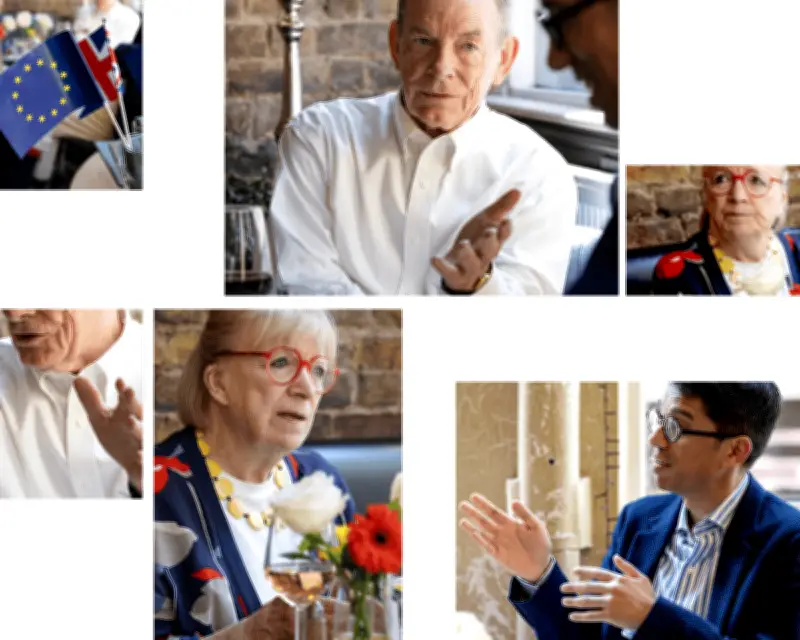
Ten years after the Brexit referendum, three Guardian columnists—Aditya Chakrabortty, Polly Toynbee, and Simon Jenkins—gathered to debate the legacy of leaving the European Union. They discussed whether the UK has become richer or more racist, and how the union is faring without us.
The Vote: Anger, Confusion, and Racism
Aditya Chakrabortty recalled three distinct memories from that period: the sense of anger, confusion in Westminster, and a quick curdling into base racism. He reported around south Wales and the north-east of England, then returned to London, noticing that one group talked about anger and frustration while the other discussed facts. On the morning of the vote, he woke at 4am to write and thought David Cameron would have to go quickly. At 6am, his editor confirmed Cameron would step down. That weekend, a friend in east London heard a man shout, 'We've got our country back, and now I'm going to burn down that mosque.'
Polly Toynbee spent referendum day at a Labour phone bank campaigning for remain. The group she was with phoned Nottinghamshire, and every call was 'Out, out, out. I want my country back. I want control. Get rid of the foreigners.' She saw it as the archetype of the remain-leave divide and how painful it was. She went to bed feeling terrible, despite confidence that it would be alright.
Simon Jenkins was initially against joining the EU, a Eurosceptic from the start. He saw the prospect of joining a bureaucratic common market versus being an international country. But once in, he moved to pro-Europe because he was slightly wrong about the EU, and the alternative was worse. On the day of the vote, he was in Germany at a conference at Humboldt University. European journalists and academics expressed deep concern about Britain leaving. Two of them said, 'You will be leaving us in charge,' making him realize Brexit was about the future of Europe, not just Britain.
The Deal: No Plan and Hard Brexit
Chakrabortty noted that leave campaigners—Michael Gove, Nigel Farage, Boris Johnson—had no clue what they would do. The Treasury and Bank of England, which worked on Project Fear, had no plan B. For years, the UK had no trade policy, no fiscal policy, and became easy to 'mug off.' Brexit was a highly technical decision.
Jenkins said ordinary people think politicians have plans until they realize they haven't a clue. He pleaded with believers to clarify what they needed—soft or hard Brexit—but they had no idea.
Toynbee blamed the double wickedness of leavers pushing for the hardest possible Brexit, partly because Johnson wanted to embarrass Theresa May. He went for the worst option, knowing nothing about what a hard Brexit would do. But she primarily blamed Jeremy Corbyn, who refused to join remainers in favour of a soft Brexit during critical votes.
Chakrabortty disagreed that Corbyn played a blinder, but noted Labour was exercised by the anti-establishment nature of the Brexit vote. Responding by getting together with Tories like Rory Stewart would not look good.
Attitudes to the EU and Migration Now
Jenkins found it encouraging that the debate has become more technical and less emotional. Some racism has gone; it's now about trade, student exchange, and food barriers—what it should always have been.
Toynbee noted that specific policies are viewed positively by the public. A recent poll asked, 'Would you swap freedom of movement for easier trade?' and the answer was yes. People have 'got it' that freedom of movement doesn't feel so bad, partly because the 'wrong' people from outside Europe came in after Brexit, contrary to expectations that it would end immigration.
Chakrabortty disagreed that the debate is less about race. One lasting legacy of Brexit is making extremism mainstream, especially on race. Farage sets the terms of political debate. People now routinely say stuff in Westminster that would have been ostracized ten years ago. The rightwing press publishes things bordering on hate speech. The Australian-style point system was meant to be the answer, but it brought people from the Commonwealth to work in social care, IT, and other industries. Now people say 'These are the wrong kind of people,' purely about skin colour.
Toynbee agreed, noting that care workers from Albania or Nigeria are viewed differently based on skin colour.
Our Future with the EU
Jenkins asked whether the UK should move to rejoin the EU or go forward bit by bit—rejoin the Erasmus scheme, sort out food-importing regulations—so that in two or three years, it has 'half joined.'
Toynbee hoped a new prime minister would say there are no red lines, negotiate as they go, and speak positively about the EU. She followed an industrial valve-maker in Bristol who had to change products from the European CE mark to a British one, then was told he didn't have to—an appalling experience.
Chakrabortty warned that tiptoeing back through laws feels anti-democratic, a charge remain lobbyists still face. A big study claims a 6-8% hit to GDP from Brexit, enormous given current arguments over 0.1% growth. The hit came from surprise and uncertainty for businesses. From a democratic and commercial point of view, the argument must be clear about what is being signed up to.
Jenkins said the case must be clear and debated in public. He hates public inquiries, but there ought to be a major research exercise asking what the arguments and economic predictions are—make it an argument about facts, then about negotiation.
Toynbee thinks it should be emotive stories about shops that shut, things people can identify with. Also, Russia is a dangerous enemy to Europe and the UK. She feels entirely vindicated by what they wrote in the Guardian: 'Don't do this, it'll be a terrible mistake—not just economic, but political, emotional, everything.' Now they are beginning to recover and can put that decade to rest.




