
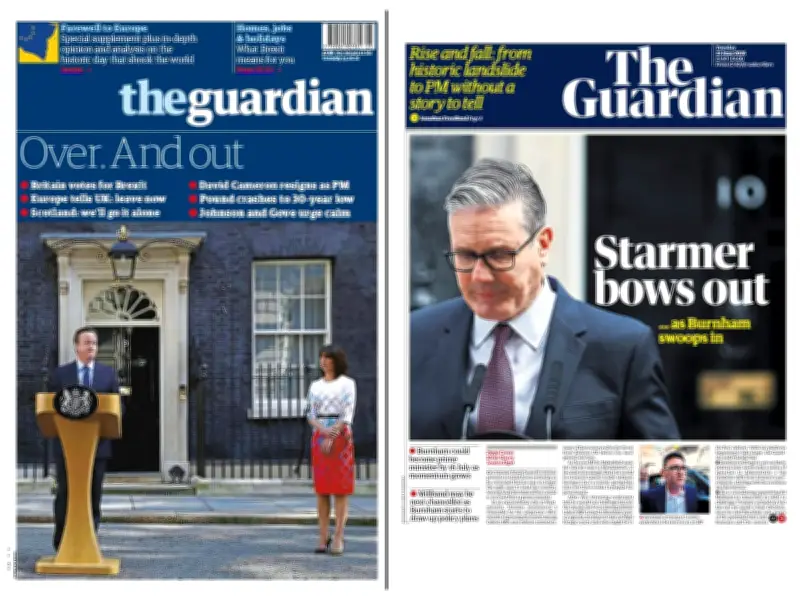
The resignation of Keir Starmer on Monday marks the seventh time a British prime minister has stepped down from the "podium of doom" in the past decade, a trend that began with David Cameron's resignation 10 years ago this week after the UK voted to leave the European Union. The Guardian's defence and security editor Dan Sabbagh, who was national news editor in 2016, reflected on the sense of deja vu and the ongoing political instability triggered by the Brexit vote.
A Decade of Resignations
Before 2016, departing prime ministers rarely used a lectern for their resignation speeches, and none had left office after only a few months. Cameron's resignation on June 24, 2016, was a shock to many, as he had been a dominant figure for six years. Since then, his successors have come and gone, none leaving from a position of strength. Starmer's resignation, while more dignified than Boris Johnson's "Them's the breaks" comment, similarly marked the end of the road for his premiership.
The Morning After the Brexit Vote
Sabbagh recalled waking up in the early hours to find the UK had voted to leave the EU. He took a taxi to work at 3am, picking up deputy national news editor Rebecca Allison on the way. The newsroom was fully staffed by 4am, with senior journalists and editors grappling with profound political uncertainty. Cameron's resignation at 8.15am came after a night of nervous exhaustion. The Leave campaign leaders, Boris Johnson and Michael Gove, held a press conference at 11am looking "shell-shocked," with no clear plan for implementing Brexit.
Constitutional and Emotional Turmoil
The immediate aftermath of the vote raised questions about Scotland's future in the UK and the potential reopening of tensions in Northern Ireland, threatening the Good Friday Agreement. Sabbagh noted that the murder of Labour MP Jo Cox a week before the referendum had shocked the nation, with some believing it would sway voters against Brexit. However, Nigel Farage's victory speech eight days later declared Brexit had been achieved "without a single bullet being fired."
The Role of Disinformation and Slogans
Sabbagh highlighted the effective use of simplistic slogans like "take back control" and the claim of saving £350m a week for the NHS. While there was no immediate sense of an online disinformation campaign, later analysis revealed the manipulation of social media by right-wing actors. The Oxford Dictionaries' word of the year for 2016 was "post-truth," reflecting the changing political landscape.
Normalised Dysfunction
Sabbagh concluded that Brexit has not delivered the promised economic growth, leaving the country with pent-up frustration and unstable politics. Each prime minister since Cameron has become the most unpopular in history, with Nigel Farage remaining a persistent background figure. "Brexit represents a kind of faultline in British history," Sabbagh said, "We've traded away a much more stable politics for a messy panoply of resignations."




