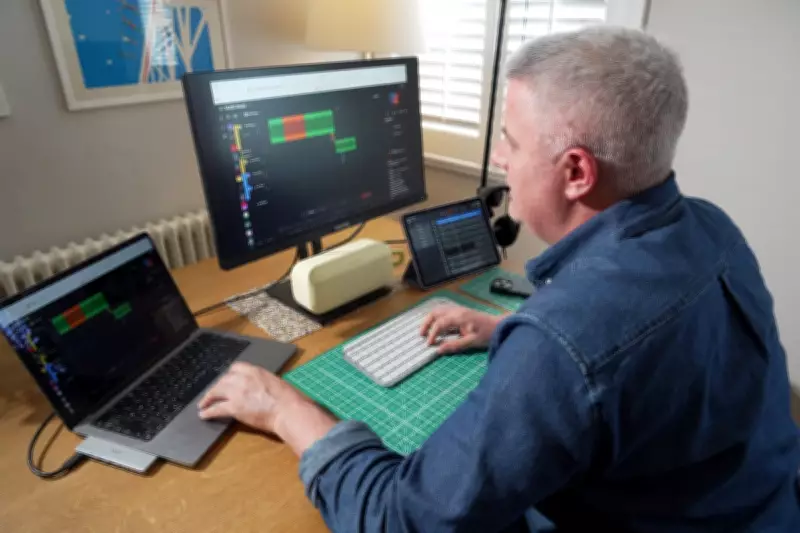
London-based singer-songwriter Samuel Smith has turned to artificial intelligence to sustain his musical career after Parkinson's disease severely affected his ability to play the guitar. Diagnosed with the progressive neurological disorder in 2020, Smith recently released his second album, The Art of Letting Go.
AI-Powered Creativity
For the instrumental track "Horizon," Smith employed AI music generation platforms to craft demo arrangements. These digital sketches were vital for conveying his artistic vision to the musicians who eventually recorded the song. His process involved humming melodies into his phone and uploading them to AI generators like Suno and Udio. Smith stressed that these AI-generated demos were strictly for guidance and not intended for the final studio version.
The shift to AI became essential as Parkinson's symptoms—tremors, stiffness, and fatigue—progressively hampered his guitar skills over the more than a year he spent on the album. "So then I'm faced with a question: Don't play, don't be creative, or find a way out, find a route. And for me, this was the route," the 49-year-old artist said.

Divided Industry
Generative AI has split the music industry, with artists and labels suing companies like Suno and Udio over copyright concerns. Sony Music, Universal Music Group, and Warner Records filed lawsuits in June 2024, though Universal later settled and partnered with Udio, and Warner did the same with Suno. Less discussed is how these platforms can aid serious musicians like Smith, whose disease affects the hands—central to his songwriting and identity as a guitarist. He released his debut album, In the Springtime, in 2023, hoping to leave a legacy for his two sons.
"I'd always written, I'd also played, I always sang. And immediately it became clear to me that I was in trouble, that my music was going to be seriously compromised," Smith recalled.
From Prompts to Convincing Demos
AI music generators analyze patterns in melody, harmony, and rhythm to create audio from prompts or uploaded recordings. Users need not be musically talented to produce a serviceable song. Smith noted that crafting convincing demos often required "50, 100, 150 attempts" and extensive editing "to get something that sounds close to my music." After humming a tune into his phone, he provides prompts describing instrumentation, mood, and style.
"AI is not replacing anything for me. It's unlocking, it's enabling. It's allowing me to keep writing. I upload my lyrics; AI doesn't create my lyrics. I upload my music; AI does not create my music," he explained. "It then brings it to life in a way that I can play to session players and say, 'Here, that's what I'm thinking, that is what I'm hearing.'"
A Bittersweet Guitar Duet
The album was produced by Grammy-winning pianist Matt Rollings, who assembled renowned roots and bluegrass musicians, including dobro player Jerry Douglas, banjoist Alison Brown, fiddler Stuart Duncan, guitarist Bryan Sutton, bassist Viktor Krauss, and singers Jonatha Brooke and Glen Phillips. For Smith, singing in a Nashville studio alongside these legends was "an extraordinary moment." Grammy-nominated guitarist Julian Lage performed on the title track and "Horizon." The latter became a bittersweet highlight: despite his disease, Smith managed a guitar duet with Lage. "I hadn't been able to play for months, but I kept telling myself that if I wrote something to take to the studio, perhaps the clouds would part for a few minutes," Smith said. "That's what happened. I had a window of about 10 minutes in the studio when my arm freed up. ... So in the end, I was able to capture the last breath of my guitar playing."

New Possibilities and Perils
Experts believe AI-assisted music tools could benefit others with disabilities. Ruaidhri Mannion, a composer and lecturer at Brunel University of London, noted that affordable digital recording software has "democratized the making of music" in recent decades. AI tools that generate polished material from voice or text prompts could similarly help songwriters communicate ideas and collaborate. "If these tools enable people to participate with other creative groups and encourage more confidence to reach out to an ensemble or orchestra, then that is all for the better," Mannion said. However, he warned that overreliance on technology might hinder the trial, error, and synergy vital to artistic development. "What makes a lot of music-making meaningful is the collaborative element. There's a lot of experimentation and development and failure that's part of musical discovery."
Udio and Suno have denied copyright infringement claims, stating they want to work with the industry. Yet some musicians remain skeptical. A group including singer-songwriter Tift Merritt, David Lowery, and Blake Morgan published an open letter in February headlined "So no to Suno." "Many in our community are embracing responsible AI as a tool for creation and for fans to explore our artistry. That's wonderful," the letter read. "But it's not the same as creating an environment where AI-generated works sourced from our music are mass distributed to dilute our royalties or reward those seeking to commit fraud. Artists need to know the difference."
'Show Us What You Can Do'
Smith believes his experience demonstrates how AI can benefit society and expand creative access if developed responsibly. "My message would be that if these companies want to show they've got a place, a role in society, then step up. Engage with health professionals, engage with music therapists, engage with society and show us what you can do," he said. On May 21, Smith collaborated with the Berklee Music and Health Institute for a New York event examining music's role in supporting people with neurological conditions. He discussed his Parkinson's journey and sang with musicians from The Art of Letting Go.
Creating music is crucial to the legacy Smith hopes to leave for his children, ages 4 and 17. "My 4-year-old is probably never going to remember me playing, and it's heartbreaking," he said. "But I've been able to pull this into something and refuse to be defined by this disease."