It was the first day of spring this year. Jonathan Oldfield was topless, face-down on a foldaway travel table, as the masseuse uttered six words that brought his attempt at relaxation to an abrupt end: “I think your arm is haunted.”
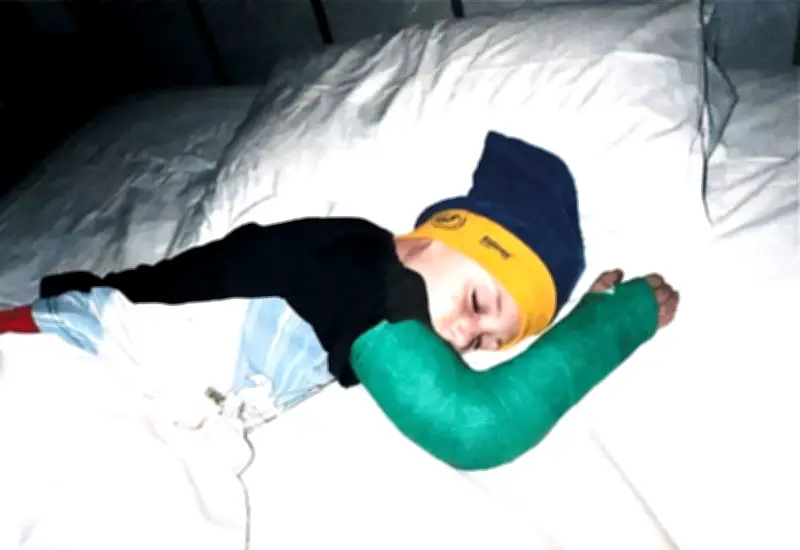
Oldfield has broken his right arm seven times: seven breaks on seven separate occasions. Some years, his arm was in a sling more than it was out of one. The novelty of getting friends to cover his cast in that 00s graffiti “S” and the relief of missing the bleep test at school quickly wore off.
The Seven Breaks
Oldfield’s arm-breaking debut came in 2002, when he was eight and fell off his bike. The second time, he fell off a trampoline. The third time, he jumped off a swing and into his younger brother. Then he was pushed off a bed by his eldest brother. The fifth time, he was playing hopscotch with the girls next door a little too vigorously and fell flat on his face (and arm). For number six, most agonisingly, surgeons deliberately re-broke his arm under anaesthetic because the previous operation had set it incorrectly. The final time was in Paris in 2007, when he was 13. Playing football, he went to head a ball and fell, hard. Before the pain hit, he stood up and said to his coach: “I think my arm’s broken.” By then, the dull ache of ruptured bone felt familiar, but it didn’t take a doctor to see that his wrist was six inches away from where a wrist should be.

Oldfield grew up in different countries for most of his childhood, living across South America, Asia and Europe before moving back to the UK. His parents, language graduates with a severe case of wanderlust, kept travelling and he moved with them. He experienced some of the planet’s greatest cultures and cuisines, but also some of its worst orthopaedic departments.
The Haunted Arm Revelation
Oldfield hasn’t broken his arm for almost 20 years now and rarely thinks about those days of contorting his body like a gymnast to shower without getting his cast wet (top tip: put your arm in a plastic bag). Or of losing a chopstick under the cast after trying to scratch a hidden itch (another tip: metal or plastic chopsticks work best; wooden ones tend to snap and leave splinters).
He asked the masseuse what she meant by “haunted” and she explained that, in some cultures, a repeated injury to the same part of the body could be interpreted as your ancestors trying to contact you. Your ancestors are trying to teach you a lesson, and they are repeating it until it’s learned. “You seem a little tense,” she added, giving him the phone number of someone who could exorcise the arm.
Instead, Oldfield rang his parents and jokingly asked if there was any reason an ancestor might be haunting him. His mother said his great-great-grandfather lost his right arm in the first world war. In a rehabilitation camp back in the UK, he learned woodwork and weaving; he made a stool that Oldfield used to sit on as a boy. “What would he be wanting to tell me?” Oldfield asked. “I think he’s telling you to collect all your stuff from our shed,” his father piped up, “because it’s taking up a lot of space.”
Listening to the Body
In the weeks that followed, Oldfield told the haunted arm story at the pub with a smirk. But when he was alone, he found himself reflecting on it more seriously. He didn’t feel as if he was haunted by a first world war soldier, but perhaps he was haunted by the raw and intense experience of repeatedly breaking a bone during childhood. Each time the plaster cast was removed, he would ignore the lingering dull ache, or the small voice telling him to wait another week, and within days he’d be back on his bike, or on the trampoline or annoying his brothers. He ploughed on, pushing through the discomfort. He learned how to play squash. He learned the drums. He even mastered the diabolo.
But to this day, whenever he is sick or stressed, his arm hurts first. When he got Covid for the first time, he Googled whether pain in the right arm was a symptom. On holiday last month, he went up the Eiffel Tower, and as he leaned over the edge, he swears his arm felt the fear before his brain did. And when he comes home after a long day, he sometimes finds himself subconsciously cradling his arm, as if it’s in a sling.

Perhaps ignoring what his body has been through, what it is “haunted” by, has caused him greater pain in the long run. Maybe thinking of himself as simply “unlucky” was a convenient way of not admitting that, somewhere around break number four, he had stopped trusting his body.
Since being told his arm is haunted, Oldfield has become more interested in listening to what his body remembers than ignoring what his mind wants to forget. These days, when he is run down or finds the ache starting to creep in, he treats it as a sign to slow down and remain cautious. It is a useful reminder to take it easy. With that in mind, he hasn’t called in the arm exorcist yet.
Jonathan Oldfield: Exquisite Corpse is at the Edinburgh festival fringe, 5–30 August.