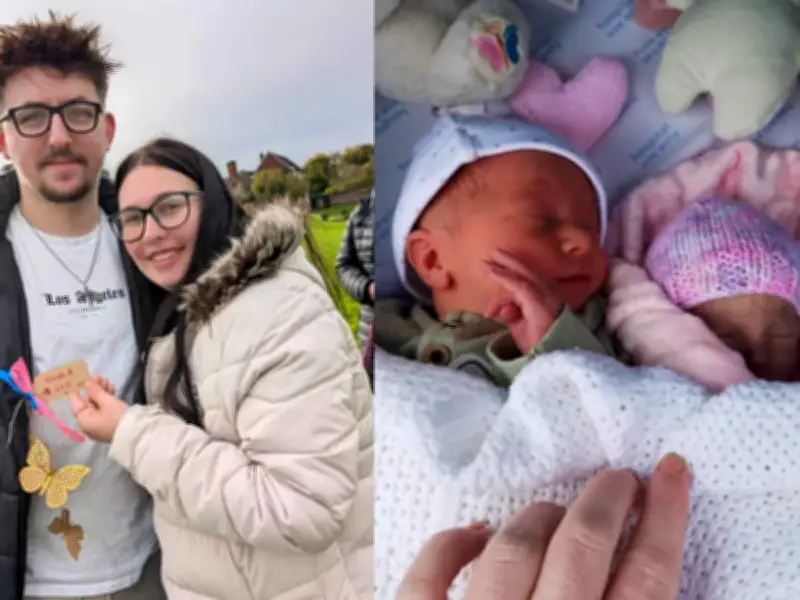
Twins Evie and Noah, born in April 2024, died three weeks apart from separate conditions. Their parents, Jasmine Wheaton, 24, and Matt Snook, 25, from Basingstoke, Hampshire, are now speaking out to raise awareness.
Evie's Death from Edwards' Syndrome
Jasmine gave birth to Evie and Noah via C-section on April 15, 2024. Evie died one hour and 39 minutes after birth due to Edwards' syndrome, a rare genetic condition that currently cannot be cured, and associated heart complications. Doctors had told the couple that Evie had a high potential of passing away in the womb.
During a pregnancy scan, fluid was noted around the back of one baby's neck, indicating a possible syndrome. An amniocentesis confirmed Edwards' syndrome, also called trisomy 18, a week later. The couple decided to proceed with the pregnancy, and Jasmine reached 37 weeks.
Noah's Death from Group B Strep
Noah became unwell at 15 days old, feeding poorly and appearing pale. After admission to hospital, he was transferred to John Radcliffe Hospital in Oxford, where tests confirmed group B strep sepsis. Meningitis was suspected after seizures developed, and Noah had suffered severe brain damage. He died at 21 days old on May 6, 2024, due to late-onset group B strep (LOGBS) infection.
Before the pregnancy, the couple said they had not heard of group B strep, a type of bacteria called streptococcal bacteria, and were unaware that testing was available. They now want to ensure other parents are aware and do their research.
Support for the BEATRIX Study
The couple are supporting the BEATRIX study, the first large-scale phase three vaccine trial in the world for group B streptococcus (GBS). It is supported by the National Institute for Health and Care Research (NIHR) and sponsored by Pfizer, and is being developed by researchers from the NHS and UK universities, alongside international partners.
Jasmine said: "We just want to raise awareness because we didn't know about (group B strep) and it was so fast. Doctors said we couldn't have acted any faster if we tried, and it was still too late, so we just want to try and get it out there as much as possible. Hopefully, we can try and prevent it from happening again to other people."
Matt added: "I think about the twins every day... and everything we do is in their memory. I'd say just do your research and get some knowledge behind you because that's not what we had. It wouldn't have altered the outcome no matter how much we knew... but people need to understand what's out there and how it can affect people during and after pregnancies."
For more information on the vaccine trial or to take part in clinical research, visit the NIHR's Be Part of Research Service online or through the NHS app.