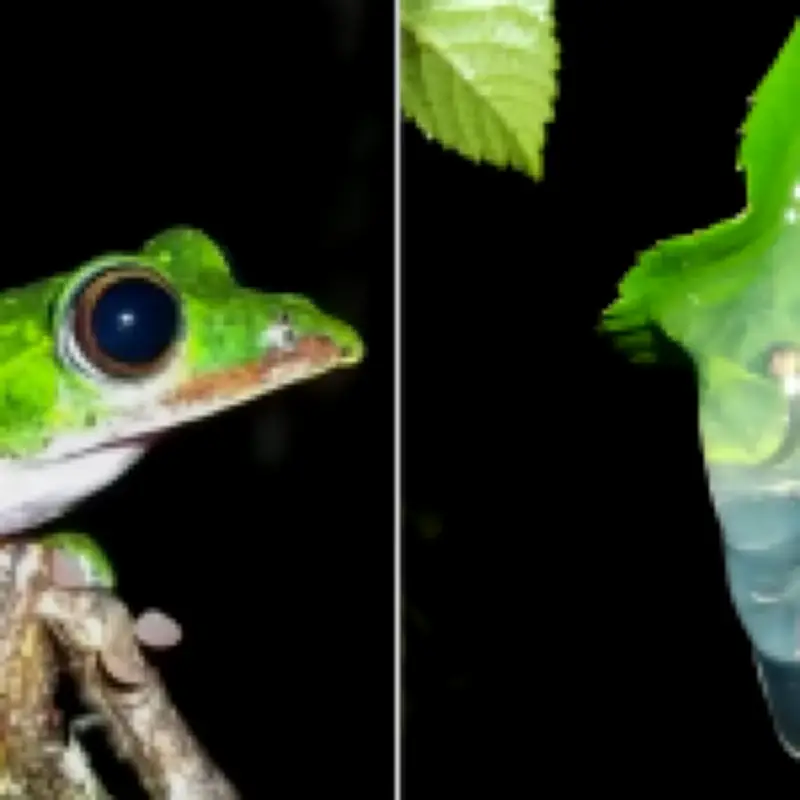
A tiny Asian flying frog with unusual egg-laying habits, named Rhacophorus kurniatiae, has been discovered in Sulawesi, an island near Borneo, Indonesia. Scientists from Bogor Zoology Museum and the University of California, Davis, identified the new species after surveying the region's mountainous wildlife.
Discovery in a Seasonal Mountain Lake
During surveys conducted from 2009 to 2013, researchers waded through rivers and camped during lightning storms. They spotted the frogs at Danau Coca-Cola, a seasonal mountain lake, where thousands of the frogs live more than 6,100 feet above sea level. The frogs have pointed snouts and giant webbed feet that allow them to glide from tree to tree.
Co-author Alan Hitch, a research affiliate with the UC Davis Museum of Wildlife and Fish Biology, said, 'You don't really see frogs in big congregations like that. This was something super special.'
Unusual Egg-Laying in a Gelatinous Matrix
Unlike other shrub amphibians that lay eggs in foamy nests in water, Rhacophorus kurniatiae lays its eggs in a 'gelatinous matrix,' according to co-author Alamsyah Elang Nusa Herlambang, a researcher with Museum Zoologicum Bogoriense. The frogs deposit a blob of clear jelly that dangles off a leaf overlooking the remote lake, with tadpoles visible inside after a few weeks.
'It's unique,' added Herlambang.
A Cryptic Species Named in Honor
To confirm the frogs were not one of the other 40 Rhacophorus species, the team examined 28 physical traits, DNA, and calls. Andrew Engilis Jr., curator of the UC Davis Museum of Wildlife and Fish Biology, described Rhacophorus kurniatiae as a 'cryptic species'—genetically distinct despite looking and jumping like most flying frogs.
Indonesian scientists named the species after the late Hellen Kurniati, a herpetologist. Hitch said, 'She had a heart of gold, and I think that's part of what drove her to do such great work.'
Conservation Implications for Sulawesi
Most creatures on Sulawesi are endemic, found nowhere else on Earth. Rhacophorus kurniatiae is the second new frog species discovered by the researchers, who also found worms with whip-like tails, fish with lanky snouts, and the gecko Cyrtodactylus hitchi.
'When you're a conservation biologist, your ultimate goal is conserving biodiversity,' Engilis added. 'As a result of all the work we did in defining the Mekongga's unique diversity, including these new species, this region of Sulawesi is now under consideration to become a national park.'