
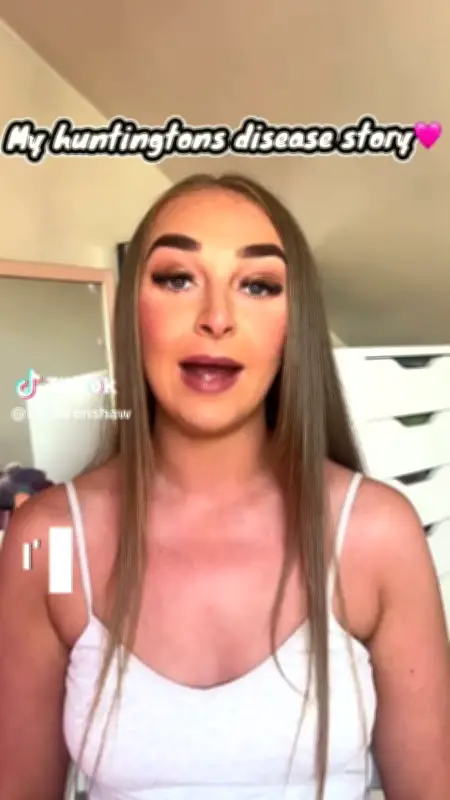
Farah Renshaw, 24, from Salford, Greater Manchester, has tested positive for Huntington's disease, the inherited brain disorder that killed her nana, auntie, and father. Instead of despair, she felt an overwhelming sense of relief at finally knowing her fate.
A family shadow
Growing up, Farah knew her family was different. Her nana couldn't speak or move, and no one explained why. As she got older, she learned that her nana and auntie had Huntington's, losing their fights in 2008 and 2011. When Farah was ten, her parents told her that her dad would become unwell like them.
Huntington's is a rare, inherited brain disorder that destroys nerve cells, robbing sufferers of movement, speech, and independence. Over 17 heart-breaking years, Farah watched it take her nana, her auntie, and ultimately her dad, who died in December 2024.
The 50/50 chance
From the beginning, Farah's parents were honest with her and her brother Louis. They explained that each child had a 50/50 chance of inheriting the fatal gene, and they would never know unless they chose to be tested when older.
For years, uncertainty hung over Farah's life. A year and a half after losing her dad, she decided to get tested. At 9.30am on May 26, at Saint Mary's Hospital in Manchester, doctors confirmed she had the gene. She said: "The constant like wondering, 'oh, what if, what if,' and not knowing has been worse for me than finding out. I know that sounds really daft. I think unless you like have been through something similar, it's hard to understand like that that's how you would feel."
Childhood in the shadow of Huntington's
Her father was the youngest among his siblings, so his symptoms emerged while Farah was young. By the time she was ten, he received his official test results, coinciding with his sister's death from cancer in 2011. Farah recalled: "My mum told me to go and sit with my dad, because they were sat on like opposite couches. And they basically just explained that he was going to be like my aunties and how my nana was. They didn't say like it's Huntington's disease because I was only 10."
During her teenage years, her dad's condition deteriorated, especially during COVID-19 lockdowns. Farah and her mother became primary carers, planning nights out around each other to ensure someone was home. Eventually, it became unsafe for her father to stay at home, and he moved to a care facility in August 2024.
Harder than death
Farah said: "Putting him in the nursing home was harder than when he passed away. It was absolutely dreadful. The guilt around it was awful." Yet the move allowed the family more quality time together. On 23 December, her father died suddenly aged 55 from aspiration pneumonia, a common complication for Huntington's sufferers. Seeing him at peace gave Farah closure: "He was so still, and he just looked like he was asleep. It was the most at peace I'd seen him for years and years, because his movements were so extreme. It was just really peaceful."
Testing and raising awareness
In the UK, children of parents with Huntington's can choose to be tested after turning 18, with support from a specialist counsellor. Farah began the process in May 2024 but put it on hold due to her father's care and death. She returned to complete her final appointment in May 2026. She is now awaiting a referral to the Huntington's team and will opt into clinical trials.
Farah is using social media to raise awareness. She said: "I think Huntington's disease is one of the cruellest diseases that there is on the planet. I think it's a mixture of like Alzheimer's, MS, motor neuron disease and Parkinson's as well. It's a mixture of all of those diseases put into one cruel disease, and you've got this short life expectancy and the potential of passing it on to your children."
Her TikTok video about her testing decision has been watched more than 200,000 times, with hundreds sharing their experiences. She said: "I was really nervous posting that first video... But I just thought, 'Oh it really doesn't matter as what as the impact I can have on other people.' So yeah, that's why I've decided to do it, and honestly, I did not imagine the reaction that I've had. I feel so lucky and grateful."




