
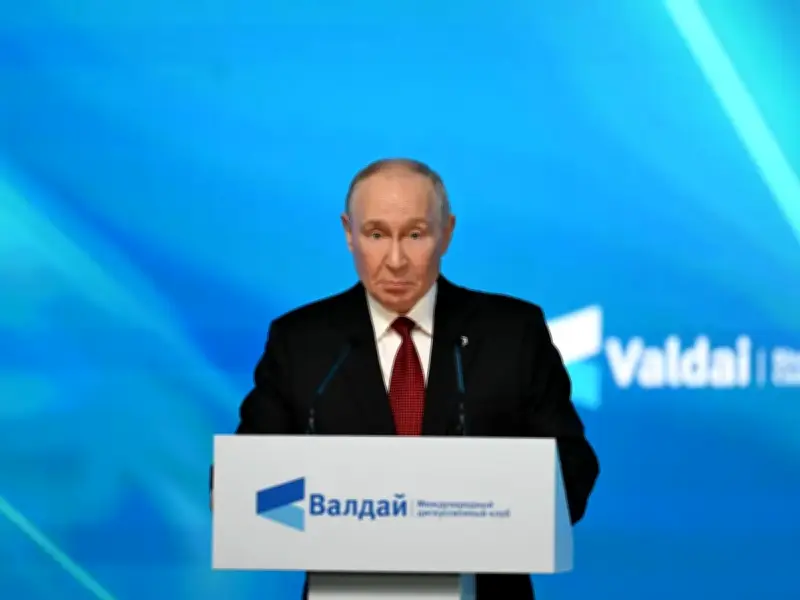
Russia's latest draft federal budget has earmarked approximately 2.1 trillion rubles (£19bn) for longevity research, prompting a Russian expert to claim that Vladimir Putin is planning to live forever. The allocation appears in the government's Draft Federal Law covering the budget from 2027 to 2029, as reported by The Daily Beast's Allison Quinn.
The funds are designated for the "Long and Active Life" initiative, championed by the Kremlin, which seeks to prolong human lifespan to 120 or 150 years. The programme also aims to preserve approximately 175,000 lives by 2030 through treating biological ageing as a governmental priority.
Putin's Immortality Ambitions
Putin, 73, was overheard on a hot microphone last year discussing immortality with Chinese leader Xi Jinping. He remarked: "With the developments of biotechnology, human organs can be continuously transplanted, and people can live younger and younger, and even achieve immortality."
Speaking on The Daily Beast's YouTube channel, Allison Quinn revealed: "What I will say, another reporter came out today, and this is kind of funny. I think Putin's planning on living forever. The new budget came out and there's an increase in the amount of money for research into longevity and this is all for Putin. The reporters discovered that he's asking for I believe a few trillion rubles for his efforts to stay alive forever."
Research Casts Doubt
Following Putin's remarks, Russian journalist Mikhail Rubin told the Guardian that it demonstrated longevity was amongst his primary preoccupations: "That suggests the Russian president is preoccupied with his health and longevity. I believe Putin dreams of ruling for many more years, and places great hopes on the progress of modern medicine."
However, specialists at the Brigham and Women's Hospital in Boston conducted research into heart transplants in mice alongside tissue specimens from cardiac transplants. Results published at bioRxiv revealed that once a heart had been transferred from a younger body to an older recipient, it gradually adopted the biological age of its new host.
Jesse Poganik, one of the specialists conducting the research, explained: "The environment of the transplanted organ really dictates how it seems to behave biologically." The research also indicated that remaining organs throughout the body were largely unimpacted by the new organs' introduction, undermining Putin's hypothesis. The study demonstrated that ageing is not a straightforward process of merely growing older and it's not akin to fitting new parts into an old car.
Mr Poganik added: "There are aspects of biological age that are probably reversible, and there are aspects that are probably not."




