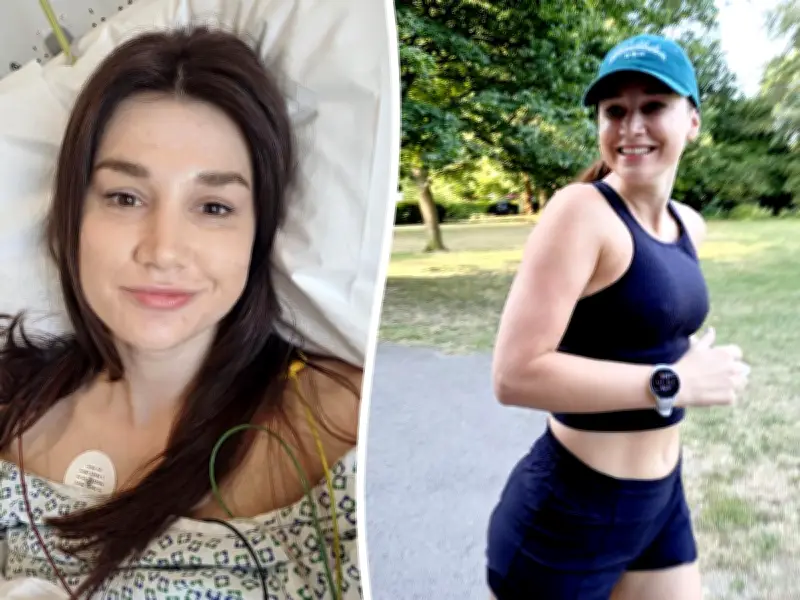
Denisa Fraser, 33, from Horsham, West Sussex, spent years dismissing her dizzy spells as being too unfit or stressed. But after a free workplace health assessment, she was diagnosed with Wolff-Parkinson-White syndrome, a rare heart rhythm disorder, and a large coronary sinus diverticulum, a rare pouch in a vein of her heart.
Diagnosis and symptoms
According to the NHS, the main symptom of Wolff-Parkinson-White syndrome is suddenly getting a very fast heartbeat, which can last from a few seconds to several hours and usually stops by itself. Other symptoms include a fluttering feeling in the chest, a pounding or racing heartbeat, feeling dizzy or faint, shortness of breath, or chest pain or discomfort.
Denisa, originally from Czechia, said: "I genuinely thought everyone felt like that. I thought it was just going to be an MOT because I considered myself healthy. I do yoga, I went to spin classes and I'd started running, so I didn't think anything bad or sinister would happen. When I ran though I struggled. I'd feel faint and my heart would race. I just thought I wasn't fit enough or that I needed to train harder."
Pushing through symptoms
She would feel dizzy and faint every time she ran, and experienced episodes where her heart would suddenly race, sometimes into the hundreds. At work, she assumed the palpitations were caused by stress and thought these were symptoms everyone experienced.
Thinking she just needed to improve her fitness, Denisa pushed herself harder by running more often and even taking cold plunges to lower her heart rate. But after a free workplace health assessment highlighted an issue, she underwent further investigation.
Treatment and recovery
During a procedure expected to last around 30 minutes, doctors triggered one of Denisa's abnormal heart rhythms within minutes, sending her heart rate soaring to 260 beats per minute. She was kept under general anaesthetic for more than three hours while further investigations were carried out. This is when she was diagnosed with Wolff-Parkinson-White syndrome, and the rare pouch was also discovered, meaning the procedure could not be safely completed at that time.
Three weeks later, she underwent a second operation lasting eight hours to map and treat the abnormal heart rhythm. Although the first few days of recovery were difficult, she soon noticed dramatic improvements. She said she could now exercise without her heart racing uncontrollably, breathe more easily, and felt noticeably calmer throughout the day.
Warning to others
Denisa, a procurement manager, said: "The recovery after the second surgery was quite rough because it was such a long operation, but after the first week things improved really quickly. The biggest difference is that everything feels calmer. I breathe better, my heart rate is lower and even at work my body's physiology is calmer. I didn't realise how much I'd been living with until afterwards."
She now urges others not to ignore persistent symptoms or assume they are part of everyday life. She added: "I didn't realise how much I'd been living with until afterwards. If you're offered a health check, just do it. Don't assume you're not in the risky category because you're young or active. I think a lot of women put symptoms down to stress, hormones or their period and just carry on. I was putting so many symptoms down to not being fit enough when actually there was something wrong. I wasn't hiding symptoms from anyone. I genuinely thought this was just how everybody felt because I'd been born that way."