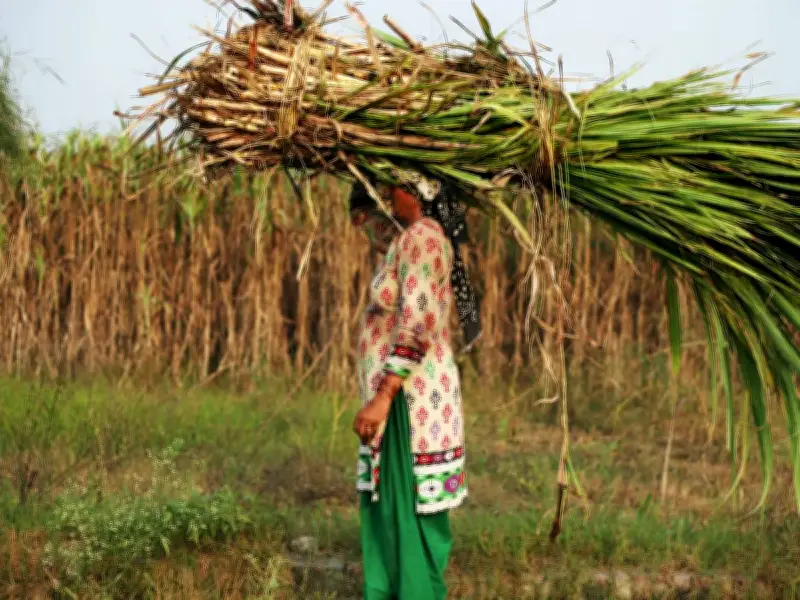
Female sugarcane cutters in India are reportedly being pressured to undergo hysterectomies to keep their £3-a-day jobs, according to workers who described feeling compelled to sacrifice their health to continue earning.
India is the second-largest producer of sugarcane globally, but the demand comes at a brutal cost for some women. An estimated 1.5 million people cut sugarcane across the country, often working 14-hour days for as little as ₹400 (£3). Working in pairs, usually husband and wife, they labour from early morning until night, stopping only to load the harvested cane onto trucks.
Harsh Conditions and Debt
With few employment opportunities at home, many turn to the arduous work to feed their families. Some travel more than 500km from their villages, spending months in makeshift camps without toilets or clean water. For female cutters, managing their periods in those conditions adds another painful challenge.
Missing a single shift can mean losing wages and facing a fine, leaving some feeling obliged to undergo hysterectomies - surgery to remove their wombs - so they can keep working. Contractors arrange workers’ travel and provide an advance, which couples must repay by harvesting an average of three tonnes of cane a day. Each pair works within a group of seven or eight couples, with others charging a fine when a woman cannot work.
Workers' Accounts
Poornima, a worker considering the operation in the hope of easing her suffering, said: “My suffering isn’t reducing. If I continue this work, it’ll only grow. If I can stop lifting such heavy weights, maybe it’ll be better. But we don’t have an option other than to do this job.”
She told The Independent: “We never have a day off. Once we arrive here, it’s constant work every single day for the next four to five months. Even removing my own uterus requires taking on debt. It feels like my body itself has become a slave to the system.”
Cane cutter Savita underwent a hysterectomy in March 2025. She said: “Nobody helps you [on the fields]. They don’t let you rest at all. I was so sick yet no one helped me. My stomach hurt, I couldn’t climb the ladder to load onto the truck; I fell thrice last year while doing that, yet I couldn’t complain.”
Medical Concerns and Denials
Despite the surgery, she explained she is still bleeding and in greater pain over a year later. She claimed she travelled to Pune, where she was told she had an infection, but was refused her surgical reports when she asked for them.
She said: “I trusted them (the doctors), thinking the hysterectomy would actually help, so I agreed to get it done and end all the misery in one go. I’m still in immense pain but nobody had warned me of this before at all.”
Dr Neelam Gorhe, a politician whose 2019 report highlighted high rates of unnecessary hysterectomies, has worked on women’s welfare alongside activist Sangita Chavan. Sangita said some women were pressured to visit private facilities where operations were performed without adequate clinical justification. Government-appointed Accredited Social Health Activist (ASHA) workers help women in rural India access public healthcare.
However, Sangita claimed she had spoken to some ASHA workers who admitted being paid to refer women for hysterectomies. ASHA worker Ganga Shevante denied that workers received financial incentives and said she had never been paid to make such a referral. She said she did not recommend private clinics, but “certain families who are able to afford private clinics turn to those for consultation, rather than the public hospitals we recommend”.
Contractors' Response and Government Action
Sugarcane contractors said they did not force anyone to undergo surgery. However, they also said they did not allow paid days off because fewer workers meant less cane to fill the trucks. Local sugarcane workers’ contractor Ashruba Datta said: “Our wages depend entirely on the weight of the harvest we bring to the factory. If we get more labourers, our tractor earns well. If we have fewer labourers, we can’t force them to lift more weight just to compensate for the missing people.”
In 2019, a Maharashtra government committee surveyed 82,309 women in Beed who had migrated for sugarcane harvesting. It found 13,861 had undergone hysterectomies, with more than 45 per cent of those women later reporting physical or psychological distress. The government subsequently introduced measures intended to monitor hysterectomies and improve conditions for migrant workers. However, The Independent reported that a follow-up report due in November 2025 had yet to be published.
Poornima, who said she spent ₹50,000 (£395) a year on pain relief, described her pain as “unbearable”. She added: “I have to get the surgery done when I return to my village, but that requires borrowing more money. It feels like the system has claimed my very womb just so I can keep working.”
Coca-Cola told The Independent it had partnered with international civil society organisation Solidaridad to improve access to clean water, sanitation, shaded rest areas, ergonomic tools and feminine hygiene products. The company said 100,000 people had benefited from the partnership.