
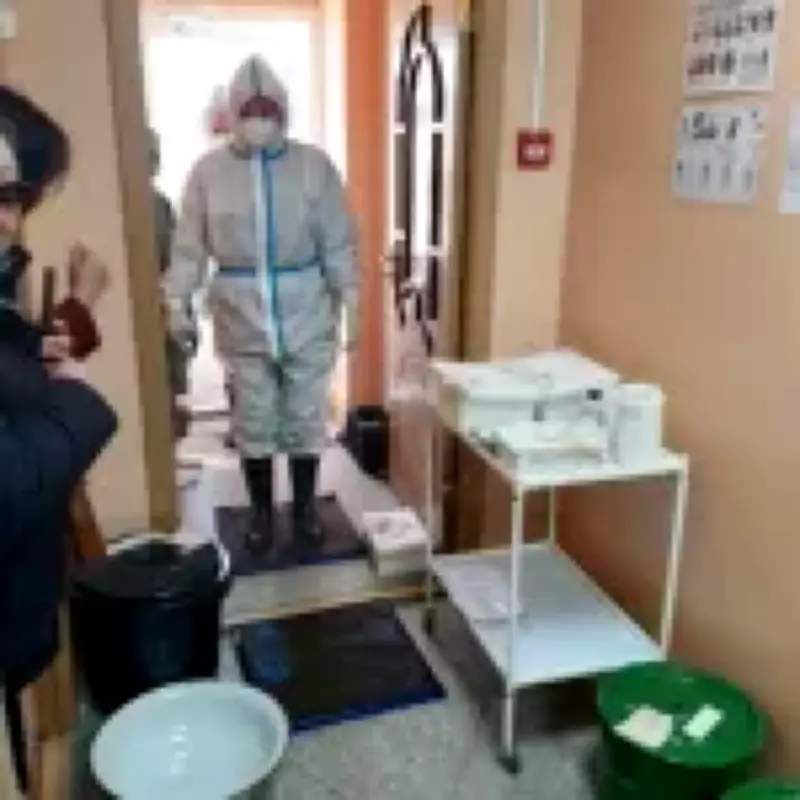
Russia's government has been accused of covering up an outbreak of plague in Siberia that has killed one person and forced 189 others into quarantine. Reports say the country's chief infectious diseases doctor, Anna Popova, has travelled to Irkutsk to take charge of the situation, with public events cancelled across the region.
Outbreak linked to laboratory assistant's death
Officials ordered residents of neighbouring Baikalsk to avoid travelling to Shelekhov, where the outbreak is reported to have taken place, although the message was later deleted. There are also claims that antibiotics in the region have sold out.
The outbreak is linked to the death of a laboratory assistant, Daria Shipilova, at the Irkutsk Anti-Plague Research Institute. Some reports claim the 28-year-old fell ill while on an expedition on the border between Russia and Mongolia, while others say she was infected at the Institute after 'breaking a test tube'.
Quarantine and official response
She is said to have died at Shelekhov District Hospital, which is now under quarantine, along with the Institute, with a total of 189 people under lockdown. Governor Igor Kobzev said mass events had been cancelled following a 'particularly dangerous infectious disease'.
Russian news outlet Mash said: 'Doctors and Rospotrebnadzor [Russia's public health watchdog] are investigating the circumstances of the infection and carrying out anti-epidemic measures.'
Criticism and comparisons to Wuhan
News of the outbreak was posted in Telegram channel Nezygar, which compared the authorities' reaction to those of China when Covid broke out. 'The situation in Shelekhov, Irkutsk region, where a plague quarantine has been declared, resembles the Wuhan case,' it said. 'An employee of the Irkutsk Research Anti-Plague Institute, Shipilova, broke a test tube containing pathogens while at work, after which she left the laboratory and travelled home to Shelekhov.'
Russian epidemiologist Mikhail Favorov, who now lives in America, criticised authorities for their response and for allowing 'a lot of nonsense' to circulate. 'Someone working at the anti-plague institute in Irkutsk wears a protective anti-plague suit,' he said. 'If you break a test tube, the likelihood of infection is actually very low.'
'The story about the test tube? It's laughable. It's not as if the plague just flies out of the test tube, after all. That's not how it works. In short, it doesn't matter to the general public. They'll believe the "dropped test tube" story.'
Popova's presence in Irkutsk meant it is a 'terrible, critical situation', he said, adding that a cover-up was underway and 'we will not be told what really happened'.




