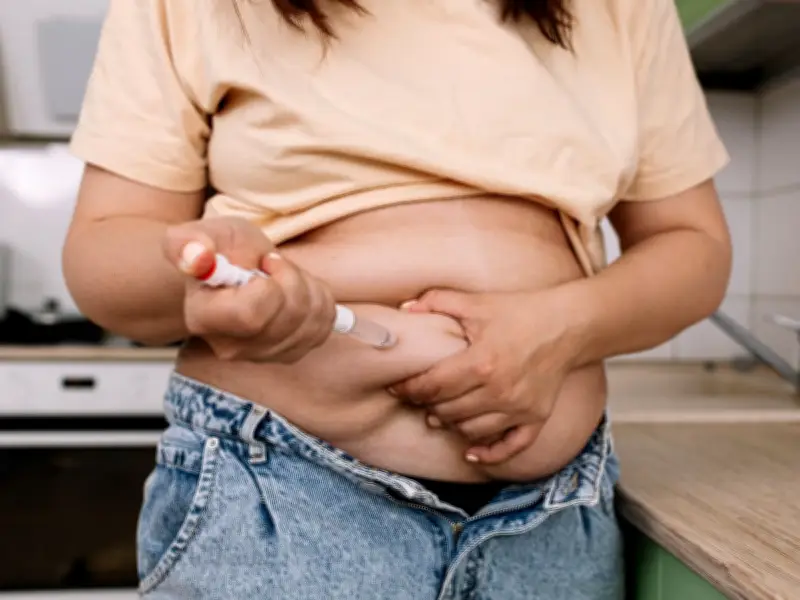
More than 200 reports from people who suspect deaths were related to ingredients contained in weight loss jabs like Wegovy and Mounjaro have been made to health officials, according to new figures.
Data from the Medicine and Healthcare Products Regulatory Agency's (MHRA) Yellow Card Scheme shows that more than 200 people have reported deaths they believe are related to the drugs, with a further more than 150,000 reporting adverse reactions. The reports have been made across multiple brands and communicate issues like gastrointestinal problems while taking them.
Deaths and adverse reactions by drug
The MHRA data shows that 106,189 adverse reactions - including gastrointestinal problems - and 120 deaths have been reported to the scheme regarding tirzepatide, which is sold under the brand name Mounjaro. People reported 48,089 reactions and 59 deaths they suspect were related to semaglutide, the active ingredient for the weight-loss drug Wegovy.
Semaglutide is also the active ingredient for diabetes treatments Ozempic and Rybelsus. A total of 4,491 adverse reactions and 37 deaths were reported as being suspected to be linked to liraglutide, which is sold under the brand name Saxenda.
MHRA stresses reports do not confirm causation
The MHRA stressed that adverse reactions reported to its Yellow Card Scheme did not necessarily mean that the death or the reaction was caused by the medicine, only that the reporter had a suspicion that this may have been the case.
An MHRA spokesperson said: "It is important to place these reports in the context of the millions of GLP-1 prescriptions issued in the UK."
"Reporting volumes can be influenced by increased use, greater awareness of a potential adverse reaction and other factors. As with all medicines, the safety of GLP-1s are kept under continual review including emerging evidence from spontaneous data and scientific publications."
"Any potential updates regarding the safety for these medicines would be promptly communicated to patients and healthcare professionals, and appropriate steps taken to mitigate any identified risk. On the basis of the current evidence, the benefits of GLP-1 receptor agonists outweigh the potential risks when used in line with their authorised uses."
Government response
Health Secretary Yvette Cooper told LBC Radio that there is a deep system of regulations in place that ensures any adverse reactions to weight loss drugs are recorded and analysed.
She said: "We have a whole system of health safety regulations in place where experts will do monitoring of any adverse impacts, of any safety reports, any concerns that are raised."
"And the good thing about the fact that we have a National Health Service means that all of those reports can be collected together - all of them can be monitored. And we ensure that those experts, the expert regulators, are monitoring that at all times and making sure if there are any wider concerns, if there are any issues that need to be raised, then they are brought to the health secretary, to health ministers, as well as to the public, to make sure that safety is always paramount."
Popularity and usage
There are three types of weight-loss jab currently available in the UK on the NHS - Wegovy, Mounjaro and Saxenda - with Wegovy being the most popular. In January, researchers from University College London estimated that 1.6 million people across England, Wales and Scotland used drugs to help themselves lose weight between early 2024 and 2025.
And they found a further 3.3 million would take the drugs in the near future. Lead research author Professor Sarah Jackson, from the UCL's Institute of Epidemiology & Health Care, said the findings, based on a population representative sample of 5,260 people responding to a survey conducted in early 2025, reveals figures that "far exceed" NHS England's initial goal for the drugs.
She said: "Our findings show that an estimated 4.9 million adults in Great Britain – nearly one in 10 – have recently used a drug to support weight loss or were interested in using one in the near future. This usage far exceeds NHS England’s initial goal of prescribing these drugs to 220,000 people over three years.
“We do not know about our survey respondents’ BMI or health conditions, so it is not clear how far this reflects a genuine medical need or how often the drugs are used unnecessarily by people of a healthy weight.
“We hope to gather more detailed data in future, monitoring how trends change over time. Good data are important as large numbers of people are taking these drugs outside medical supervision and there is wide potential for misuse. NHS prescribing data only captures a small part of the picture.”
According to NHS inform, common side effects of taking weight loss drugs can include constipation, diarrhoea, painful stomach cramps and abdominal pain, nausea and vomiting, headaches, fatigue and hypoglycaemia (low blood sugar). Less commonly, people may experience changes to vision, kidney failure, pancreatitis, gallbladder problems or an allergic reaction.