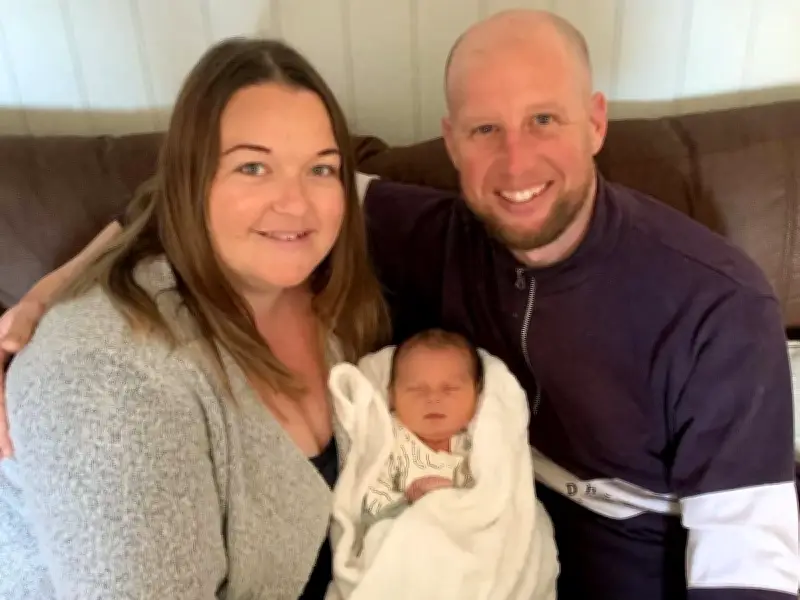
A mother whose newborn son died from catastrophic brain injuries following an infection has called for ambulances to prioritise babies under three months old, after a coroner condemned the delays in reaching him.
Ezrah Pollard was just 19 days old when he began displaying "red flag markers" of infection. His parents contacted NHS 111 and were assured help was on its way, but when they followed up with emergency services an hour later, an ambulance had still not been dispatched. It subsequently transpired that there was a four-hour wait for category two calls – the second-highest priority – that evening.
Coroner's report finds avoidable delay
The development follows a fresh coroner's report which found there was an avoidable delay in administering antibiotics to Ezrah, with warnings issued that future deaths could occur unless action is taken.
Ezrah's parents Sarah Doolin and Craig Pollard, from Cornwall, drove their son 20 miles to the closest hospital, where staff immediately recognised he was critically unwell. He was subsequently transferred to a Bristol hospital, where a CT scan uncovered catastrophic brain injuries.
Ms Doolin, 39, told the Press Association that Ezrah had been examined by a senior midwife the day before he fell ill in March 2022, who was "thrilled with his progress". She had initially assumed Ezrah had a cold, but he grew less interested in feeding as the day wore on.
Parents' ordeal on the night
"I was still completely unaware of the idea that he could be very sick," Ms Doolin told PA. "I thought maybe he needed a dirty nappy to clear his belly and I was thinking around things like a little cold."
"By early evening things were more alarming. Ezrah's breathing had changed, and I now know this is called a grunt and it's a sign of infection. But, to me, it sounded like he was coughing gently."
At approximately 8.30pm, Ezrah's parents contacted NHS 111 and were put through to the South West Ambulance Service. They were informed that a paramedic would examine their son at home and were instructed to await its arrival. The call was categorised as category two, which typically has an average response time of 18 minutes.
Delay and tragic outcome
An hour later, the couple followed up on the ambulance but it hadn't yet been dispatched "owing to significant operational pressures", a new prevention of future deaths report by coroner Andrew Cox states. The parents drove Ezrah to the Royal Cornwall Hospital, around 20 miles from their St Martin home, before he was moved on to Bristol.
Ezrah succumbed to an infection triggered by group B streptococcus (GBS), a harmless bacteria present in between 20% to 40% of people. During labour, it can occasionally transfer to the infant, leading to severe illness, with symptoms typically emerging within seven days. Ezrah had late onset GBS, which is rarer and occurs in babies aged between seven days and three months.
An inquest heard there is presently no protocol for babies up to three months old to receive a category one ambulance response, which averages seven minutes. Ezrah received a category two classification despite displaying "red flag markers" of infection, including "fever, grunting, breathlessness, 'deathly colour' and drowsiness", according to the report.
Mother's call for change
Ms Doolin expressed her concerns to PA: "I would love to see that change. I don't understand why a baby is not considered category one. Newborn babies aren't ever category one unless they've stopped breathing. In which case, by that point, it's too late."
Under NHS England guidelines, a newborn would only warrant a category one response if unconscious, fitting, choking on solids, in cardiac arrest, or experiencing major blood loss. Neither NHS 111 nor the South West Ambulance Service could offer Ezrah's parents any explanation for the ambulance delay, Mr Cox's report stated. It emphasised that "Ezrah required immediate antibiotics, yet their administration was avoidably delayed".
At that time, ambulances were averaging four-hour response times for category two incidents. The report highlighted that even when a category one response isn't "considered appropriate" for young infants showing infection symptoms, parents should receive immediate advice to transport their child to hospital. Additional concerns emerged regarding insufficient information about Ezrah upon his hospital arrival, despite his parents providing his history to 111.
Fundraising and legacy
Ms Doolin urged improved communication, explaining she was forced to "repeat everything multiple times to different services". Speaking to PA, she expressed feeling "hopeful" that Ezrah's inquest might trigger nationwide improvements. "It would be amazing to see that taken more seriously," Ms Doolin remarked. "I remember thinking when I phoned 'he'll be priority', and obviously he didn't end up being."
"I understood from the inquest that they weren't even looking at the category two calls because they were too busy looking at category one and trying to make that work. To think I made that phone call; it's almost pointless, because no-one looked at it. And I'm sat thinking something's being done, and nothing's being done. I really do believe in 2026 we could do better. We could do better in terms of clinicians checking the call list right through from category one through onto the other two and three and beyond."
She proposes this might enable medics to inform parents of hold-ups, allowing them to travel independently to hospital and ensure infants receive swifter treatment. Based on NHS England guidelines, newborns fall under category one classification.
Ms Doolin, who teaches English, alongside her 42 year old husband Mr Pollard, has subsequently collected over £100,000 in Ezrah's honour. The pair, who are also parents to a three year old daughter, are championing efforts to highlight warning signs of infection in newborn infants. Ms Doolin commented: "Fundraising is an amazing way to put our energy into building a legacy for Ezrah that feels powerful, off the back of such a short life and such a painful and tragic story in terms of his illness. It's our way of trying to do something that's in the light rather than in the dark."
Dr Timothy Godfrey, medical director of enhanced and critical care at the South Western Ambulance Service NHS Foundation Trust, expressed his "sincere condolences". He stated that since 2022 "clinical oversight of waiting calls has significantly increased" within the trust.