
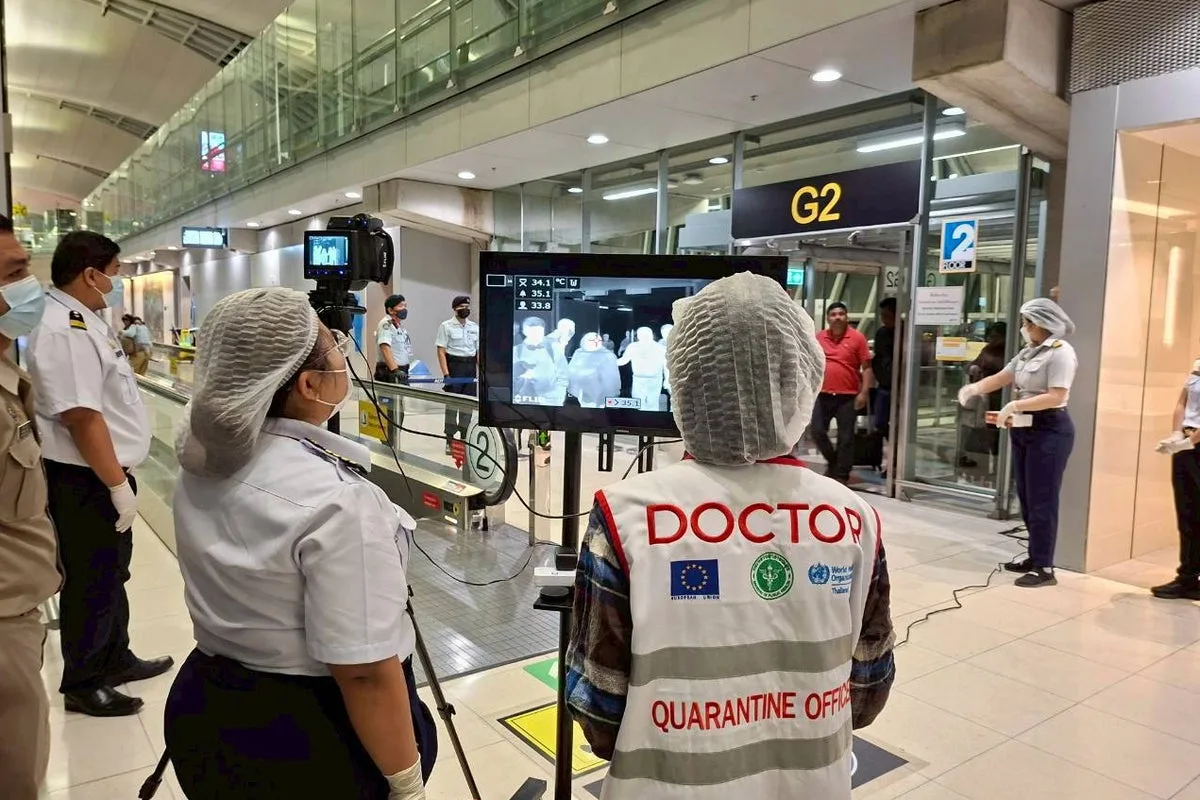
Thailand has intensified health surveillance at major airports, screening approximately 1,700 incoming passengers following a Nipah virus outbreak in India's eastern state of West Bengal. No infections have been detected so far, the Ministry of Public Health said.
The screening measures focus on travellers arriving from West Bengal, the epicentre of the outbreak, chiefly through Suvarnabhumi, Don Mueang and Phuket airports. India reported two confirmed cases in Kolkata, both healthcare workers, with 196 identified contacts testing negative for the virus.
Public Health Minister Phatthana Phromphat said the enhanced checks were introduced on the instructions of Prime Minister Anutin Charnvirakul and deployed late last week. Nearly 700 travellers arrive daily from Kolkata on flights to the three airports. If a suspected case is found, the individual will be quarantined and test results will be available within eight hours.
The minister emphasised that Nipah transmission differs from Covid-19, noting that asymptomatic carriers do not spread the virus. Thailand has never reported a Nipah infection. The virus was first detected in Southeast Asia after outbreaks in Malaysia and Singapore in 1998 and 1999, with later human outbreaks in India and Bangladesh linked to consumption of raw date palm sap contaminated by fruit bats.
Thai authorities also addressed public concern over flying fox sightings in Phra Nakhon Si Ayutthaya, saying there is no evidence linking them to infections. Meanwhile, health experts in Hong Kong are advising against travel to West Bengal, and Nepal has introduced screening at Kathmandu airport and land border crossings. Taiwan has proposed classifying Nipah as a Category 5 disease, reserved for rare or emerging infections posing major public health risks.




