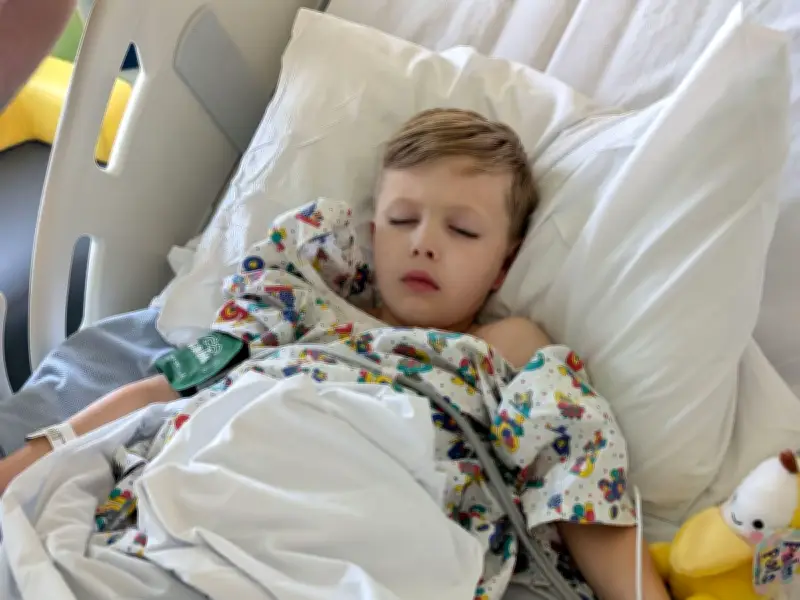
Lara Holt's 19-month-old son Cillian contracted E.coli while holidaying in Hurghada, Egypt, which saw him fighting for his life after the infection progressed into Haemolytic Uraemic Syndrome (HUS), a rare yet potentially fatal condition.
“It was the most terrifying experience of my life,” Lara said. “One moment, we thought we were dealing with food poisoning from a holiday, and the next we were being told our baby could go into cardiac arrest.”
Holiday turns to nightmare
Lara flew to Hurghada with her husband, Richard, and their three children: Cillian, Lily-Mae, and Olivia. The family had spent months looking forward to the trip, which initially seemed perfect. However, days after arriving, Richard fell ill with severe stomach cramps and diarrhoea. A day later, Lara and the children had the same symptoms.

While Richard, Lily-Mae, and Olivia were treated by a doctor at the hotel, Cillian was too young for the medication, and Lara could not take it due to other health issues. The toddler became lethargic and weak, prompting the family to try to return home early, but they could not find flights.
At the airport, Lara changed Cillian's nappy and saw extreme diarrhoea. She discarded his clothes and bought replacements for both of them. After returning to the UK, most of the family recovered slowly, but Cillian's condition deteriorated rapidly.
Emergency hospital treatment
Lara took Cillian to A&E, where he stayed overnight but was sent home without a diagnosis due to a lack of a urine sample. The next day, he woke sleepy with blood in his urine. Blood tests at the hospital confirmed HUS, caused by E.coli. Doctors told Lara that Cillian could go into cardiac arrest due to high potassium levels.
At Alder Hey Children's Hospital in Liverpool, a surgeon and a kidney specialist confirmed the diagnosis. HUS damages small blood vessels, destroying red blood cells, lowering platelet counts, and causing acute kidney injury. Cillian underwent emergency kidney dialysis for 10 days with 24-hour nursing, blood transfusions, a platelet transfusion, and feeding support.
“Hearing those words about your baby is something you never forget,” Lara said. After dialysis, Cillian suffered two seizures, and doctors warned of possible brain damage. His sisters were allowed to visit because there was a chance he would not survive.
Recovery and long-term effects
Fortunately, Cillian began to recover. His feeding tube was removed, and his family could hold him again. “The first time we got to hold our baby was such a special moment. He was completely swollen from the treatment; just being able to cuddle him was unreal,” Lara said.
The toddler spent 21 days in hospital in 2019. Now eight years old, Cillian is a “happy, energetic little boy,” but the experience has had long-term effects. He is still monitored for kidney damage, which could cause complications later in life. He also suffers from ongoing stomach and bowel issues and recently had his gallbladder removed.
Lara added: “What happened to Cillian changed our family forever. At the time, we genuinely believed once he survived and came home, the nightmare was over. But years later we are still dealing with the emotional and physical aftermath. No family goes on holiday expecting their child to end up fighting for their life.”
Lara advises other parents to “trust your instincts” and seek medical help immediately if a child shows unusual tiredness, paleness, lethargy, severe diarrhoea, or signs of dehydration after illness abroad.