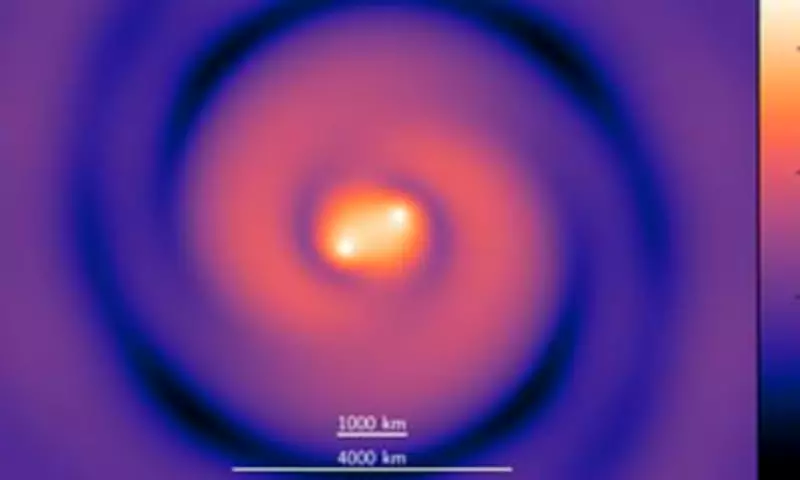
Dark matter, the invisible substance that makes up about 85% of the universe's matter, has eluded direct detection for decades. However, researchers now suggest it might have been detected by accident seven years ago, hidden in gravitational waves from a black hole collision.
Gravitational Waves as Dark Matter Tracers
An international team of scientists proposes that dark matter could leave a subtle imprint on gravitational waves emitted when black holes merge. If black holes collide within a dense cloud of dark matter, the ripples in spacetime would carry information about that environment, altering the wave's signature.
The 2019 Signal
In a new study, researchers analyzed 28 black hole merger signals from the LIGO-Virgo-KAGRA observatory network. Among them, the signal GW190728, detected in 2019, showed a promising hint of a dark matter imprint. This signal originated from a binary black hole system with a total mass about 20 times that of the Sun.

How Dark Matter Affects Mergers
According to one theory, dark matter consists of light scalar particles that can behave as waves near black holes. Through a phenomenon called superradiance, dark matter waves can extract rotational energy from a spinning black hole, becoming highly dense. This dense dark matter creates a drag force on the black hole binary, causing it to lose energy faster and merge more quickly than in empty space. This difference would manifest as a measurable change in the gravitational wave signal.
New Methodology
The team created a mathematical model to predict gravitational wave signatures from mergers in empty space versus those in dark matter clouds. They simulated various scenarios and compared them to real data. While 27 signals matched the empty-space model, GW190728 aligned better with a dark matter-influenced merger.
Cautious Interpretation
Co-author Dr. Katy Clough from Queen Mary University of London cautioned: 'The evidence we found in the data isn't sufficient to be sure of what we are seeing, and we need to check other possibilities. However, it is an interesting hint that something might be going on, and because we expect more signals from black hole mergers over the coming years, if this is a true signature of dark matter, we will see it again.'
Future Prospects
The researchers stop short of claiming a detection. Instead, they present their method as a way to screen gravitational wave data for dark matter hints, which can then be confirmed with other techniques. Co-author Dr. Josu Aurrekoetxea from MIT added: 'We know that dark matter is around us. It just has to be dense enough for us to see its effects. Black holes provide a mechanism to enhance this density, which we can now search for by analyzing the gravitational waves emitted when they merge.'