Healthcare workers and aid organisations in eastern Congo have issued urgent appeals for additional supplies and personnel to combat an outbreak of a rare strain of Ebola, warning that the epidemic is accelerating. The region, already plagued by displacement and a severe humanitarian crisis, faces further instability due to ongoing attacks by armed groups.
Dire Need for Resources
Hama Amado, the Bunia field coordinator for the aid group Alima, described the situation as deeply concerning. “The situation is worrying because this is gaining momentum,” he told The Associated Press. “This is spreading in many areas. So everyone must mobilise.” He stressed that it is far too early to declare the outbreak under control.
The Bundibugyo strain of Ebola, for which no vaccine or specific treatment exists, went undetected for weeks after the first known death. Authorities initially tested for a more common Ebola virus and received negative results, allowing the disease to spread silently.
Underreporting and Infrastructure Strain
Experts believe the true scale of the outbreak far exceeds official figures. To date, there have been 139 suspected deaths and nearly 600 suspected cases. The World Health Organization (WHO), which has assessed the global risk as low, confirmed that the index case has not yet been identified.
Although nearly 20 tons of aid have been airlifted to Bunia, where the first death occurred, doctors are reportedly using outdated facemasks and treating suspected Ebola patients in general wards due to a lack of isolation facilities. Early detection is critical for survival, but the region’s already fragile health system has been further weakened by international aid cuts.
According to the United Nations, over 920,000 people are internally displaced in Ituri province, the epicentre of the outbreak. Dr. Lievin Bangali, Senior Health Coordinator for the International Rescue Committee in DRC, noted that communities are under immense pressure from conflict, displacement, and a collapsing health system. “Years of underfunding, compounded by recent cuts to frontline health and outbreak preparedness programming, have weakened the ability to detect and respond to outbreaks quickly,” he said.
The IRC has been forced to suspend surveillance activities in three of five areas in Ituri over the past year due to funding shortfalls.
Human Impact
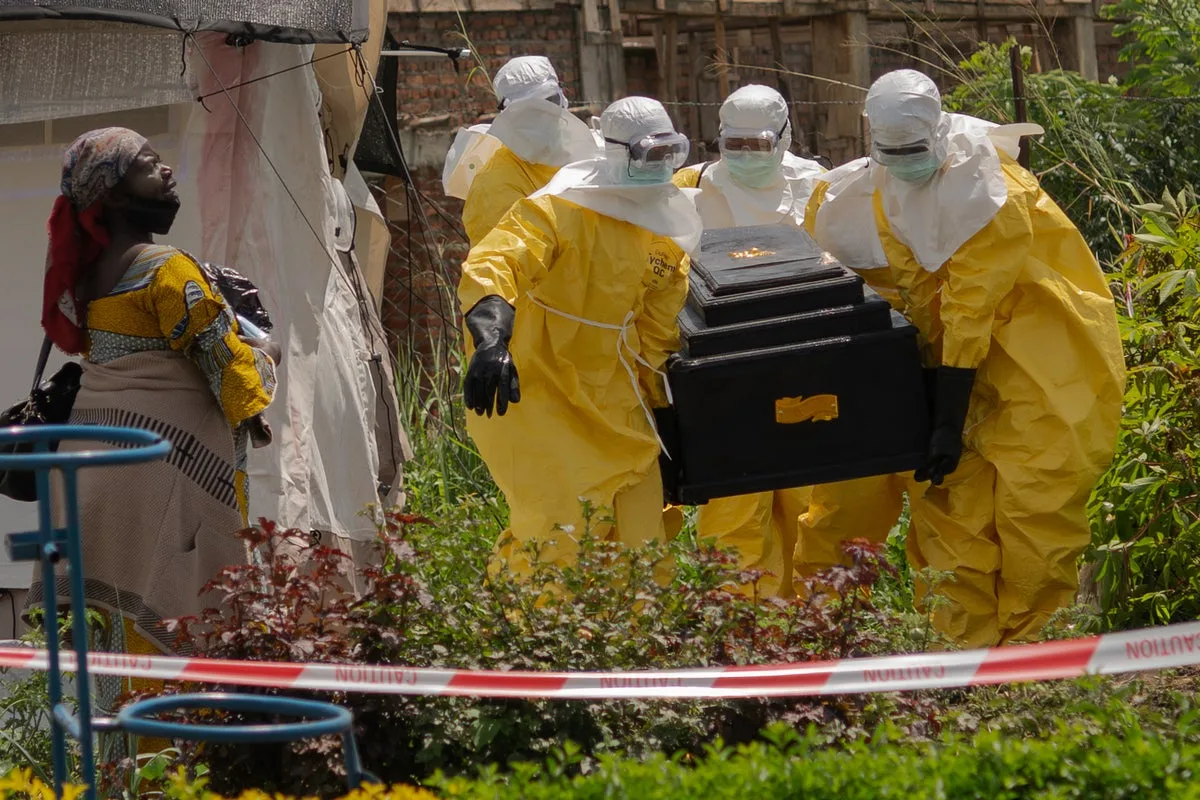
At a treatment centre in Rwampara, healthcare workers in protective gear handled the bodies of suspected Ebola victims. Families watched as workers disinfected corpses and placed them in coffins for secure burial, with some relatives breaking down in tears. The disease struck suddenly, often mistaken for illnesses like malaria.
Botwine Swanze, who lost her son, recounted his rapid decline: “He told me his heart was hurting. Then he started crying because of the pain. Then he started bleeding and vomiting a lot.”
Ebola is highly contagious, spreading through contact with bodily fluids such as vomit, blood, or semen. Symptoms include fever, vomiting, diarrhoea, muscle pain, and sometimes internal and external bleeding.
Lack of Protection
In Bunia, schools and churches remain open, and some residents have begun wearing facemasks, which are increasingly scarce. “It’s truly sad and painful because we’ve already been through a security crisis, and now Ebola is here too,” said resident Justin Ndasi.
Anxiety is mounting at health centres. Trish Newport, an emergency programme manager for Doctors Without Borders, reported that a team identified suspected cases at Salama hospital but found no available isolation ward. “Every health facility they called said, ‘We’re full of suspect cases. We don’t have any space.’ This gives you a vision of how crazy it is right now,” she said on social media.
At Bambu General Hospital in Ituri, suspected Ebola patients shared wards with other patients. In Mongbwalu, where the first victim’s body was taken, the border with Uganda remains open and gold mining continues, complicating containment efforts. Civil society leader Chérubin Kuku Ndilawa noted that while there is no panic, public handwashing stations are lacking.
At Mongbwalu General Hospital, Dr. Didier Pay reported treating around 30 Ebola patients, and a medical student died on Wednesday. “The patients are scattered here and there in rather unusual conditions,” said Dr. Richard Lokudu, the hospital’s medical director. “We hope for the proper triage and isolation facilities to be installed today, and if that doesn’t happen, we will be completely overwhelmed.” He added that staff are undertrained and lack protection.
WHO Warning and Scale of Epidemic
The WHO has declared the outbreak a Public Health Emergency of International Concern. Director-General Tedros Adhanom Ghebreyesus expressed deep concern about the scale and speed of the epidemic, while the WHO’s Congo chief warned the outbreak could last at least two months. Investigations into the source are ongoing, but Anaïs Legand, a viral haemorrhagic fevers expert, said it likely began months ago.
As of Wednesday, 51 cases had been confirmed in Congo’s Ituri and North Kivu provinces, with two cases in Uganda. However, Dr. Tedros emphasised that “the scale of the epidemic is much larger.” The MRC Centre for Global Infectious Disease Analysis in London estimates that actual cases could already exceed 1,000, noting that the true magnitude remains uncertain.
Insecurity Complicates Response
The region’s volatility, marked by attacks from numerous armed groups, further hampers the response. Local leaders reported that an attack by militants linked to the Islamic State group killed at least 17 people on Tuesday in Alima, Ituri. Fighters from the Allied Democratic Forces (ADF), which has ties to IS, used machetes and firearms, burned homes and businesses, and took hostages. Civil society groups warned of threats to other villages.
The number of ADF fighters in Congo is unclear, but they remain a significant presence. Another active group is CODECO, a coalition of militia groups primarily from the ethnic Lendu farming community.
Associated Press writers Jamey Keaten in Geneva; Jean Yves Kamale in Kinshasa, Congo; and Wilson McMakin in Dakar, Senegal contributed to this report.