The Timeless Appeal of Cacio e Pepe: A Journey from Ancient Rome to Modern Caves
In the heart of Rome, nestled within the historic Monte Testaccio—a hill formed from ancient broken amphorae—lies a network of caves and tunnels. Today, these spaces host a vibrant mix of nightclubs, restaurants, a theatre, and even an Apostolic church. Some venues proudly display sections of old pots, reminiscent of snapped wafer biscuits, while others have smoothed the walls with plaster. However, a few caves retain their original purpose: serving as natural warehouses with steady low temperatures and optimal humidity, perfect for ageing cheese and cured meats.
Reviving Ancient Traditions in Urban Caves
Vincenzo Mancini, founder of DOL, a project distributing artisanal products from small farms in Lazio, has reclaimed a deep cave behind door 93. This space now functions as an urban ageing facility for cheese and cured meats. Recently, chefs from Trullo in London visited for a cheese tasting, where they experienced an unexpected rendition of cacio e pepe, a classic Italian dish.
The term cacio, derived from the Latin caseus (possibly from cohaesus, meaning cohesive), refers to cheese, while formaggio comes from medieval Latin formaticum, related to the Greek word for a wicker container used in cheese-making. Around AD 50, the agronomist Columella emphasized that the best cheese required minimal additives, a principle that still holds today. His writings detail cheese-making processes, particularly using fresh sheep's milk coagulated with rennet, then drained, salted, and aged in cool, dark places.

Pecorino Romano: From Local Staple to Protected Product
Historically, pecorino—from the Latin pecus pecŏris (sheep)—was a generic term for local sheep's milk cheese, needing no geographical designation until trade expanded. Today, varieties like pecorino romano, sardo, and toscano have official protected status, though hundreds of unofficial types exist. Notably, over 95% of pecorino romano is now produced in Sardinia, with the remainder in Lazio and Grosseto, due to historical laws and urbanisation.
In Lazio, Vincenzo collaborates with Deroma dairy in Torrita Tiberina, ageing 12-month pecorino romano wheels in the cave's unique microclimate. The bacterial microflora on the walls enhances flavour development, transforming the cheese over 24 to 48 months into a deeper, mellower, yet more assertive product with mould coats ranging from clam brown to moss green.
A Traditional Recipe with a Cave-Aged Twist
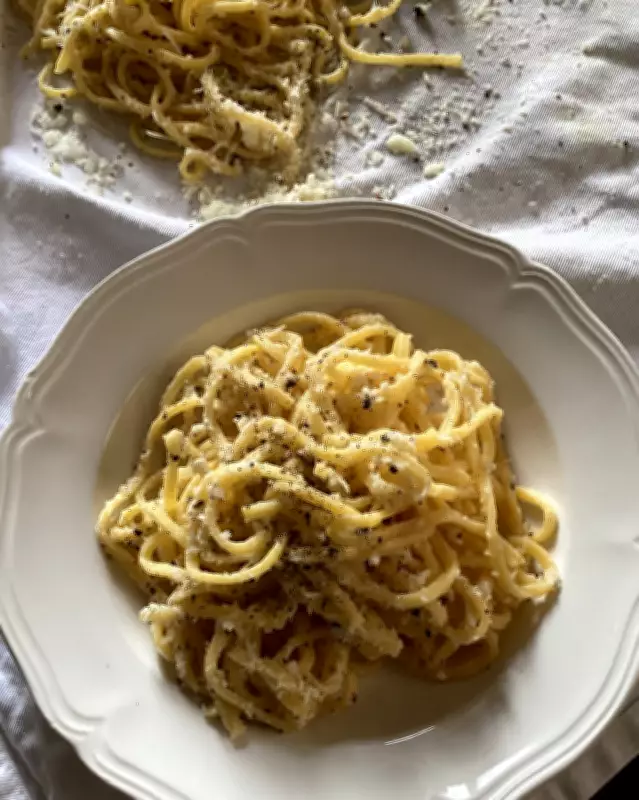
Adjacent to Vincenzo's cave is Flavio al Velavevodetto restaurant, where discussions on perfecting cacio e pepe led to a demonstration. Vincenzo fetched just-cooked tonnarelli from the restaurant, tossed them in a cloth with grated 36-month pecorino and black pepper, then shook and rubbed the bundle to create a creamy sauce. This method likely mirrors how shepherds and innkeepers once prepared the dish, encouraging more wine consumption. The result is a sandy, clingy coating on the pasta, offering a uniquely satisfying experience.
How to Make Cacio e Pepe in a Cloth
Ingredients:
- Salt
- 100g pecorino romano
- 2 heaped tsp whole black peppercorns
- 1 large napkin or cotton tea towel
- 300g fresh tonnarelli or tagliatelle
Instructions:
- Bring a pan of well-salted water to a boil.
- Grate the pecorino on the star side of a grater for a soft, sandy texture; avoid a microplane.
- Coarsely crush the peppercorns with a heavy object.
- Prepare a cloth large enough to form a bag for shaking.
- Cook the pasta until al dente, then lift it onto the cloth with a spider slice or tongs, spreading it to dry slightly.
- Sprinkle the grated cheese and pepper over the pasta, gather the cloth ends into a bag, and shake and rub to distribute evenly.
- Serve directly from the cloth or transfer to plates, accompanied by wine or water.
This cave-aged version highlights how ancient techniques and modern innovation can elevate a simple dish, making cacio e pepe more enjoyable than ever.