

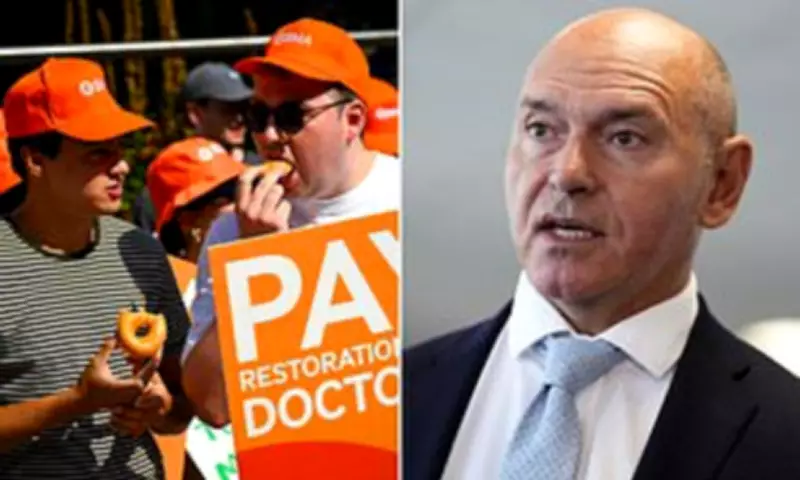
An NHS chief executive has issued a stark warning that junior doctors could embark on monthly strike action over the coming year, as Health Secretary Wes Streeting admitted it appears increasingly difficult to reach a negotiated settlement. Sir Jim Mackey, head of NHS England, told hospital leaders that the British Medical Association (BMA) union is likely to organise walkouts 'every four weeks' for the next twelve months if the government fails to secure a pay deal promptly.
Imminent Six-Day Strike Action
This alert comes as resident doctors, commonly referred to as junior doctors, prepare to commence a six-day strike from 7am on Tuesday, immediately following the Easter bank holiday weekend. This industrial action marks the 15th round of strikes by junior doctors in England since 2023, with previous walkouts totalling 59 days since March of that year. The BMA holds a mandate to continue striking until August, and next week's disruption is projected to cost the NHS over £250 million in lost activity and overtime payments to senior medical staff covering shifts.
A 'Long Slog' of Industrial Disruption
Sir Jim Mackey cautioned that the health service faces a 'long slog' of industrial action potentially lasting another full year unless an urgent pay agreement is finalised. He indicated that the NHS must adapt by becoming 'less reliant' on junior doctors to treat patients, advocating for a permanent shift in workforce deployment. This strategic change would involve greater utilisation of other clinicians, including nurses, pharmacists, and paramedics, to maintain service reliability during periods of strike action.

New legislation, championed by former Labour deputy leader Angela Rayner, now enables any future BMA ballot to grant the union a mandate for strike action spanning an entire year. Sir Jim explained that NHS England is actively exploring ways to 'build services less reliant on a transient training workforce and more on a blended clinical family.' He emphasised the necessity of developing alternative service models to ensure population needs for reliable healthcare are met, particularly if the current system continues to face instability.
Government and Union Standoff Intensifies
Health Secretary Wes Streeting has written to Dr Jack Fletcher, chairman of the BMA's junior doctors committee, characterising the upcoming strikes as 'unnecessary and damaging.' Streeting expressed disappointment that the BMA rejected a pay offer worth up to 7.1 per cent for this year without presenting it to members for a vote. This proposed deal would have resulted in a total pay increase of 35 per cent over the past three years for junior doctors.
Streeting noted that the offer would have elevated basic pay for the most experienced junior doctors to £77,348, with average earnings exceeding £100,000 annually. First-year doctors fresh from medical school would earn an average of £52,000 per year, representing a £12,000 increase compared to three years ago. Labour leader Sir Keir Starmer accused junior doctors of 'recklessly' walking away from this offer, stating that patients will 'pay the price' for the continued industrial action.
Broader Implications for NHS Workforce Planning
Sir Jim Mackey revealed that some local NHS leaders reported services operating more smoothly during junior doctor strikes, when consultants and other clinicians assumed their responsibilities. He suggested that alternative working models reducing dependence on junior doctors could benefit hospitals that have historically struggled to recruit trainees. Drawing from his experience leading Northumbria Healthcare Foundation Trust for two decades until 2023, Sir Jim previously developed a service model less reliant on junior doctors.
He acknowledged the need for 'a pipeline of consultants' but pointed to successful service models in other countries that demonstrate reduced dependence on trainees. The government has scrapped plans to expand specialty doctor training places following the BMA's failure to meet a 48-hour deadline to cancel industrial action. The Department of Health and Social Care stated that offering 1,000 additional training places this year is no longer 'financially or operationally' feasible as the NHS prepares for strike fallout.

Union Response and Future Negotiations
Dr Jack Fletcher responded that eliminating extra training places is 'bad for doctors, and it's also bad for patients.' Junior doctors have expressed willingness to meet with Wes Streeting over the Easter weekend to avert next week's walkouts, but insist there must be 'an improvement' on the rejected deal. The BMA has faced criticism for offering its own staff a pay rise of just 2.75 per cent while demanding higher increases for junior doctors, citing inflation pressures exacerbated by global conflicts.
Sir Jim Mackey stressed that NHS England would become 'more active in this area' if confronted with a prolonged period of strikes, but clarified this was not intended as a threat to junior doctors. The situation remains volatile, with the BMA also preparing to ballot senior doctors, including consultants, on potential strike action. As the standoff continues, the NHS faces significant operational challenges and financial pressures from what could become a year-long cycle of monthly industrial action by junior medical staff.





