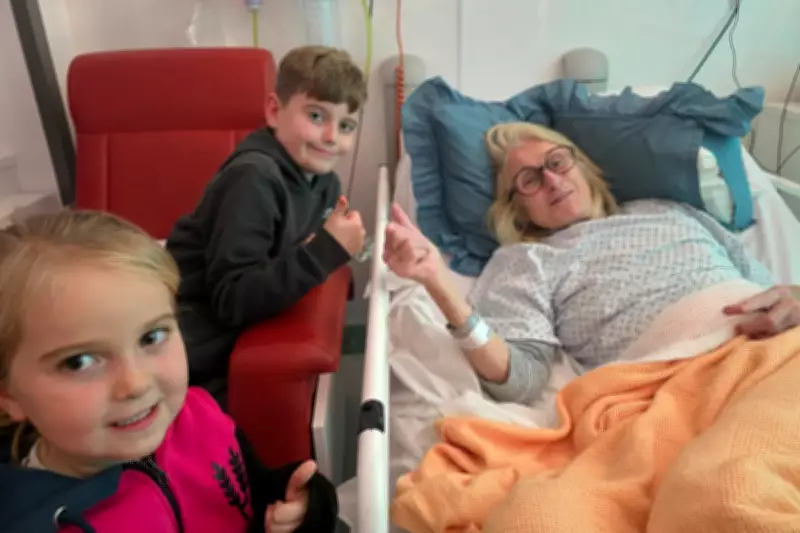
A grandmother from Aberystwyth has been left with life-altering brain damage after medical professionals repeatedly misdiagnosed a rare but serious brain inflammation as a simple urinary tract infection. Helen Edwards, 74, saw her active lifestyle vanish almost overnight when viral encephalitis went unrecognised by multiple healthcare providers.
From Festival Dancing to Complete Disorientation
Just one week before falling ill, Helen Edwards was dancing at a festival, sea swimming, and walking everywhere. The fit and healthy grandmother of ten suddenly developed flu-like symptoms and nausea in September 2025. Her GP initially suspected a urinary tract infection and prescribed antibiotics, but her condition rapidly deteriorated when her entire body began shaking uncontrollably.
"She had gone into the toilet thinking it was her office, and then was using a notepad and pressing it as if it was a phone," her daughter Jane Richards recounted, describing the alarming behavioural changes that followed the failed antibiotic treatment.

A Week of Misdiagnosis Before Critical Discovery
After visiting her GP for the second time and being told again she had a UTI, Ms Edwards became increasingly confused and disoriented. Her daughter took her to the Accident and Emergency department at Ysbyty Bronglais Hospital in Aberystwyth, where after a ten-hour wait she was sent home with suggestions her behaviour might represent delirium from a urinary infection.
Only when Ms Richards returned her mother to hospital the following day did she receive intravenous antibiotics, though medical staff still believed they were treating a UTI. The breakthrough came when a consultant noticed her persistent shaking and unusual behaviour during routine rounds and ordered a CT scan.
The Devastating Diagnosis
A full week after first seeking medical help, Helen Edwards was diagnosed with viral encephalitis - a serious inflammation of the brain that proves fatal in approximately twenty percent of cases. Her specific condition was caused by herpes simplex virus type 1 (HSV-1), commonly known as the cold sore virus, despite her never recalling having experienced a cold sore.
This virus can remain dormant for years and is estimated to affect more than half of people under fifty worldwide. The NHS lists confusion, disorientation, seizures, personality changes, speech difficulties, bodily weakness, and loss of consciousness as key symptoms of encephalitis.
A Global Awareness Crisis
Encephalitis International reports that nearly seventy-seven percent of people globally cannot identify what encephalitis is, contributing directly to dangerous delays in diagnosis and treatment. The organisation, which is supporting the Edwards family, emphasises that such delays frequently lead to irreversible brain injury or death.
"Time is of the essence," stressed Jane Richards, noting that antiviral treatment administered within forty-eight hours can dramatically reduce the risk of severe symptoms. "If someone is behaving strangely, if they've got flu-like symptoms, medics just assume a lot of the time, with older people particularly, that it is a UTI."
The Long Road to Recovery
Helen Edwards spent twelve weeks in hospital before being discharged at the end of November 2025. The brain damage she sustained has resulted in a painfully slow recovery process. Despite intensive physiotherapy and occupational therapy sessions, she returned home unable to recognise familiar rooms or navigate her own living space.
"She didn't know what anything was or how to do anything," Ms Richards explained. "She has no recollection and she can't navigate places." The family now takes turns providing care, including cooking and shopping, as professional carers cannot offer the level of assistance required.
Further Complications and Medical Response
In February 2026, Ms Edwards developed autoimmune encephalitis as a complication and is currently receiving treatment at Morriston Hospital in Swansea. Dr Ava Easton, chief executive of Encephalitis International, told The Independent that "delay in an accurate diagnosis can be devastating."

"Encephalitis is a medical emergency, and recognising it early - regardless of age - can be the difference between recovery or severe disability and death," Dr Easton emphasised. "Too often, HSV-1 encephalitis in older people may result in the early symptoms being mistakenly attributed to something less serious such as a UTI."
Health Board Statement
Hywel Dda health board responded that staff receive training to the highest standards to "respond quickly to symptoms for a wide range of conditions." Medical director Mark Henwood acknowledged that "encephalitis is a rare and serious condition that is difficult to diagnose because the symptoms are similar to several other conditions."
"As a health board, we are committed to sharing information about as many illnesses and conditions as possible - especially most common conditions that affect a large number of people," Henwood added.
The case highlights the critical importance of recognising encephalitis symptoms promptly, particularly in elderly patients whose neurological symptoms might be mistakenly attributed to more common conditions like urinary tract infections.