
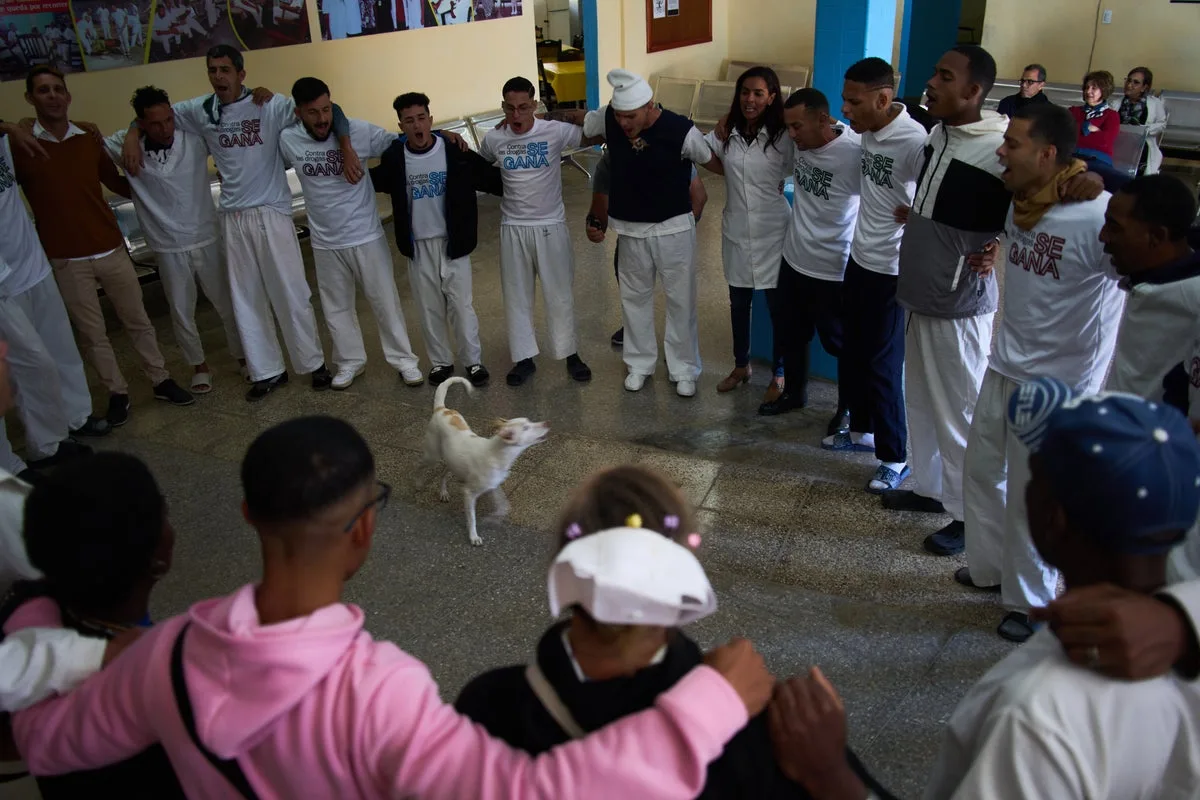
Several dozen people stood in a circle in a room at a Havana psychiatric hospital, holding hands and chanting in unison, vowing to rid their bodies of “the toxins that enslave.” The collective plea to reclaim their freedom for the next 24 hours was the first step of a 90-day detoxification before beginning rehabilitation.
Drug use was almost unknown in Cuba until the start of this decade. However, a deepening economic crisis, shortages of basic goods and the emergence of low-cost synthetic drugs have transformed the landscape. In Havana and other cities, it is no longer unusual to see young people in public parks sleeping, walking with difficulty or lying unconscious.
According to authorities, the primary threat is “químico” (chemical), a potent cocktail of synthetic cannabinoids and hazardous additives. Also known as “papelitos” (little papers), the drug is absorbed into sheets of paper, sliced into tiny doses and smoked. At roughly 250 Cuban pesos per hit (50 cents), it costs less than a loaf of bread or a can of soda. “It’s very cheap...and it’s everywhere,” said David Morales, 25, who is in recovery after treatment at government-funded health centres and now receives rehabilitation therapy at the Alcance Victoria Cuba evangelical Baptist church.
Acknowledging the rise in consumption, Cuba's Ministry of Health and several state agencies in July established a National Drug Observatory to research, monitor and mitigate the impact of illegal drugs. Dr Tania Adriana Peón, head of mental health and addictions at the General Directorate of Health, pointed to emergency room data as a barometer: in 2024, 467 people sought help or were registered in emergency rooms in Havana; by 2025, that figure nearly doubled to 886.
Cuba has a zero-tolerance policy on drugs, with trafficking punishable by up to life imprisonment. While it is not a drug-producing country, authorities acknowledge it is not immune. Sporadic seizures of cocaine packages abandoned by traffickers or washed ashore are reported, and drugs are smuggled in among imported goods. Col. Juan Carlos Poey Guerra of Cuba's Interior Ministry said the primary challenge comes from new psychoactive drugs or synthetic cannabinoids, originating mainly from the United States. Police laboratories detected 46 new synthetic formulations in the last year, and between 2024 and 2025, authorities thwarted 72 attempts to smuggle drugs into the country from 11 different origins.
Health care in Cuba is state-run and free, so neighbourhood family clinics are typically the first to detect signs of drug use. Patients with severe conditions are referred for longer hospital stays. The Associated Press recently toured a 40-bed men’s ward at the Havana Psychiatric Hospital, where patients aged 20 to 30 undergo a 90-day detox. The space features two-bed cubicles with family photos, a reading area, a dining room and recreation space. Patients wear white T-shirts with the slogan “We win against drugs” and take responsibility for cleaning their surroundings. For decades, the state was responsible for treating drug and alcohol users, but the magnitude of the challenge has opened the door for other actors, including churches.




