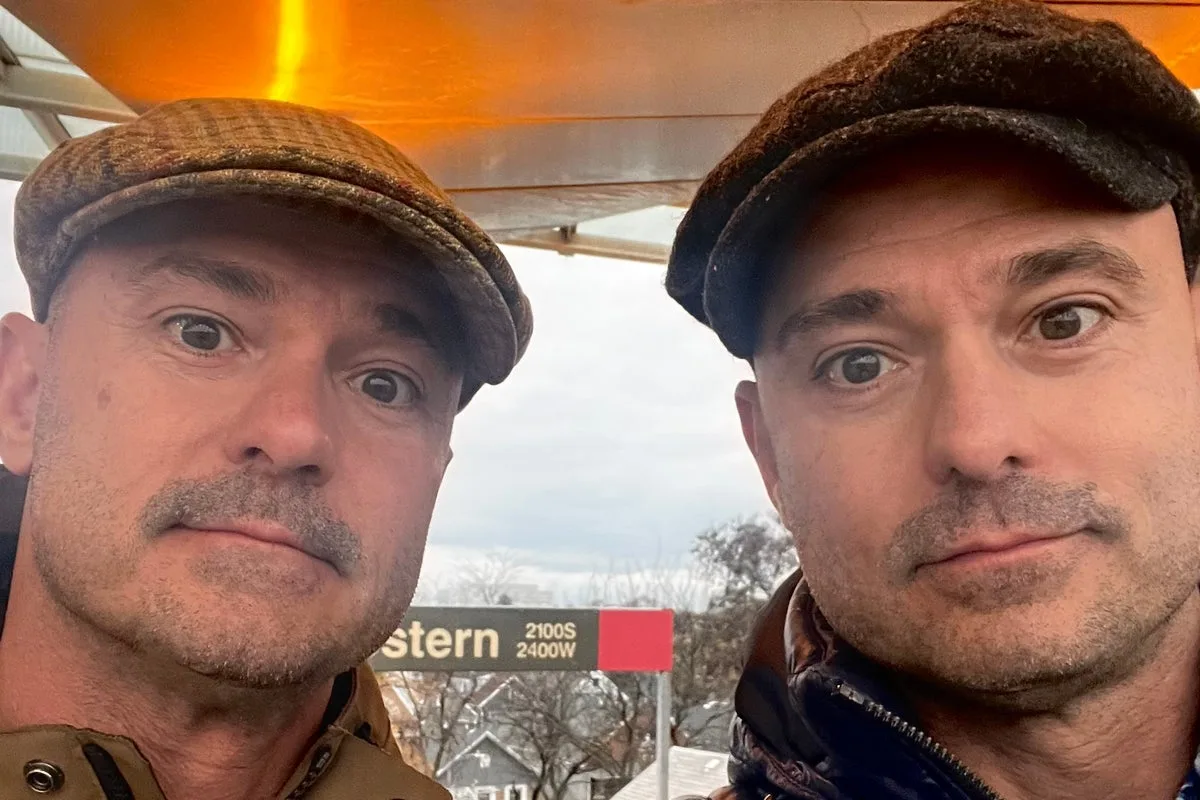
When you’re a twin, the first question people always ask is: “What does it feel like to be a twin?” The second is, “Can you feel each other’s pain?” – to which the short answer is no. My identical twin, Brian, nicknamed Bob, and I had the same answer: “We don’t know what it feels like not to be one.” Then we’d pause and usually add: “But it seems like it would be really lonely to not be a twin.”
Bob died two years ago, aged 46. I now identify as a lone twin. That phrase captures both what I am and how I feel. A part of me is missing, and that absence is the source of the loneliness. Being a twin is extraordinary, and inversely, so is losing one. That experience is explored in a new film, Twinless, which follows two men who meet through a twin bereavement support group – a group I am also part of.
We absolutely loved being identical twins. For the first 20 years of our lives, we barely referred to ourselves as “I”, it was always “we”. As we got older and lived apart – Bob in Chicago, I in the UK and other countries – we became even more conscious of how being twins was core to who we were. We had a shared feeling of comfort, connection and uniqueness. That oneness carried a specialness and completeness I didn’t fully recognise at the time.

Our relationship wasn’t perfect. There were tensions and frustrations throughout our adult lives. But being a twin shaped me in lasting ways. My brother was gay, and I’m straight; that contrast widened the world I was exposed to through him. He was the first openly gay person from our tiny town in rural Nebraska, and he carried a deep respect for the history and resilience of the gay community that I shared.
Bob died unexpectedly after drinking too much vodka on vacation in Florida. The shock was immediate and absolute. I lived with a level of fear and pain I had never known, with anxiety and panic attacks for the first time. Life narrowed to second-by-second living, then minute-by-minute, then day-by-day, until it began to shift into another phase of grief, focused on loss of the future and my identity.
I hadn’t only lost Bob, but a part of myself and our future. We owned a place in Chicago we called “Twincation” – our retirement plan, our idea of being twins always on vacation – disappeared in an instant. Losing my twin felt like the earth without the moon, a natural orbit suddenly gone, leaving me unanchored and hurtling through space. I carried vast amounts of anger: towards him, the unfairness of life, and at myself. During that first year, I wasn’t always easy to be around; I acted out, I was selfish, and at times, honestly, I was a bit of an asshole.