
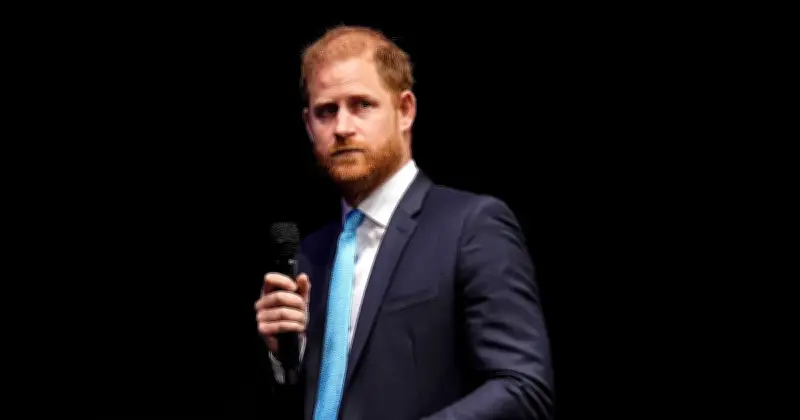
Prince Harry has been offered professional guidance after revealing he felt he had lost his identity when he left the British Army. Psychotherapist Mark Vahrmeyer, founder of Brighton & Hove Psychotherapy, shared his perspective on the Duke of Sussex's struggle to redefine himself.
Harry, 42, and his wife, Meghan Markle, 45, stepped back as senior working royals in early 2020 and moved to the United States, where they lived for six years before recently returning to Britain. Harry has also published his memoir Spare in 2023, appeared in multiple documentaries and dedicated significant effort to his charitable work, most notably the Invictus Games.
Harry's military departure and loss of purpose
Before meeting Meghan in 2016, Harry formally left the British Army in June 2015 after a decade of full-time military service, including two operational tours in Afghanistan. He has acknowledged that stepping away from military life left him without a clear sense of identity and direction.
Speaking to the NATO Military Committee in Brussels earlier this month, Harry reflected on his transition from service, saying: "When I hung up my uniform, I felt as though I had lost not simply a profession, but part of my purpose and identity. I was fortunate. I had another way to serve."
He revealed that this experience was a fundamental motivation behind establishing the Invictus Games, created to help wounded and transitioning service personnel rebuild their self-assurance, identity and purpose after their military careers.
Psychotherapist's advice on identity
Vahrmeyer told the outlet: "I think Harry's difficulties with identity may go back much further than his departure from the army. The title of his autobiography, Spare, is particularly revealing in terms of how he has understood his place within his family."
He added: "To define oneself as the spare is to define oneself in relation to somebody else. The question then becomes, who am I in my own right?"
Vahrmeyer noted that the army "does not necessarily encourage individuals to develop their own identity. Rather, it provides them with one." He said: "There is a clearly defined hierarchy, a role, a uniform, a community and a sense of purpose. In return for belonging to the institution, the individual is required to surrender something of their individuality."
He continued: "This is not necessarily a bad thing. Indeed, the sense of belonging and purpose that military life provides can be enormously containing. However, the difficulty comes when somebody leaves and that structure is suddenly no longer there."
"What strikes me about Harry is that he was born into one institution that defined who he was and subsequently joined another that offered him a different, but equally prescribed, identity. He has now left both," Vahrmeyer said.
From a psychoanalytic perspective, the task is not simply to find another role to fill the gap but to develop a sense of self less dependent on external structures and the expectations of others. "That can be a difficult and sometimes painful process because it involves mourning what has been lost, while also confronting the question of who we are when those external definitions fall away," he said.
Life in the UK and family arrangements
Harry has since described his principal role as a "full-time dad" to Archie and Lilibet during an appearance on Joe Marler's podcast, Joe Marler Will See You Now. Reports suggest he is now the primary stay-at-home parent while Meghan travels for professional commitments and oversees her business ventures and acting projects.
Harry's return to the UK has not eased tensions with his father, King Charles III. The King has publicly clarified that the couple are functioning as private individuals rather than official working members of the Royal Family. Harry and Meghan are not anticipated to spend Christmas in the UK or join the Royal Family at Sandringham, with those close to the couple suggesting that a shared royal Christmas remains too uncomfortable and that no invitation was anticipated or requested.
The couple's festive plans instead centre around Meghan's mother, Doria Ragland. Sources indicate that while they would welcome Doria visiting the UK, they plan to respect her wishes, which is likely to mean travelling to California for Thanksgiving and Christmas.
Advice for veterans rebuilding identity
Psychotherapist and mental health specialist Noel McDermott, founder of Mental Health Works, explained that the armed forces purposefully cultivate a highly distinctive identity, particularly among front-line troops, to help with the responsibility of confronting danger.
"Loss of that identity is a well-known issue within the armed forces and they invest a lot in supporting staff in making the transition to civilian life," he said. "Nevertheless, many discharged personnel find the transition challenging."
McDermott suggests rebuilding a new identity involves four fundamental principles: finding a bigger purpose; staying connected with veterans' groups and associations; translating core military concepts such as discipline, leadership, logistics and crisis management into civilian roles; and accepting that all major changes to central life circumstances involve this type of transition and that we need to grieve the old self to move on.
He further advises those departing the armed forces to seek assistance with any PTSD difficulties stemming from their service through EMDR, Rewind or medication. "Do not ignore these issues as they won't go away without help and PTSD will stop someone from being able to do the work needed to develop a new identity," he said.




