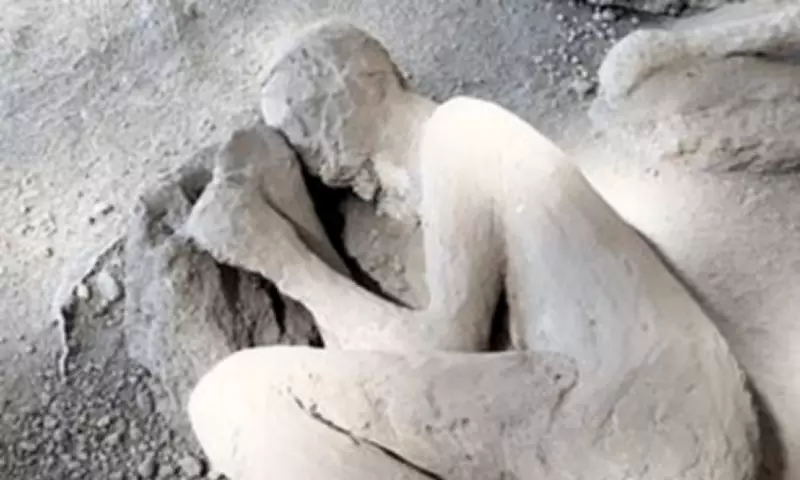
Archaeologists have uncovered a chilling detail from one Pompeii victim, revealing his attempts to save others caught in the blast. The man was carrying a medical kit with him as he fled Vesuvius' deadly eruption, a new study has revealed. This indicates he was a physician, or a 'medicus' in Latin, who may have been attempting to treat others injured in the disaster.
The man was one of 13 Pompeii victims found in a vineyard later named the 'Garden of the Fugitives', where they had gathered to take shelter. However, their brief refuge ultimately proved deadly as the group were overtaken by a cloud of deadly gases and superheated ash.
Gabriel Zuchtriegel, director of the Pompeii Archaeological Park, said in a translated statement: 'Even two thousand years ago, there were those who didn't practice medicine, limited to office hours, but simply were doctors, at all times, even when fleeing the eruption. This man brought his tools with him to be ready to rebuild his life elsewhere, thanks to his profession, but perhaps also to help others.' However, Mr Zuchtriegel says that this heroic effort was 'thwarted by the pyroclastic flow that struck the group of refugees attempting to leave the city through Porta Nocera.'

The eruption of Vesuvius in 79 AD was one of the biggest natural disasters of the ancient world, killing at least 2,000 in Pompeii, Herculaneum and other nearby towns. Many were killed as they attempted to flee the volcano's pyroclastic flow, an avalanche of gas, ash and rock reaching 800°C (1,500°F) and travelling at 450 miles per hour (700 km/h). These cascading ashes entombed the victims, setting into a hard layer that captured their final moments in incredible detail.
Archaeologists used these ash casts to create plaster models of around 104 Pompeii victims from various locations around the ancient town. The newly identified medic was discovered in 1961 when archaeologists made plaster casts of the voids in the Garden of the Fugitives. Archaeologists soon noted that one plaster cast contained a mysterious case made of 'organic material', but its contents remained a mystery until now. Using X–ray and CT scans, scientists were able to peer inside the leather case and reveal its contents to the world.
This revealed that the case contained a number of small bronze surgical tools resembling scalpel blades and a small, flat slate tablet with a slight depression in the middle. Archaeologists think this tablet would have been used for mixing medicines, which often included powdered plants, honey, wine, or vinegar. The scans also reveal the surprising sophistication of the medical case's construction, which featured a locking mechanism based on a toothed wheel. When the man died, he was holding the bag tightly, clutching it near his belly as he curled up on the ground.
These 'tools of the trade' clearly mark out this Pompeii victim as a member of the medical profession, a position that was becoming increasingly well respected at the time. Previously, educated Greek slaves often served as medics for wealthy Romans, but by the time of Emperor Titus, when Vesuvius erupted, medicine was seen as a high–status profession. This victim also had money and possessions of his own, as shown by a small fabric bag of bronze and silver coins found on his body.
These sorts of everyday items are often found with the victims of Pompeii, including such mundane objects as house keys and oil lamps. However, archaeologists have also found signs that people tried to flee with their wealth, finding bodies carrying precious jewels and coins. Likewise, researchers have recently uncovered more harrowing details of how victims attempted to save themselves during the disaster. Archaeologists found the remains of one man clutching a large terracotta pot, which he is believed to have been using as an improvised helmet.
Ancient accounts, including Roman writer Pliny the Younger's, describe Pompeii's residents using objects to protect themselves as ash and debris blanketed the city. Researchers believe the man died early in the disaster, during a heavy fall of volcanic debris. He was found with the pot and was also carrying a lamp, a small iron ring and ten bronze coins.

The eruption of Mount Vesuvius in AD 79 buried the cities of Pompeii, Oplontis, and Stabiae under ashes and rock fragments, and the city of Herculaneum under a mudflow. Every single resident died instantly when the southern Italian town was hit by a 500°C pyroclastic hot surge. Pyroclastic flows are a dense collection of hot gas and volcanic materials that flow down the side of an erupting volcano at high speed. They are more dangerous than lava because they travel faster, at speeds of around 450mph (700 km/h), and at temperatures of 1,000°C.
An administrator and poet called Pliny the younger watched the disaster unfold from a distance. Letters describing what he saw were found in the 16th century. His writing suggests that the eruption caught the residents of Pompeii unaware. He said that a column of smoke 'like an umbrella pine' rose from the volcano and made the towns around it as black as night. People ran for their lives with torches, screaming and some wept as rain of ash and pumice fell for several hours. While the eruption lasted for around 24 hours, the first pyroclastic surges began at midnight, causing the volcano's column to collapse. An avalanche of hot ash, rock and poisonous gas rushed down the side of the volcano at 124mph (199kph), burying victims and remnants of everyday life. Hundreds of refugees sheltering in the vaulted arcades at the seaside in Herculaneum, clutching their jewelry and money, were killed instantly.
As people fled Pompeii or hid in their homes, their bodies were covered by blankets of the surge. While Pliny did not estimate how many people died, the event was said to be 'exceptional' and the number of deaths is thought to exceed 10,000. The excavation of Pompeii, the industrial hub of the region and Herculaneum, a small beach resort, has given unparalleled insight into Roman life. Archaeologists are continually uncovering more from the ash-covered city. In May archaeologists uncovered an alleyway of grand houses, with balconies left mostly intact and still in their original hues. Some of the balconies even had amphorae - the conical-shaped terra cotta vases that were used to hold wine and oil in ancient Roman times. The discovery has been hailed as a 'complete novelty' - and the Italian Culture Ministry hopes they can be restored and opened to the public. Upper stores have seldom been found among the ruins of the ancient town, which was destroyed by an eruption of Vesuvius volcano and buried under up to six meters of ash and volcanic rubble. Around 30,000 people are believed to have died in the chaos, with bodies still being discovered to this day.