
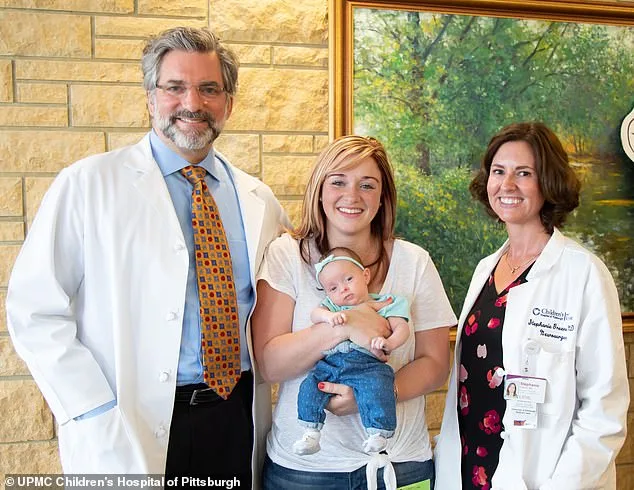
A baby girl who underwent surgery while still in the womb to treat spina bifida is now thriving at home, two months after her birth. Allee Mullen, from Pittsburgh, Pennsylvania, was 20 weeks pregnant when doctors diagnosed her daughter with the severe birth defect, which occurs when the spinal cord does not form properly.
Doctors at UPMC Magee-Womens Hospital discussed all options with Mullen and her husband, including in-utero surgery that can preserve neurological function better than surgery after delivery. In January, surgeons performed one of the first such operations in the Pittsburgh area to close the spinal column while the baby was still in the womb. The procedure went without complications, and Mullen gave birth at 33 weeks.
Spina bifida is a defect of the neural tube, which normally closes early in pregnancy. When it fails to close, the spine and nerves are left vulnerable to damage. Symptoms range from mild to severe and can include walking and mobility problems, bowel and bladder issues, and breathing difficulties. More than 1,600 babies are born with spina bifida each year in the US.
A 2011 study in the New England Journal of Medicine found that in-utero surgery can result in better neurological outcomes than postnatal surgery. Dr Stephen Emery, director of the Center for Innovative Fetal Intervention at UPMC Magee, said the decision involves a complex risk-benefit assessment, but can mean the difference between walking and being in a wheelchair.
Dr Stephanie Greene, director of vascular and perinatal neurosurgery at UPMC Children's Hospital, performed the operation when Mullen was 25 weeks pregnant. Emery Greene was born in February with her surgical wound fully healed and performed well on postnatal neurological tests. 'She was kicking her legs and flexing her toes,' said Dr Emery. 'That means neurologic function is there. We won.'
In gratitude, Mullen and her husband named their daughter Emery Greene after the two doctors who treated her: Dr Stephen Emery and Dr Stephanie Greene.




