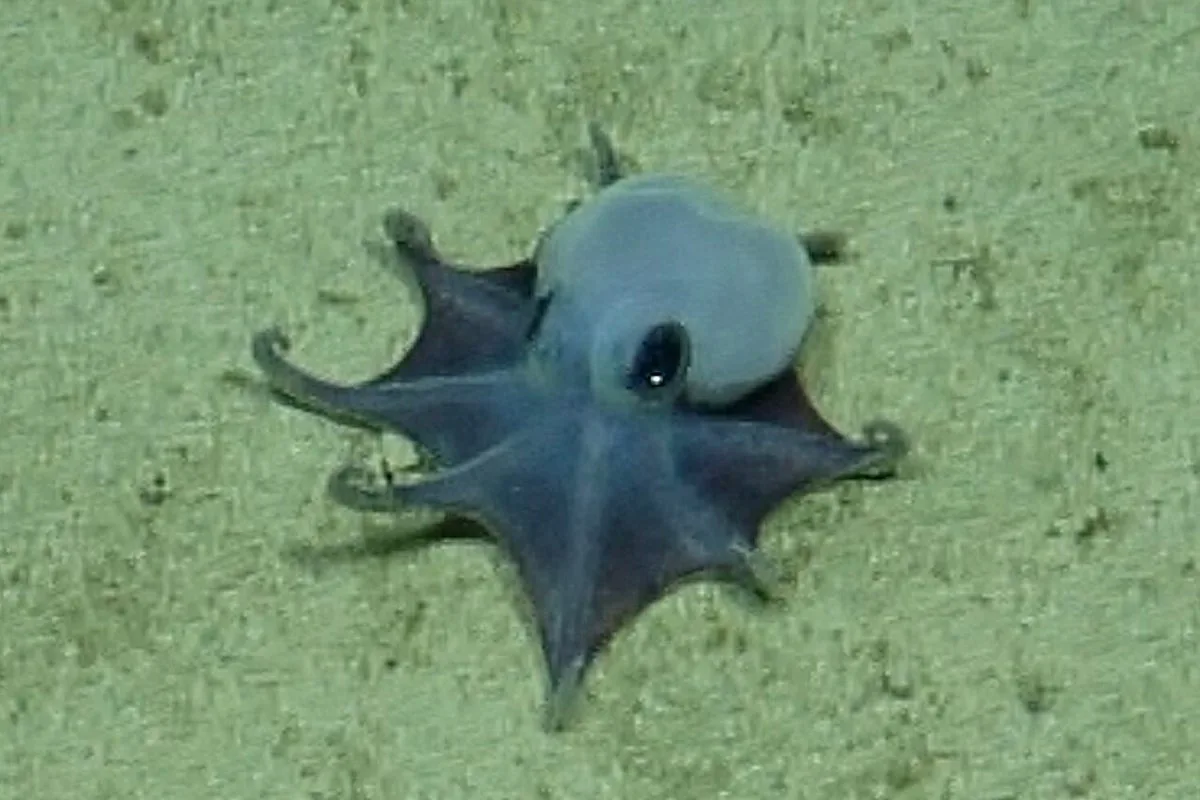
A palm-sized blue octopus first spotted off the Galapagos Islands in 2015 has been identified as a new deep-sea species, according to a new study published in the journal Zootaxa. The octopus, now named Microeledone galapagensis, was discovered during a deep-sea expedition aboard the research vessel EV Nautilus.
Discovery of the Deep-Sea Octopus
The vessel's crew deployed a remotely operated robot to explore the seafloor near Darwin Island at the northern edge of the Galapagos archipelago. As the robot moved near an underwater mountain, its camera captured the strange octopus about 5,800 feet below the surface. The crew collected the octopus and filmed two others that appeared similar.
The researchers collected several specimens during the expedition, but the blue octopus, roughly the size of a golf ball, stood out. It was preserved in alcohol and formalin and sent to the Chicago Field Museum for further research.
Scientific Analysis and Confirmation
"Right away, I knew it was something really special. I'd never seen anything like it," said Janet Voight, an author of the study. The Chicago scientists faced a challenge as they had only one specimen to examine. "When you describe a new species of octopus, you have to look at all the parts, including the mouth, the beak and the teeth. And to see those things, you have to cut the specimen open. We only had the one specimen, so I didn't want to take it apart," Dr Voight explained.
To conduct a thorough analysis without damaging the specimen, the researchers used CT scans. "Because CT imaging is non-destructive, it's especially important for type specimens like this one. And that's great for me because people are often bringing me these incredibly rare and stunningly beautiful specimens that I get the privilege of virtually opening up," said Stephanie Smith, another author of the study.
Combining multiple CT scans created an accurate 3D model, revealing fine details of the octopus's internal organs, including its mouth, and confirming it as a new species.
Implications for Deep-Sea Exploration
"These are little octopuses that live in the deep sea and hardly anybody on Earth has ever gotten to see them. I just feel lucky that I got to work with them," Dr Voight said. "If you took all the land on the Earth and pieced it together, you wouldn't cover the Pacific Ocean. The oceans are so big and there's so much left to explore."
The discovery highlights how much of the ocean around the Galapagos Islands remains unexplored. "Every new species helps us better understand these hidden ecosystems, and why protecting them matters," said Salome Buglass, a marine scientist from the University of California, Los Angeles.






