
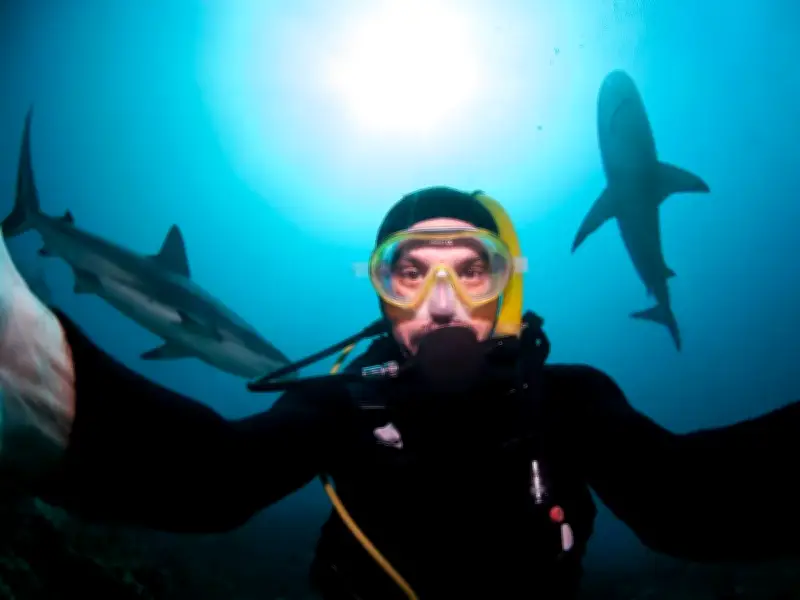
Experts have warned that wannabe social media influencers are putting themselves at risk by trying to get videos with sharks, after a number of people were bitten by the marine creatures.
Divers and swimmers should never touch or agitate sharks in their natural environment, and doing so could put both parties at risk, according to experts.
Recent Attacks
Last month, Henry Gibbs, a content creator from New Zealand, was attacked by a grey reef shark while spearfishing in Fiji. Footage captures the moment the shark charges towards him and bites him. Henry needed four surgeries and a skin graft, and in the days following the incident, took to Instagram to acknowledge his errors.
"I was in its environment hunting its food," he wrote. "Wrong place, wrong time, and there are definitely a few lessons I'll share when I post the footage in the hope it helps someone avoid ending up in the same situation and a bit on how to respond to it. For now, just feeling very lucky and with an even greater appreciation for life."
He added: "It's possible the commotion from the boat, the sounds of our spearguns, and the activity in the water gradually made this shark more interested or excited. I'll never know exactly what caused the change, but eventually it started making tight semicircles beneath us, became increasingly agitated and even sprinted at the boat."
"Looking back, that should've been enough of a sign to call the dive. I never thought a shark of that size posed much of a threat, and that was a mistake."
In January, a diver exploring waters off the Brazilian state of Pernambuco sustained a severe bite wound following an encounter with a nurse shark. Footage on social media shows Tayane Dalazen swimming in close proximity to the creature, which suddenly latches onto her leg. She was left with a substantial bite wound on her limb.
Tayane said: "I felt it shaking me by the leg. I thought I could not put my hand there, because it could rip it off. The guide had to hit it so it would let me go."
Expert Concern
Nurse sharks typically feed on smaller creatures such as molluscs, with their jaws and teeth specifically adapted to vacuum up food from the ocean floor and crack open shells. Attacks on humans are uncommon, with specialists noting that when incidents do occur, they're typically linked to disrupted feeding behaviours.
Eric Clua, a marine biologist at the École Pratique des Hautes Études in Paris, told MailOnline that research into the motivations behind shark bites has revealed an increasing number of incidents caused by people getting too close to these creatures. He voiced his concern that social media videos are leading people to believe there is no danger associated with approaching sharks closely.
"The message transmitted by influencers is 'Look! Touch the shark, nothing will happen to you'," he stated.
Safety Advice
The International Shark Attack File, a database of incidents involving sharks organised by the Florida Museum of Natural History, says: "If a shark is sighted, stay calm and maintain your position in as quiet a manner as possible. Most sharks merely are curious and will leave on their own accord. Enjoy your opportunity to see one of nature’s most magnificent predators."




