Abandoned Amazon Company Towns Show Nature Reclaiming the Land
For decades, foreign corporations established settlements in the Brazilian Amazon to support extractive activities such as rubber, manganese, and timber production. These corporate towns, including Fordlândia, Serra do Navio, Laranjal do Jari, Marituba, and Velho Airão, were built with no regard for the forest or its people. When projects failed, companies left, and the towns were abandoned. Today, the remains of these settlements stand as ghostly reminders of a failed industrial utopia, with nature slowly reclaiming the structures.
Fordlândia: A Rubber Town on the Tapajós River
Fordlândia, established in 1928 on the banks of the Tapajós River in Pará state, was built by Ford Motor Company to produce rubber for the US market. The company built warehouses, housing, and infrastructure, but the project failed due to disease, poor management, and local resistance. Today, a Ford warehouse remains, along with other decaying buildings. The town is now a ghostly relic, with the forest encroaching on its streets.
Velho Airão and the Strangler Fig
In Velho Airão, a former rubber-producing town in Amazonas state, a ruined building is completely enveloped by a strangler fig. The ghostly marks of vines climbing old walls are visible throughout the town. When the rubber boom ended, the company left, and the town was abandoned. Some residents stayed, but the jungle has taken over much of the settlement.
Manganese Mining and Railway Remains
Corporate towns primarily served to extract commodities such as manganese, latex, and timber. In Serra do Navio and Santana in Amapá state, the remains of railway lines that once carried manganese ore serve as reminders of the transport networks that shaped the Amazon. The Icomi mineral extraction project contributed to the formation of Amapá state, but left behind old railway infrastructure and environmental damage.
The Jari Project: A $1 Billion Failure
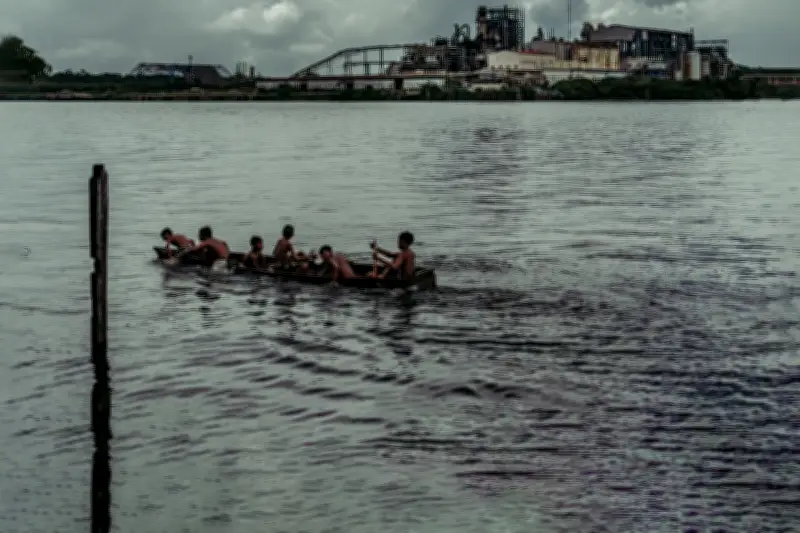
One of the most ambitious Amazonian projects involved Daniel Ludwig, then one of the world’s wealthiest men. He constructed an entire pulp factory in Japan, transported it across the ocean on a floating barge, and docked it in Laranjal do Jari in Amapá in the 1970s. The decades-long project, which began in the 1960s and cost more than $1 billion, ended in failure. Much of the factory remains, including a tailings reservoir of waste from the Jari pulp mill, illustrating the environmental damage caused by one of the world’s most polluting industries. The exit gate of the abandoned nursery bears the words "Bom descanso" (good rest).
Environmental and Social Impacts
The environmental damage extends beyond the Jari project. The company Eletronorte stuffed and displayed animals that died during the construction of the Tucuruí hydroelectric power plant in Pará state in the 1980s. A cemetery stands in the monoculture desolation of a soya plantation in Belterra. In Vila Cristalino, the ruins of a small family home built from "Volkswagen-standard" bricks in the 1970s remain, when the Companhia Vale do Rio Cristalino, owned by VW, occupied more than 100,000 hectares in the south-eastern Amazon. The carmaker’s estate, promoted as a model of modern agriculture and livestock ranching, became a symbol of environmental and labour conflicts.
Contrasts in Serra do Navio
In Serra do Navio, a swimming pool built exclusively for foreign professionals who held senior positions at Icomi stands as a symbol of inequality. The town, designed by architect Oswaldo Arthur Bratke and listed by the Brazilian National Institute of Historical and Artistic Heritage, contrasts with the devastated landscape around it. An abandoned sugar mill overtaken by nature in Medicilândia, Pará state, and a building in what was formerly a Pirelli rubber estate, now designated the Metropolis of the Amazon wildlife refuge, show the forest reclaiming its territory.
These abandoned towns reveal human resilience as nature reclaims the land, but also highlight the lasting scars of extractive industries on the Amazon rainforest.