
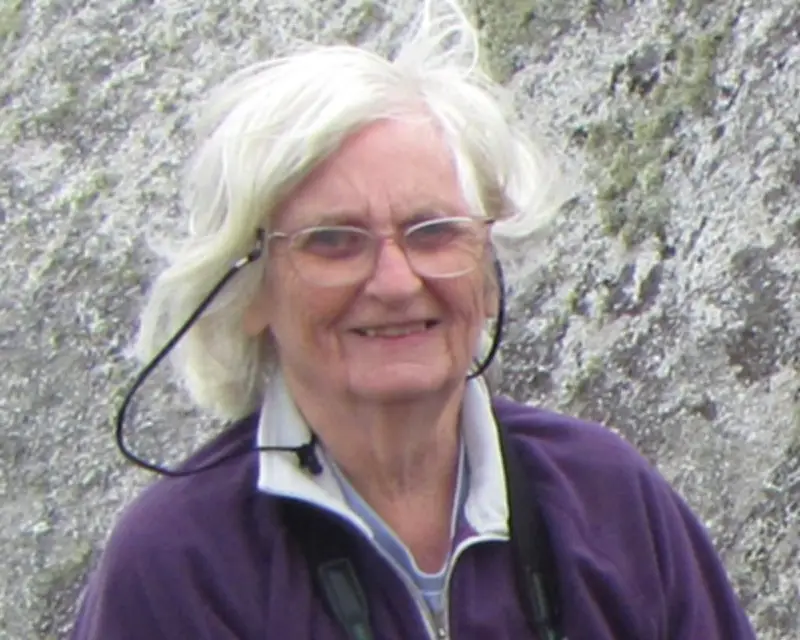
Rosemary Parslow, who has died aged 90, spent much of her life studying the wildlife of the Isles of Scilly, the archipelago off the coast of Cornwall, on which subject she was the acknowledged authority.
She first set foot on the islands in 1958 to ring seabirds and collect specimens of marine life for the Natural History Museum. That visit, she recalled, “was the start of a lifetime love affair with Scilly”. Visiting the islands once or twice every year, she documented all their wildlife, from seabirds and bats to wild plants and the denizens of rockpools and shallow seas. She was the natural choice to author the standard work on the islands’ wildlife, The Isles of Scilly (2007), in the New Naturalist Library published by Collins.
Lifetime dedication
Her visits to Scilly were timed to coincide with the lowest spring tides around Easter and again in autumn. The specimens of fishes, sponges, worms and starfish she collected in the 1950s and 60s are now part of the Isles of Scilly collections in the Natural History Museum. At the same time, she and her second husband, the ornithologist John Parslow, helped to operate the bird observatory on St Agnes, overnighting on uninhabited islets to ring seabirds, among them her favourite Manx shearwaters and storm petrels.
Latterly the museum would send her collecting gear packed into sturdy milk churns, to be returned full of carefully preserved and labelled specimens. The process did not always go smoothly, especially when the carrier mistook Scilly for Sicily. Parslow once came close to drowning after falling out of a boat laden with heavy gear. Over the years she came to know all the farmers of Scilly and gained their friendship and respect.
Rare fern passion
Parslow was particularly captivated by a thumbnail-sized fern, the fittingly named least adder’s-tongue, Ophioglossum lusitanicum, which is confined in Britain to a few square yards of Wingletang Down on St Agnes. As it grows only in midwinter, Rosemary scheduled a family holiday on the island at Christmas. Her children remember her searching on hands and knees under a wintry sky. “I sometimes wondered whether I was wasting my time,” Parslow recalled, “but it means so much to me to be passing on my knowledge to people who are almost as enthusiastic as I am.” The children “thought I was totally barking”, she added. Her last visit to Scilly, to celebrate her 90th birthday, took place only weeks before her death.
Daughter of a prominent Scottish horticulturist, Simpson Millar Gault, and his English wife, Phyllis (nee Bold), Rosemary was born in Slough, Berkshire, and attended schools in Northampton and Reading. From an early age she was fascinated with natural history, especially shore life. After leaving home aged 19, she found work as a research assistant with the Natural History Museum, where she specialised in echinoderms (starfish, sea urchins and their relatives). After years of collecting and cataloguing the collections, Rosemary was forced to leave the museum staff in 1960 when she and John, newly married, decided to start a family (maternity leave was not then on offer). However, she continued to collect specimens for the museum.
Career and legacy
In the late 1970s, after working as a cartographer in Cambridge, she joined the Nature Conservancy Council (the government agency for nature conservation, now Natural England), with responsibility for Northamptonshire. She went on to work for the Bedfordshire, Cambridgeshire and Northamptonshire Wildlife Trust as nature reserves director. Parslow was able to add 20 new reserves to the trust’s portfolio, as well as compiling the Red Data Book for Cambridgeshire, listing rare and threatened species, before retiring in 2000. She was botanical recorder for the Isles of Scilly from 1983 and for a time a trustee of the Ornithological Society of the Middle East. She also led wildlife tours to Europe, the Middle East and (of course) the Isles of Scilly.
From childhood onwards Parslow kept unusual pets, often injured or orphaned animals and birds, which she would nurse back to health. They included a magpie, a crow, a swan, a muntjac deer and an injured bat, which she carried in a pouch around her neck. She was a good raconteur, had a wry sense of humour, and was boundlessly enthusiastic about her interests.
Her New Flora of the Isles of Scilly (2017), written with Ian Bennallick, won the 2018 presidents’ prize from the combined Botanical Society of Britain and Ireland and the Wild Flower Society. She was awarded the Wildlife Trusts’ Christopher Cadbury medal for services to nature conservation in 2023.
She was married three times: firstly, and briefly, to the Dorset naturalist WG “Bunny” Teagle; then to Parslow, with whom she had three children, Jon, Annette and Helen; and lastly to Adrian Colston. All three marriages ended in divorce. She is survived by her children. Rosemary Elizabeth Parslow, writer and naturalist, born 26 April 1936; died 23 July 2026.




