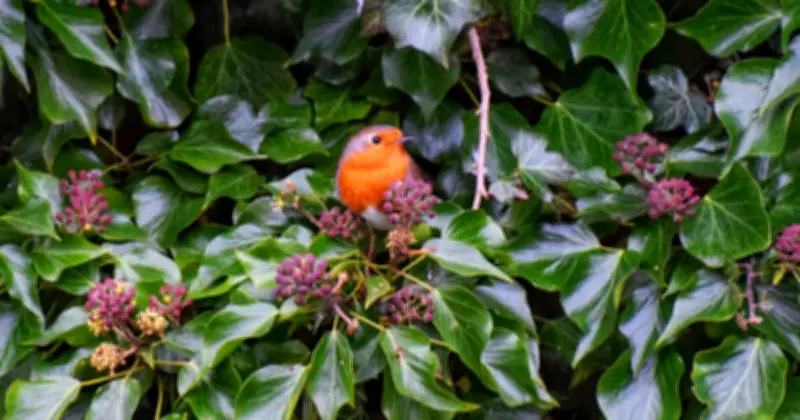
Leaving ivy untrimmed in your garden can keep robins coming back throughout winter, as the plant offers both essential shelter and a high-energy food source.
While much of nature lies dormant in the colder months, robins, wrens, sparrows and blackbirds remain active. Gardens can act as a sanctuary for these birds in search of food and shelter, and households can help without buying or planting anything new.
Why Ivy Is a Winter Haven for Birds
According to the Woodland Trust, ivy and honeysuckle are popular with birds because they provide dense cover, fruits and attract insects for birds to feast on.
The Royal Horticultural Society (RHS) notes that while it may not be fashionable to grow ivy on walls and fences, it is an absolutely excellent plant for providing nest sites for colonies of house sparrows as well as robins and wrens.
The Canal & River Trust describes holly and ivy as a “winter haven” for birds. The charity says ivy berries are a good winter food source, estimating that these berries have the same number of calories as a chocolate bar, gram for gram. Darkly coloured and rich in fat, they grow in abundance along canals and rivers.
Other Garden Tasks to Skip
While ivy blooms in November, birds will consume shorter-lived fruit such as holly berries first, before turning to the hardier ivy berries from December onwards.
Another garden task that can be struck from the to-do list is obsessing over lawn mowing. The RHS points out that dandelion seedheads serve as a food source for goldfinches, while shorter grass enables blackbirds, thrushes and starlings to forage for worms and other invertebrates.
Generally speaking, a garden that welcomes birds should feature a blend of plants, trees and shrubs that offer both food and shelter. Berry-producing shrubs such as hawthorn and elder trees are an invaluable asset for birds.
Come May, elder trees burst into bloom with large clusters of creamy, fragrant elderflowers cherished by both humans and wildlife alike. Crab apple trees and rowans may draw in waxwings, while bullfinches are “particularly keen” on guelder rose berries, according to the RHS.