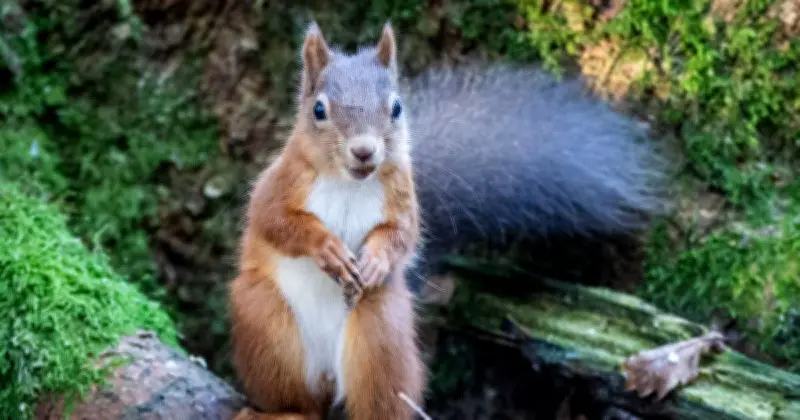
Red squirrels in England could face extinction within 25 years, with numbers potentially falling to as few as 15,000, according to conservationists. The decline is driven by dwindling habitats, a legal loophole, and the deadly squirrel pox virus carried by immune grey squirrels.
Red squirrels have inhabited Britain for 10,000 years. When North American greys were first brought to the UK in 1876 by wealthy Victorians, around three-and-a-half million red squirrels lived in the country. Now, there could be as few as 15,000 reds left in England.
Campaigners call for legal changes
Marie Carter-Robb, 48, founder of the 'Save Our Reds' campaign, said a range of factors have slowly shrunk the numbers of the native species. Speaking in woodland near Penrith, she said: "Many people think greys have always been here - that they are our native squirrel - and dislike the idea of culling them. But there's an ecological reason - they are, through no fault of their own, leading to the death of red squirrels in England."
She added: "Now it's kind of inevitable that reds will be extinct within England within 25 years if we stick to the status quo. Red squirrels are an iconic British species - they are in children's books, on coins, King Charles adores them. They are protected under some legislation but not enough. As a species they are protected but their homes are not. This is a legal loophole we are calling on the government to close right now."
Threat from grey squirrels
Grey squirrels are bigger, stronger and carry the pox virus which kills 99 per cent of infected native reds within weeks. The foreign pests also strip bark from hardwood trees, causing environmental and economic damage, with woodland losses estimated at around £37 million a year.
Across Britain, there are around 120,000 red squirrels left, but 75 per cent of those are in Scotland. Natural England fears within 25 years England's 15,000 reds could vanish. Their last remaining strongholds include the Isle of Wight, Brownsea Island, Mersea Island, the Lake District, Merseyside, Northumberland and the North Pennines.
Conservation efforts and calls for action
Terry Abraham, 50, an award-winning filmmaker and Save Our Reds ambassador who lives in the Eden Valley in Cumbria, has spent his life observing red squirrels. He noted that Cumbrian reds have dark tails or bright blonde ones, and DNA testing has shown their British lineage goes back to the Ice Age.
Some schemes have seen grey squirrel-hunting pine martens reintroduced into parts of Britain. A relative of the weasel, pine martens feast on easy-to-catch and meatier grey squirrels, while the lighter reds can escape by darting to higher, thinner branches.
Save Our Reds is calling for adding red squirrels to Schedule 2 of the Conservation of Habitats and Species Regulations 2017 in England. Carter-Robb said: "This would close a significant loophole in existing legislation and strengthen protection for the places these animals depend upon for survival. We don't need another decade of discussions. We need action."
The campaign has a petition with over 10,000 signatures calling for the loophole to be closed. The Department for Environment, Food and Rural Affairs (DEFRA) said it is protecting endangered red squirrels by tackling the threat of non-native grey squirrels, supporting research into fertility control and managing forest habitats.